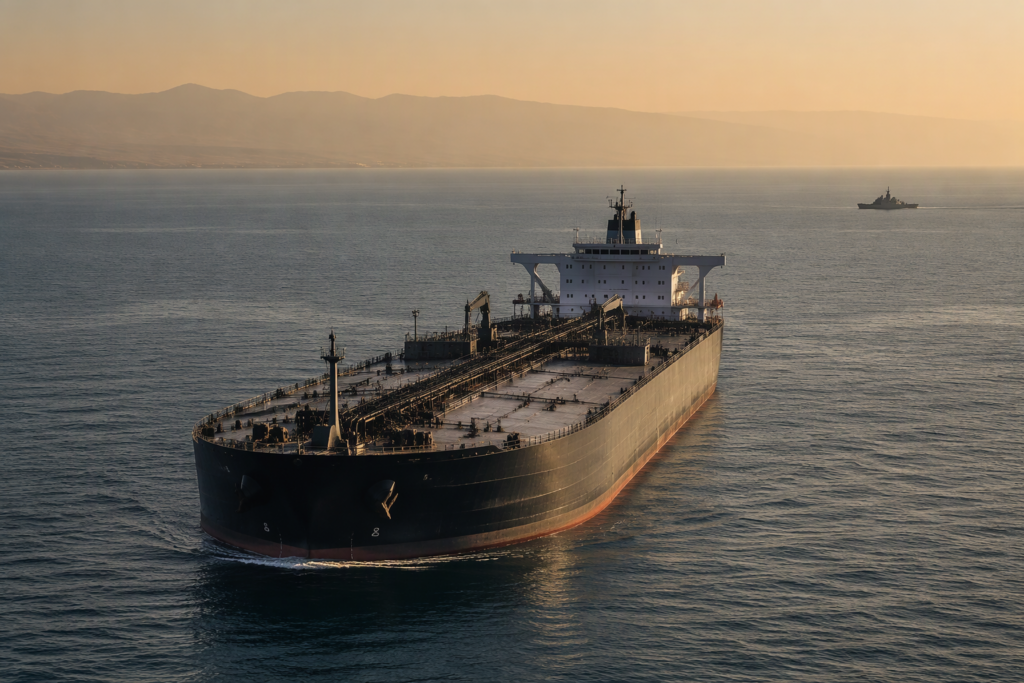
Merchant ships in the Middle East now face attacks from both the Iranian military and American naval forces, driving a dramatic surge in Gulf shipping premiums. Internal documents from the US Maritime Administration reveal that officials inside Washington knew the White House’s enforcement actions were directly squeezing the global tanker fleet.
The warning reached senior maritime officials in an October 12 alert shared after US Central Command disabled a commercial bulk carrier trying to bypass the embargo. For global supply chains and consumer fuel bills, the memo reveals an uncomfortable reality: US military strikes intended to isolate Tehran have actively deepened the shipping crisis.
Also read: Five Tankers Ablaze in Hormuz After Striking Naval Mines
According to the internal records, obtained through a Freedom of Information Act request, the US naval blockade combined with regional strikes has pushed danger zones well beyond narrow choke points and into open anchorages.
An internal warning on kinetic action from both sides
The internal alert landed in the inbox of Stephen M Carmel, the administrator of the US Maritime Administration, following an American strike on the Panama-flagged bulk carrier Ocean Molica. CENTCOM targeted the vessel after accusing it of attempting to breach naval lines. Three other tankers suffered unattributed hits around the same time.
Carmel forwarded the assessment to Michael Yarrington in the agency’s marine insurance division, asking how commercial underwriters were responding. The language inside the memo laid bare the operational fallout facing merchant vessels.
This materially escalates the previous alert: merchant ships now face kinetic action from both sides, and the threat has spread to Gulf anchorages and the Gulf of Oman.
The document warned that the expanding zone of conflict increased the likelihood of crew refusals, sharp spikes in insurance rates, and a severe drop in effective tanker capacity.
How the naval blockade drove Gulf shipping premiums
Commercial underwriters responded to the growing violence by re-evaluating routes across the region. Insurance costs for supertankers moving crude from Gulf ports to East Asia climbed nearly 200-fold between January and late October, reaching $12.29 per barrel, according to OPEC estimates.
Before the fighting erupted in February, underwriters routinely charged between 0.10 percent and 0.25 percent of a ship’s hull value to provide war risk insurance. By midsummer, quotes cited in Singapore’s parliament ranged from 3.5 percent to 7.5 percent, forcing operators to pay millions of dollars per voyage just to clear port waters.
The pressure on Gulf shipping premiums reflects the sheer frequency of maritime clashes. International Maritime Organization figures show that roughly 130 commercial ships have been hit since February 28, leaving at least 25 crew members dead. October proved the deadliest stretch yet, with 35 vessels targeted across the region.
A widening danger zone outside the Strait of Hormuz
While regional militias and Iranian forces account for the bulk of vessel strikes, American forces have claimed responsibility for disabling or destroying at least two dozen ships. Washington identified several of those targets as part of an Iranian shadow fleet, but commercial crews still found themselves caught in the middle.
Security analysts say the expanding geography of the conflict has upended traditional safety assumptions. Danger is no longer confined to the 21-mile-wide passage through the Strait of Hormuz.
Boon Chuan Lim, an independent maritime researcher in Singapore, pointed out that risk now covers vessels dropping anchor, taking on fuel, or holding outside busy terminals in the Gulf of Oman. When enforcement strikes occur in open waters, insurers adjust terms for entire geographic zones rather than single transit corridors.
These mounting transport costs helped feed broader inflation. Crude oil prices climbed as much as 60 percent during the conflict, while international fertilizer rates surged 112 percent, driving up farm and retail expenses worldwide.
Washington debates the economic fallout
Former military officials argue that economic blowback should have been obvious before Washington launched its maritime clampdown. Todd Huntley, a retired Navy captain who directs the National Security Law Program at Georgetown University Law Center, said maritime agencies typically track threats without weighing in publicly on commercial prices.
Huntley noted that policymakers either overlooked the commercial risks or decided to accept them. Ian Ralby, founder of maritime consultancy I.R. Consilium, similarly observed that the White House prioritized cutting off Iranian trade over containing global freight expenses.
President Donald Trump dismissed the prospect of an imminent settlement on Truth Social, declaring that Washington holds the financial and territorial upper hand. Still, the domestic political cost arrived quickly: surging energy prices helped Democrats capture 56 Senate seats and at least 257 House seats in the November midterm elections.
Attention now turns to the Lloyd’s Joint War Committee in London, which meets regularly to review risk boundaries and determine whether additional anchorages across the Arabian Sea will face mandatory war-risk surcharges.
Source: Al Jazeera


