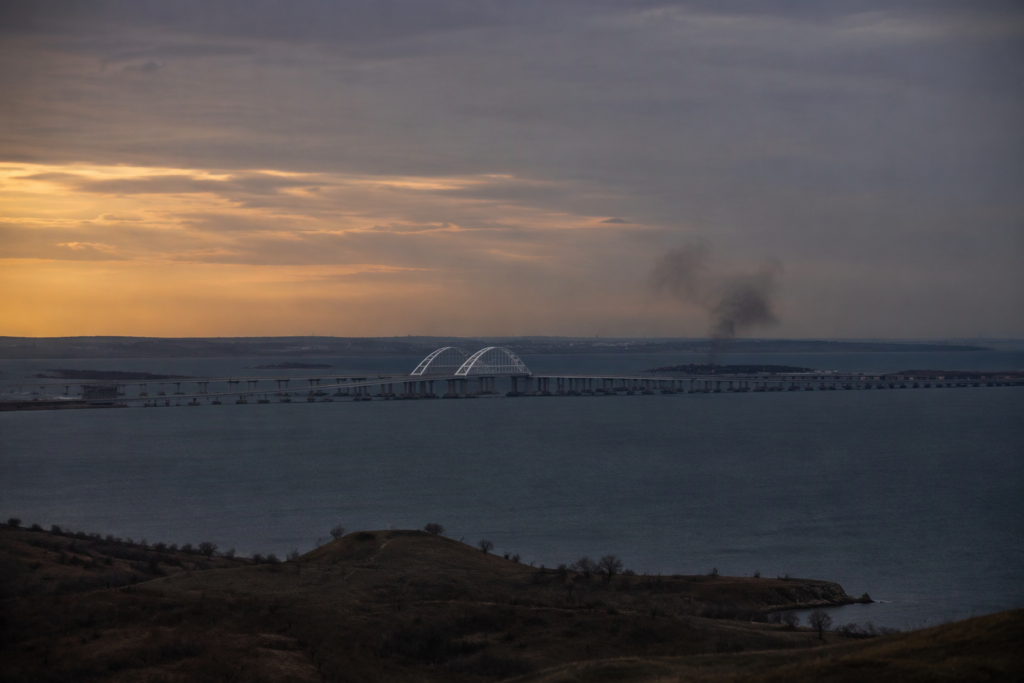
A multi-day assault by Ukrainian forces has knocked out the road section of the Kerch Strait link and halted trains across its rail span. The latest Kerch Bridge strike leaves Russian forces in southern Ukraine cut off from their fastest supply corridor at the exact moment fighting intensifies along the southern front.
Kyiv launched the operation across three days, combining homegrown missiles with swarms of unmanned aircraft. The collapse of the road span forces Russian military logistics onto vulnerable overland roads where Ukrainian drones actively hunt convoys.
Also read: Soviet Gas Pipeline Shields Ukrainian Soldiers from Drones
The logistical blow landed just as world leaders gathered thousands of miles away. As Moscow tried to project geopolitical dominance alongside Washington and Beijing, its critical military conduit into occupied Crimea lay fractured in the water.
How the Kerch Bridge strike was pulled off
Ukrainian units spent an entire month systematically taking out Russian radar systems, air defense batteries, and electronic warfare units guarding the approaches to the strait. That groundwork cleared an air corridor straight to the crossing.
The offensive began on November 16, when Ukrainian drones damaged the roadway surface and compromised the steel arched span that permits cargo vessels to travel between the Black Sea and the Sea of Azov. The next day, the Security Service of Ukraine deployed Palyanytsia kamikaze drones directly against the roadway, sending sections crashing into the water.
Ukrainian President Volodymyr Zelenskyy confirmed that forces also launched Neptune and Flamingo missiles alongside Ruta drones against the neighboring railway span. Follow-up Neptune missile strikes on November 18 and 19 forced authorities to suspend all rail traffic across the strait.
Russia’s Ministry of Defence acknowledged the scale of the aerial barrage. It reported intercepting 4,305 Ukrainian drones over a 48-hour stretch, nearly five times its daily average of 882 from the week before.
Bypassing satellite blocks with homemade tech
Ukraine carried out the entire assault without relying on American-supplied satellite networks. Ukrainian Defence Minister Yevhen Khmara stated that the military relied strictly on domestic technology rather than foreign platforms.
“The strike was carried out exclusively with Ukrainian weapons – our technology, our solutions,” said Ukrainian Defence Minister Yevhen Khmara.
Western satellite services, including Starlink and Starshield, had begun cutting connectivity whenever Ukrainian drones exceeded speeds of 160 kilometers per hour. Those systems experienced further disruptions starting November 13, pushing Kyiv to deploy its own relay network.
To guide weapons to the target, Ukrainian engineers positioned a chain of airborne drones that acted as signal repeaters across the sea. Video footage released by Kyiv showed an FP-5 missile streaming clear telemetry right up to the moment of impact, proving operators maintained direct control throughout the flight.
Targeting oil depots and front-line highways
Russian President Vladimir Putin claimed the crossing was a purely civilian site and denied moving fuel across it. Ukrainian commanders rejected that claim, describing the link as an indispensable military artery carrying ammunition, armored vehicles, and fresh troops.
The bridge was not the only target hit during the coordinated push. Ukrainian forces also struck the M-14 highway connecting Rostov to Crimea, damaging the primary overland route feeding troops in Zaporizhia.
Coordinated salvos also targeted key fuel facilities in southwestern Russia, hitting refineries and storage sites in Azov, Ilsky, and Afipsky. Farther inland, strikes damaged processing plants in Samara, Salavat, Tatarstan, and Volgograd.
The Volgograd refinery alone produces large amounts of Russian diesel. That facility feeds the Russian military while supplying export commitments made to lower global fuel prices.
Diplomatic friction in Shenzhen and Brussels
The military strikes coincided with a high-profile summit in Shenzhen, China, where Vladimir Putin joined Donald Trump and Chinese leader Xi Jinping. Kremlin officials framed the meeting as a modern equivalent of the 1945 Yalta Conference, attempting to carve out terms for a regional settlement without European diplomats present.
Dmitry Medvedev declared that the three powers now dictate terms and claimed that nobody needs Europe. Yet European leaders responded by approving billions in fresh funding for Kyiv, including 25 billion euros earmarked for direct military aid next year.
American envoys Jared Kushner and Steve Witkoff warned Kyiv that continued strikes on Russian fuel infrastructure could cost Ukraine access to US intelligence sharing. Ukrainian officials pressed ahead regardless, arguing that strangling southern supply lines remains their best chance to repel Russian ground offensives near Dobropillya and Huliaipole.
Inspectors and railway crews are now assessing structural damage along the Kerch rail tracks to see if trains can safely roll across again before winter sets in.
Source: Al Jazeera


