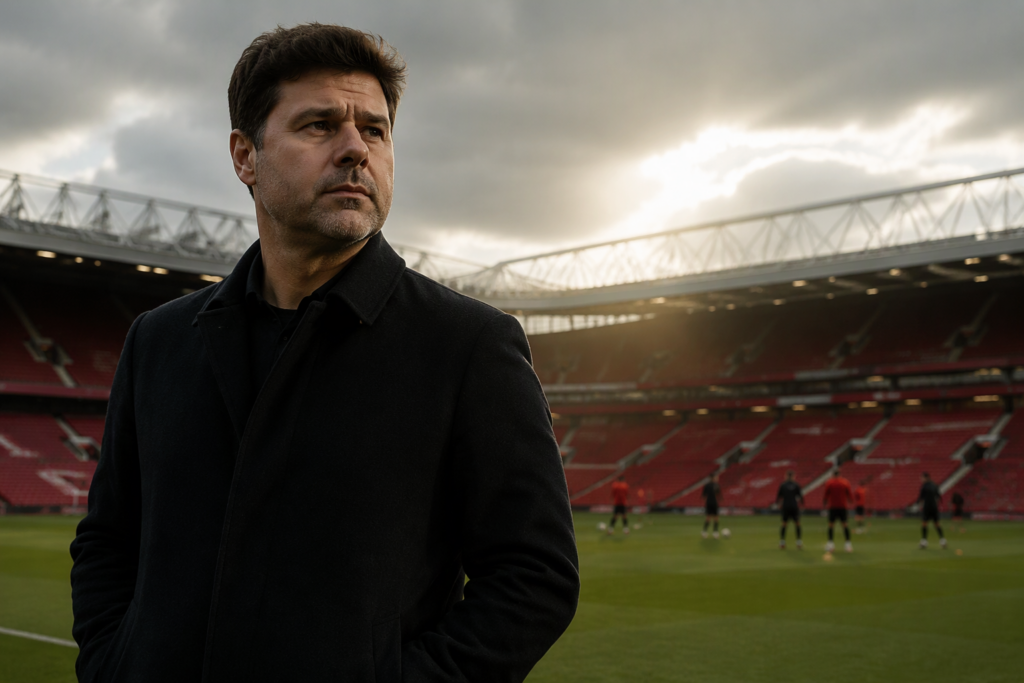
Mauricio Pochettino takes over a broken Manchester United side sitting inside the Premier League relegation zone, with his first test coming straight at Anfield against bitter rivals Liverpool. The arrival of Mauricio Pochettino Manchester United supporters are witnessing makes him the club’s third permanent boss in just three years, stepping in after Michael Carrick failed to steady the ship.
United have won just a single match all season, stumbling through their worst opening stretch of a campaign since 1986. Sitting a single point off the foot of the table, they could drop to dead last before kickoff on Merseyside if weekend results go against them. What was once the richest and most dominant club in English football now faces an unthinkable fight for top-flight survival.
Also read: Premier League News Conferences: Arteta and Pochettino Speak
The threat is stark for a side that has not played outside the top flight since the 1973–1974 season. Back then, relegation hit just six years after United lifted their first European Cup. This time, the slide has taken longer since their 2008 European triumph and Sir Alex Ferguson’s retirement in 2013, but the bottom-table reality is now impossible to ignore.
A staggering slide toward the drop zone
Few people around English football ever thought they would hear talk of Premier League relegation connected to Old Trafford. When Pochettino faced the media on Friday, reporters did not even utter the word directly to him. The sheer financial scale of modern football usually protects the wealthiest clubs from disasters of this magnitude.
Yet United have managed to construct their own disaster on the pitch. While Ferguson signed off in 2013 with a then-record 20th league title, United have failed to win the Premier League crown ever since. Bad recruitment, changing managerial styles and spiraling defensive numbers have chipped away at their standing until the drop zone finally swallowed them.
Pochettino arrives after leaving his post with the United States national team to take on what may be the hardest rescue mission in the sport. He is the ninth permanent manager to walk into the dugout in the last 13 seasons, a chaotic sequence that also saw three interim coaches come and go.
Tactical overhaul after Amorim and Michael Carrick
The immediate challenge on the pitch involves repairing a fractured playing system. Carrick’s predecessor, Ruben Amorim, forced the squad into an awkward 3-4-3 shape that never suited the players available. Carrick could not solve the puzzle either, leaving the squad adrift and leaking goals at an alarming rate.
Pochettino will look to install his trusted 4-2-3-1 setup, the same system he deployed with the United States and during his peak years at Tottenham Hotspur. That tactical blueprint helped Tottenham to a second-place finish in 2017, their highest league spot since 1962. United’s roster naturally fits a back four and a single focal striker, making the shift logical on paper.
Fixing the mental burden will prove harder than rearranging the lineup. During his introductory press conference, Pochettino spoke about shifting the club’s trajectory from the ground up:
“The job is to get the rest of the historic club, Manchester United, into a different place to where we are now.”
He also made reference to creating an individual style of play, though invoking that concept at Old Trafford carries risk. Fans and squads have previously resisted coaches who tried to replace the club’s traditional attacking identity with overly rigid theories.
Why Mauricio Pochettino Manchester United revival starts with basic structure
To pull away from danger, Pochettino must address a defensive record that ranks among the worst in England. United have already conceded 30 goals across all competitions this season, with 19 shipped in league play. Only two Premier League clubs have conceded more.
Injuries have ravaged both ends of the pitch. Luke Shaw has struggled with ongoing availability problems at left-back, leaving the back line repeatedly exposed. That flaw made the club’s failure to purchase Newcastle defender Lewis Hall during the summer transfer window even more painful. Hall has since broken into the England setup at age 22, making a renewed bid for him in January an obvious priority.
The forward line has suffered just as badly. Serbian striker Benjamin Sesko, signed two seasons ago, remains sidelined by chronic injuries at age 23. While Cameroon forward Bryan Mbeumo has worked tirelessly when asked to lead the attack, he lacks the physical size and hold-up play required of an isolated center forward.
Financial limits under Jim Ratcliffe and INEOS
The problems facing Mauricio Pochettino Manchester United cannot hide behind are structural and financial. Heavy debts dating back to the Glazer family’s leveraged takeover in 2005 continue to burden the balance sheet. Annual interest payments soak up vital cash every single year.
Co-owner Jim Ratcliffe took control of football operations three years ago alongside his INEOS team, but financial freedom has not returned. United are prioritizing a multi-billion redevelopment to expand capacity at Old Trafford, aiming to build a sustainable economic engine for decades ahead.
Because of those commitments, United can no longer outspend rivals like Liverpool, Manchester City and Arsenal. They also cannot match European powerhouses like Real Madrid and Barcelona in the market. Pochettino must squeeze results out of the talent he already has before expecting major reinforcements.
The immediate firestorm awaiting at Anfield
Hostile territory beckons for Pochettino’s opening ninety minutes on the bench. Visiting Anfield remains the ultimate test of nerve for any United squad, especially one sitting in 18th place. While Manchester derbies have intensified in recent years, the rivalry against Liverpool remains the most deeply rooted fixture in English football.
Can the new manager steady the locker room before kickoff? United supporters have historically backed their managers through dark stretches, but patience with the playing squad ran out weeks ago. Pochettino must show his players can run, fight and defend as a cohesive unit from the opening whistle.
The trip to Merseyside kicks off a grueling winter schedule where every point counts. Liverpool will smell blood, and Pochettino has only days to prove his team can survive.
Source: Al Jazeera