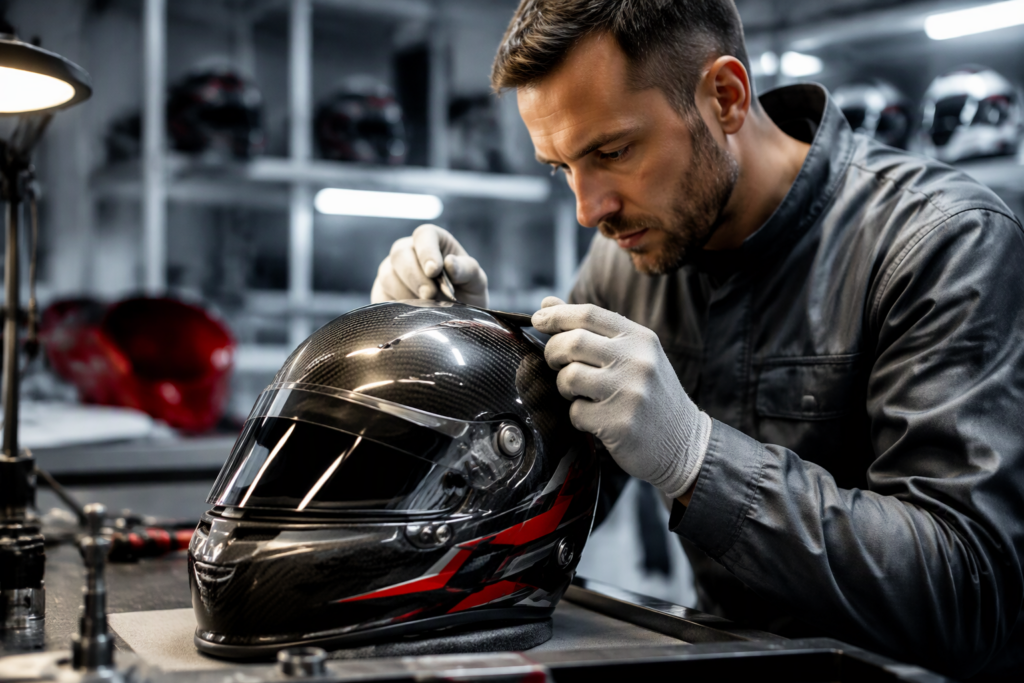
In a quiet, climate-controlled room in northern Italy, a technician named Thomaso uses a children’s rubber toy ball and a household hairdryer to shape sticky carbon composite. He spends up to six hours smoothing the dark material by hand inside this specialized F1 helmet factory, where a single microscopic flaw ruins the entire build.
His work protects drivers hurtling into barriers at 200 mph. If a shell fails quality checks, more than 1,000 euros in composite material and hours of labour go straight into the bin.
Also read: Chad Smith Joins Lions Thanksgiving Halftime Show
Helmets are the last physical shield standing between a driver and disaster. When fire erupts or debris flies off a chassis, survival depends on the craftsmanship inside these workshop walls.
A toy ball, a hairdryer and frozen carbon
Thomaso works inside a secure workshop dubbed “the magic shop” at the Schuberth Performance facility in Schio. The room operates under a strict rule: “One man, one shell.”
The raw carbon fibre blend arrives frozen and stays in storage at exactly -16°C until Thomaso begins his shift. He layers the sticky sheets into custom moulds, smoothing each section with the ball and gentle heat before sealing the shell in a vacuum bag. The unit then bakes under pressure at 120°C for three and a half hours.
Schuberth is one of four approved suppliers for the Formula 1 grid, alongside Arai, Bell and Stilo. Its helmets protect drivers including world champion Max Verstappen, Red Bull teammate Isack Hadjar, Sergio Perez, Nico Hulkenberg and Arvid Lindblad.
“Our philosophy is to make the best product for the best drivers,” says chief executive Alberto Dall’Oglio.
The company, founded in Germany in 1922, originally made industrial linings, mining equipment and motorcycle headgear. It began transforming grand prix head protection after Michael Schumacher suffered a broken leg at Silverstone in 1999, prompting a complete overhaul of racing safety.
Brutal lessons from motorsport’s darkest crashes
Grand prix protection was once almost nonexistent. Giuseppe Farina won the inaugural Formula 1 world championship in 1950 wearing a cloth cap, goggles, cotton dungarees and leather gloves.
Dan Gurney raced in the first full-face helmet in 1968, wearing a Bell Star to deflect flying stones. Still, safety standards developed slowly, pushed forward only after severe accidents exposed major gaps.
Niki Lauda lost his helmet during his fiery 1976 crash at the Nurburgring, suffering burns that forced designers to rethink strap retention and fire barriers. Fatal accidents involving Roland Ratzenberger and Ayrton Senna at Imola in 1994, followed by Jules Bianchi’s death after Suzuka in 2014, proved that head protection must integrate with cockpit survival cells, the Hans device and the halo.
In 2020, Romain Grosjean spent 28 seconds trapped inside an inferno after his car split in half at Bahrain. He escaped with burns to his hands and ankles because his helmet and overalls kept toxic flames at bay.
Modern FIA regulations force every lid to survive a 225g metal projectile fired at 155 mph. Shells must also endure a 790°C direct flame for 30 seconds and self-extinguish within 15 seconds.
Inside the F1 helmet factory: slicing carbon with 4,000 bars of water
Back on the factory floor, cured shells move to a cutting station that uses no mechanical blades. An ultra-thin stream of water pressurized to 4,000 bars cuts through the carbon like a warm blade through butter.
The jet carves out the narrow visor aperture, which measures just six centimetres high to shield the driver’s eyes from debris. Using water prevents vibration and stress fractures from weakening the carbon weave.
From there, workers carry the shell to an assembly area known as “the jigsaw”. Dall’Oglio explains that the outer shell alone requires nearly 100 individual components. Technicians add another 100 pieces during assembly, including ventilation ducts, inner fireproof padding, drinks tubes, radio gear and clear aerodynamic fins.
Technician Sven then travels across the world from February to December, looking after the finished units at the track. He carries five or six shells as hand luggage on commercial flights to prevent airport baggage handlers from bumping the fragile structures.
The battle over grams on the painter’s desk
A complete racing helmet weighs roughly 1.4 kilograms. Engineers inside the factory fight a quiet war to shave tiny fractions of weight off that total.
G-forces multiply every gram during heavy braking and 150 mph cornering, placing heavy strain on the driver’s neck muscles. Factory technicians work weeks to shave 20 or 30 grams from the carbon shell, but custom liveries often erase those gains.
Drivers view their helmets as individual artistic statements, from Senna’s yellow-and-green tribute to Schumacher’s deep red. Intricate paint schemes, glitter and clear coats can easily add 70 to 80 grams to the final build.
Dall’Oglio admits finding the right balance requires delicate negotiations between the factory, the custom painter and the driver. Still, Verstappen works closely with technicians in Schio to refine the fit and aero profile throughout each campaign.
Sven and the factory crew are already packing custom shells for the upcoming grand prix weekend, where the first practice session will put Thomaso’s hand-laid carbon to the ultimate test.
Source: BBC