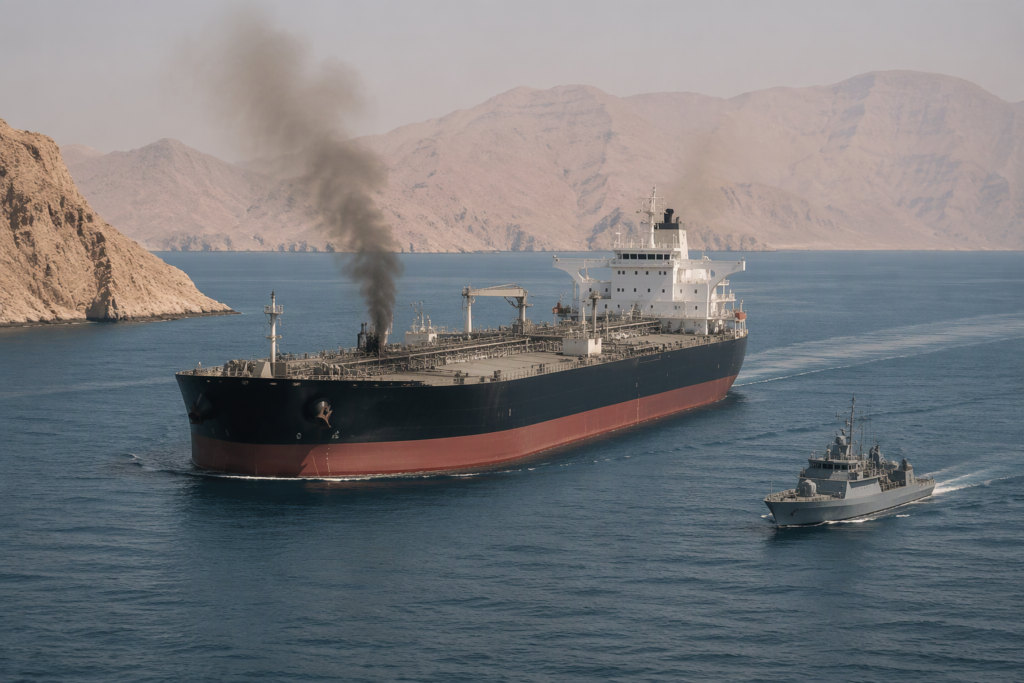
Unidentified projectiles slammed into tankers off the coast of Oman on Saturday, marking a dangerous new escalation in the narrow waterway that feeds global oil markets. The strikes occurred inside the Strait of Hormuz, where commercial vessels increasingly find themselves caught directly in the crosshairs of regional war.
Before fighting broke out, nearly a fifth of the world’s crude oil passed through this narrow choke point every day. Now, commercial crews face mounting peril as Iranian forces try to dictate who enters the passage and who gets turned away.
Also read: Strait of Hormuz Drone Shot Down as US-Iran War Stalls
For everyday consumers and shipping companies alike, the stakes could not be higher. If traffic through the waterway grinds to a halt, global fuel supplies face immediate disruption and soaring prices.
Projectiles strike ships near Khasab
The United Kingdom Maritime Trade Operations centre reported that two separate strikes took place on Saturday near the northern tip of Oman. One vessel took a hit to its rear section roughly 20 kilometres (13 miles) north of the port town of Khasab.
A second strike hit a tanker’s engine room about 31 kilometres (20 miles) east of Khasab. British maritime monitors confirmed that no crew members suffered injuries in the strikes. Authorities have not yet confirmed whether the two reports involved separate ships or the same vessel taking multiple hits.
Both strikes happened without warning. The incidents deepen an international crisis that erupted in late February, when the United States and Israel launched attacks against targets inside Iran.
Tehran points to naval mines and dark ships
Iranian military officials offered their own version of events on Saturday. State television broadcast a statement from Iran’s navy claiming an oil tanker had caught fire after running into a naval mine in a restricted zone east of the strait.
Iranian commanders accused the vessel of travelling with its identification and navigation equipment switched off. They claimed the crew ignored repeated radio warnings before hitting the explosive device.
Independent monitors have not verified Tehran’s account. It also remains unclear whether the burning ship mentioned by Iranian commanders is tied to either strike documented by British authorities.
A pattern of three attacks a day in the Strait of Hormuz
Attacks against commercial vessels inside the passage are no longer isolated surprises. Iranian military statements show that roughly 25 maritime incidents occurred over the span of a single week, averaging nearly three incidents every day.
Iranian authorities now insist that any vessel moving through the Strait of Hormuz must clear its route directly with Tehran. Ships are ordered to travel solely along lanes designated by Iranian commanders.
“This is becoming a pattern,” Al Jazeera correspondent Resul Serdar reported from Tehran, noting that Iranian forces warn that ships failing to comply will face direct strikes or hidden sea mines laid by the Islamic Revolutionary Guard Corps.
Tehran’s calculation appears straightforward. Iranian leaders want to prove that if foreign strikes prevent them from exporting their own oil, no other nation will ship crude out of the Gulf freely.
American escorts face an expanding blockade
Washington has pushed back against Tehran’s maritime rules with heavy naval power. The United States military has imposed a naval blockade on Iranian ports while dispatching warships to escort commercial convoys through the waterway.
Yet naval escorts have struggled to shield every commercial vessel along the route. Commercial operators now face a stark dilemma: accept military escorts and risk drawing fire, or navigate the passage without protection under strict Iranian surveillance.
The standoff in the Strait of Hormuz shows no signs of easing as commercial operators await new security guidance from multinational naval forces guarding the Gulf.
Source: Al Jazeera


