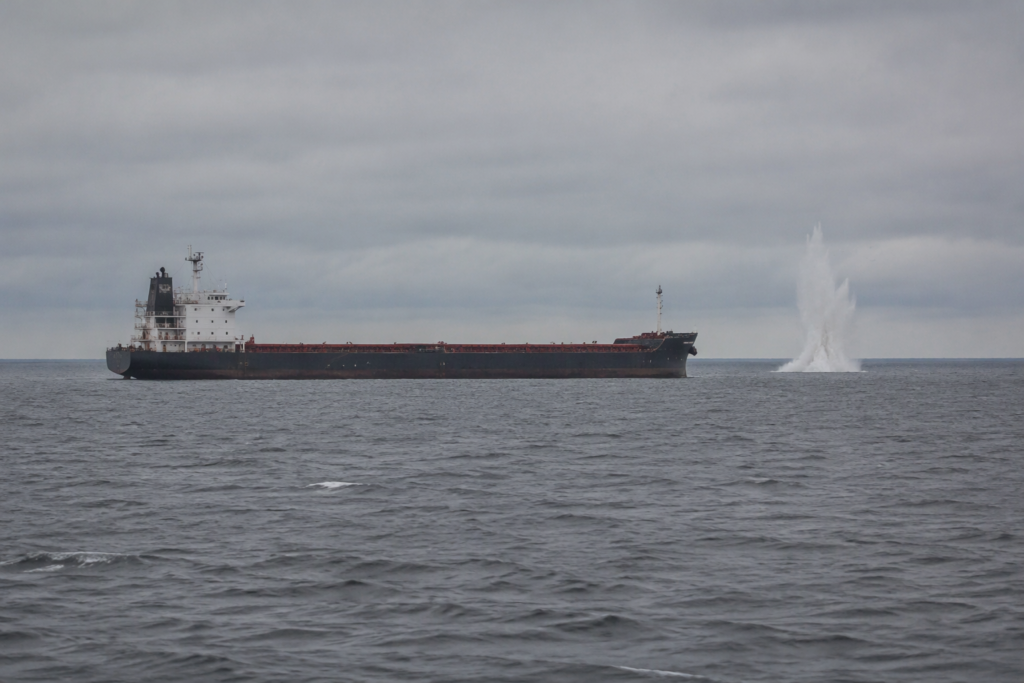
A sanctioned Russian cargo vessel linked to Moscow’s military supply chain caught fire on Saturday morning after a Gulf of Finland drone attack left it drifting into Finnish territorial waters.
Finnish defence forces quickly pointed to Ukraine as the likely source of the strike on the Sparta II, marking another aggressive expansion of Kyiv’s long-range campaign into Baltic waters. The incident pushed Finnish authorities to place temporary aviation and maritime restrictions over the area west of Suursaari island.
Also read: Kerch Bridge Strike Cuts Russian Supply Line to Crimea
The strike brings the direct fallout of the war to the doorstep of NATO’s newest Nordic member. Finnish Prime Minister Petteri Orpo addressed the incident bluntly hours after the fire broke out.
“War is spilling over into our immediate vicinity. Ukraine has the right to fight back against the aggressor.”
How the strike unfolded west of Suursaari
The Sparta II was steaming through the eastern Gulf of Finland on a voyage toward Kaliningrad, the heavily fortified Russian exclave nestled between Poland and Lithuania. Early on Saturday morning, aerial drones converged on the cargo ship.
According to preliminary information released by Kaliningrad Governor Alexei Besprozvannykh, two drones hit the ship. The impacts triggered a blaze on board, and the crippled vessel drifted across maritime boundaries into Finnish waters.
Despite the damage, the crew declined emergency evacuation when a Russian rescue vessel arrived at the scene. Besprozvannykh stated on Telegram that the sailors stayed on board to make emergency repairs and intend to resume their voyage, insisting there is “no threat” to supplies destined for the exclave.
What we know about the Sparta II cargo ship
The vessel targeted in the strike is far from an ordinary civilian freighter. American authorities placed sanctions on the Sparta II cargo ship in 2022, and Ukraine imposed its own sanctions on the vessel earlier this year.
Ukrainian and US officials identify the operator as a Russian firm deeply embedded in state defence logistics. On its corporate website, the operating company states that it was formed inside the structure of Russia’s defence ministry in 2011 and has worked directly within the country’s military construction complex since 2015.
Kaliningrad depends heavily on Baltic Sea shipping lanes for goods and military hardware because European Union sanctions restrict land transit across Lithuania.
A suspected border breach and Baltic Sea flashpoints
Minutes after the strike, Finnish radar operators picked up another potential escalation. Finland’s defence ministry announced that a Russian helicopter was suspected of violating Finnish airspace, an incursion officials believe was tied to tracking or rescue efforts for the damaged ship.
The Baltic Sea has turned into an active maritime front. Only weeks ago, another Baltic Sea drone strike attributed to Ukrainian forces struck a Russian warship in the Gulf of Finland, demonstrating Kyiv’s reach thousands of miles from the southern front line.
For residents and shipping crews along the Finnish coast, the presence of damaged, burning ships is a stark reminder of how close the fighting has come. Even so, the Finnish Border Guard confirmed that no environmental spills have been detected so far, and nearby commercial maritime traffic faces no immediate danger.
Fallout from the Gulf of Finland drone attack
Finnish Defence Minister Antti Häkkänen confirmed that the Finnish Border Guard has taken formal charge of the investigation into the Gulf of Finland drone attack and its maritime aftermath, working alongside national security agencies.
Investigators in Helsinki are now analyzing flight data from the suspected Russian helicopter airspace breach while monitoring whether the Sparta II manages to limp out of Finnish waters under its own power.
Source: BBC


