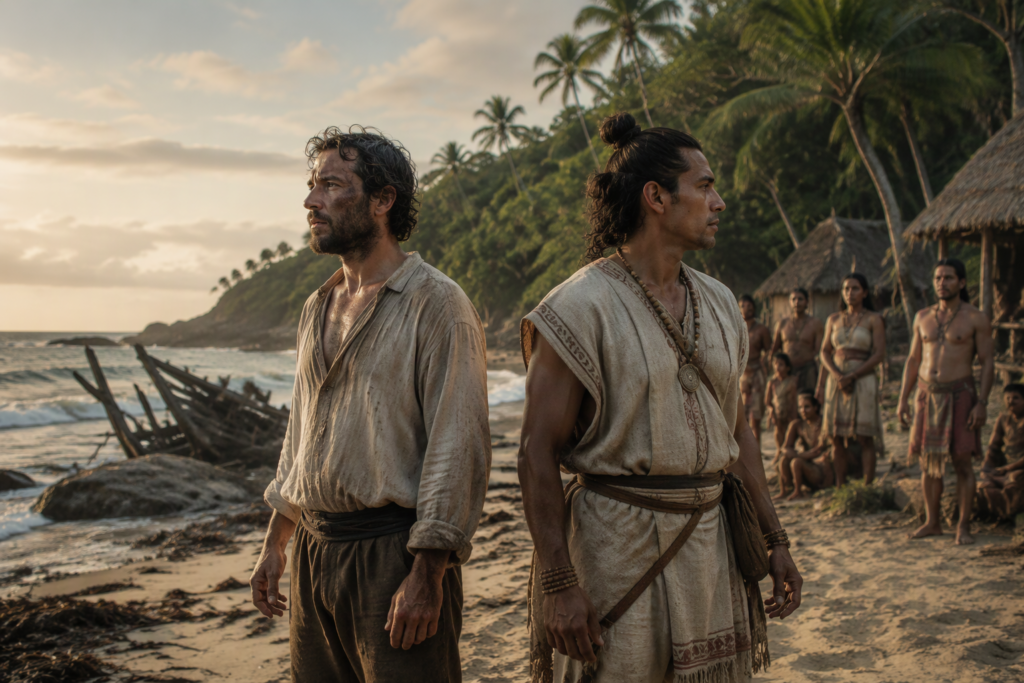
Years before Hernán Cortés reached Mexico in 1519, at least two shipwrecked spaniards had already washed ashore on the Yucatán coast and begun living among the local Maya. Their presence overturned the long-held assumption that European contact with mainland Mesoamerica started as an organized military landing.
The shipwreck changed things for everyone. By the time the Spanish fleet touched land, coastal settlements had some interaction with European outsiders.
Also read: Sudan Drone Attacks Kill Four and Damage UN Building
This early encounter altered how Spanish forces understood the territory, giving later expeditions an unexpected bridge into local languages and politics.
How shipwrecked spaniards broke the frontier myth
Many historians consider 1519 the first interaction of Mexico with Europe. However, the unruly nature of the Caribbean had already smashed Spanish vessels into the Mexican Gulf.
At least two sailors survived one of those wrecks. Instead of perishing on the beaches, they entered indigenous society long before imperial banners ever appeared on the horizon.
These shipwrecked spaniards proved that European arrival did not unfold as a single, sudden invasion. It began as accidental survival, forcing the castaways to adapt to indigenous customs, diets, and hierarchies just to stay alive.
What early survivors meant for the Spanish conquest
When Cortés finally arrived, the existence of Spanish castaways in Yucatán altered his immediate strategy. Finding men who understood local dialects handed the newcomers an immediate advantage in diplomacy and intelligence.
Not all of the survivors acted the same way toward Cortés. One castaway left to rejoin the fleet to act as interpreter. The rest show a preference to end their days either among the friendly, or to unite with hostile groups to fight among the Maya.
Because these shipwrecked spaniards chose opposing paths, they influenced both sides of the Spanish conquest. One man helped guide foreign invaders, while the other fought alongside local defenders to protect his adopted home.
Where Yucatán history looks next
Archaeologists, along with colonial historians, have re-examined early 16th century documents and coastal excavation sites in Campeche and Quintana Roo. Field teams are also preparing for new surveys scheduled for 2025 to locate early contact sites and shipwrecks along the Eastern Peninsula of Mexico.
Source: Mexico News Daily


