
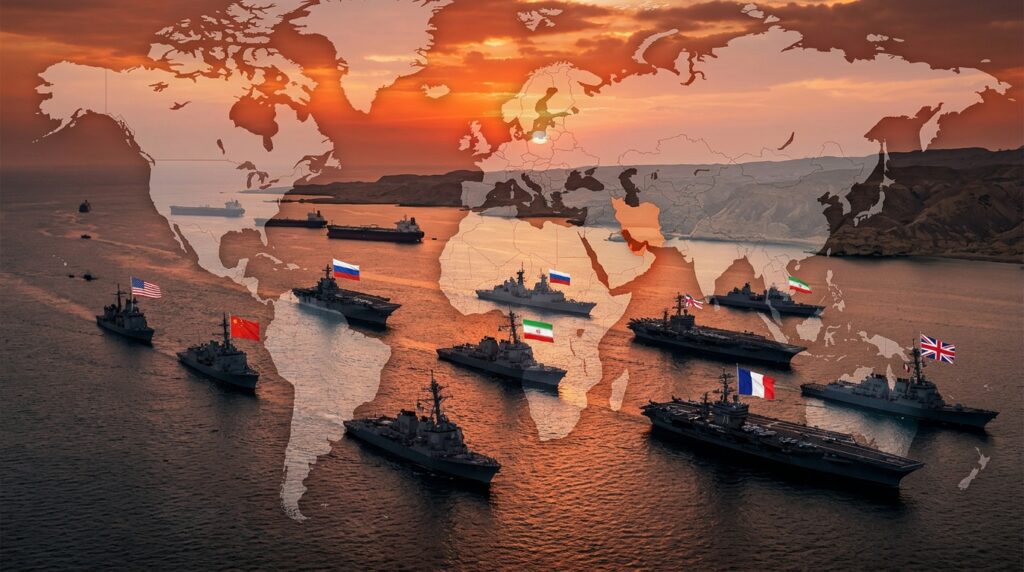
The ceasefire is holding — just. But with the Strait of Hormuz still closed, oil prices climbing, and Iran refusing to blink, Donald Trump finds himself trapped in a crisis entirely of his own making.
Introduction
When the United States and Israel launched their joint military campaign against Iran earlier this year, the stated objective was clear, swift, and confident: dismantle the Islamic Republic’s military capacity and force a rapid capitulation from a regime that, the thinking went, could not withstand the combined firepower of the world’s most advanced military forces.
That assumption has proven catastrophically wrong.
A ceasefire announced on 8 April 2026 has paused the most intense phase of fighting — but it has resolved almost nothing. The Strait of Hormuz, one of the world’s most vital commercial waterways, remains effectively closed to normal traffic. Iran shows no sign of backing down. And President Donald Trump finds himself politically cornered, trapped between the impossible demands of an adversary that refuses to fold and a domestic political base that will not tolerate the kind of concessions needed to break the deadlock.
The Ceasefire That Changed Nothing
The ceasefire brokered in early April brought a fragile pause to open hostilities between the United States and Iran — but it did not bring peace, and it certainly did not bring resolution. Both sides have continued to exchange military signals of intent, with the US maintaining powerful naval and air assets within direct striking distance of Iranian territory, and Iran keeping its own forces at elevated readiness while using the breathing space to reorganise and repair the damage inflicted during the preceding weeks of conflict.
Talks mediated by Pakistan, Qatar, and other regional partners are ongoing — but progress has been painfully slow. The first milestone on what analysts describe as a long and potentially unreachable road to a broader settlement is simply an agreement to continue talking: a so-called memorandum of understanding that would formalise the agenda for future negotiations.
Even that limited objective is proving extraordinarily difficult to achieve.
The Strait of Hormuz — A Chokepoint Holding the World to Ransom
At the heart of the entire standoff lies the Strait of Hormuz — the narrow waterway between Iran and Oman through which, in normal times, approximately one-fifth of the world’s oil and gas supply flows every single day.
Iran closed the strait following the US and Israeli strikes of 28 February 2026, and it has remained largely shut ever since. The economic consequences have been severe and far-reaching. Global oil and gas prices have surged. Supply chains have been disrupted across multiple industries. Petrol prices in countries far removed from the conflict have risen sharply.
Some workarounds exist: Saudi Arabia has been routing oil through overland pipelines to its Red Sea ports, while the United Arab Emirates has been utilising a pipeline that bypasses the strait entirely, delivering oil to terminals facing the Gulf of Oman. But these alternatives carry only a fraction of the capacity of the Strait of Hormuz itself — and the shortfall of roughly 20% of global supply is being felt acutely across the world economy.
For Tehran, keeping the strait closed is its most powerful remaining lever in the negotiation. Iran will demand a significant price — likely in the form of sanctions relief, unfrozen assets, or both — before allowing normal shipping to resume. And reopening the strait is now widely regarded as a prerequisite for any meaningful progress in broader diplomatic talks.
Trump’s Impossible Political Trap
For President Trump, the situation represents a profound strategic miscalculation with no clean exit.
The war against Iran has grown deeply unpopular with the American public. Re-escalating military operations — returning to active strikes against Iranian targets — would only deepen that opposition and risk dragging the United States into a prolonged, costly conflict that an increasing number of Americans have no appetite for.
Yet the concessions Iran is demanding in exchange for reopening the Strait of Hormuz are fiercely opposed by hawks within Trump’s own Republican Party, who view any meaningful relief for Tehran as a capitulation. Trump himself is viscerally opposed to any arrangement that could invite comparison with the 2015 nuclear deal negotiated under President Barack Obama — a deal Trump famously condemned and withdrew from during his first term in office.
This leaves the US president in a bind with no obvious resolution. He needs the strait open to ease the economic pressure bearing down on American consumers and the global economy. But the path to reopening it runs directly through the kind of diplomatic compromise that his political positioning makes almost impossible to accept publicly.
Iran’s Calculation — Survival Above All
From Tehran’s perspective, the strategic logic is stark and unwavering. Iran’s leadership believes — with considerable justification, given the events of the past several months — that it is engaged in a struggle for the very survival of its regime.
The Islamic Republic has endured nearly half a century of wars, crippling sanctions, international isolation, and sustained external pressure — and it is still standing. That institutional resilience has taught Iran’s rulers a powerful lesson: resistance works. The United States and Israel, for all their overwhelming military superiority, cannot bomb a determined nation into submission.
Military strikes alone, it is now clear, will not force Iran to abandon its core positions. And that reality has fundamentally changed the negotiating dynamic. Tehran is not negotiating from weakness — it is negotiating from a position of having already absorbed the worst the US and Israel could throw at it, and remained standing.
The Gulf States — Caught in the Crossfire
The wealthy Arab states of the Persian Gulf — long dependent on regional stability as the foundation of their economic models and long-term development ambitions — have suffered serious collateral damage from the conflict, and are desperate for it to end.
Qatar has stepped up as a full mediating partner alongside Pakistan, working to keep diplomatic channels open between Washington and Tehran. The UAE has deepened its strategic relationship with Israel, going so far as to accept the deployment of Israel’s Iron Dome missile defence system — along with IDF personnel to operate it — on Emirati soil.
Saudi Arabia’s response has been the most striking. Riyadh has acknowledged conducting its own strikes against Iranian targets in retaliation for Iranian attacks — but has been careful to signal to Tehran, through senior channels, that it acted independently and outside the US-Israel coalition. It is a delicate and revealing piece of diplomatic manoeuvring, designed to keep Saudi options open in a rapidly evolving regional landscape.
A War Built on a Fatal Miscalculation
The uncomfortable truth at the centre of this crisis is that it was avoidable — and that it stems directly from a catastrophic failure of strategic judgement.
When Trump and Israeli Prime Minister Benjamin Netanyahu launched the campaign against Iran, both leaders publicly expressed confidence that overwhelming airpower would be sufficient to force regime change in Tehran. They predicted a rapid collapse. They got the opposite.
Both men fatally underestimated the resilience of a regime that has spent nearly five decades surviving every pressure the outside world could bring to bear against it. They misread Iran’s willingness to absorb punishment and resist. And now both the United States and Israel — and much of the rest of the world — are living with the consequences of that miscalculation.
What Happens Next?
The immediate priority for all parties is preventing the ceasefire from collapsing entirely. A return to active hostilities would be catastrophic — for the global economy, for regional stability, and for the domestic political standing of leaders on all sides.
Beyond that, the path forward remains deeply unclear. Any deal that reopens the Strait of Hormuz will require Iran to receive something meaningful in return. Any concession meaningful enough to satisfy Tehran will face fierce resistance in Washington. And any agreement that resembles the 2015 nuclear deal — in structure or in substance — will be a political minefield for Trump personally.
The mediators in Islamabad and Doha are working overtime. But the gaps between the parties remain vast, the mutual distrust runs deep, and the domestic political constraints on both the US and Iranian sides are severe.
Conclusion
What began as a confident military campaign built on assumptions of easy victory has evolved into one of the most complex and consequential geopolitical crises of the decade. The ceasefire is holding — but only just. The Strait of Hormuz remains closed. The global economy continues to absorb the shock. And Donald Trump finds himself in a trap he built with his own hands, searching for an exit that does not yet exist.
Iran is not backing down. The question now is not whether the US miscalculated — it clearly did. The question is whether anyone can find a way out of the wreckage before the costs grow even higher.