
Iran’s third-highest goalscorer has been left out of the 2026 World Cup — not for footballing reasons, but for a single social media post that reportedly enraged his country’s rulers at the worst possible moment.
Introduction
In one of the most politically charged selection decisions of the entire 2026 FIFA World Cup cycle, Iran have omitted their record-breaking forward Sardar Azmoun from their tournament squad — and the reason, it appears, has nothing to do with form, fitness, or footballing ability.
Azmoun, who has scored 57 goals in 91 appearances for his country and stands as Iran’s third-highest goalscorer of all time, was not included in coach Amir Ghalenoei’s preliminary squad and has now been officially left out of the final group heading to North America. The decision has sent shockwaves through the world of football and shone an uncomfortable spotlight on the deeply uncomfortable intersection of sport and geopolitics in Iran’s current national moment.
The Social Media Post That Changed Everything
At the heart of Azmoun’s exclusion lies a single photograph — and the explosive political context in which it was shared.
In March 2026, as Iran was actively engaged in its military conflict with the United States and Israel, Azmoun — who plays his club football for Shabab Al-Ahli in the United Arab Emirates — posted a photograph of himself alongside Mohammed bin Rashid Al Maktoum, the ruler of the UAE.
The timing could hardly have been more sensitive. Iran had itself launched attacks against facilities located in the UAE during the ongoing conflict. For a high-profile Iranian national team player to publicly post a friendly image alongside the leader of a country that had become entangled in that conflict — and one that had deepened its security relationship with Israel during the war — was, from Tehran’s perspective, an act of profound political disrespect.
Reports quickly emerged that the post had deeply angered Iran’s government. Azmoun’s fate, it seemed, was sealed from that moment on.
A Tournament Like No Other for Iran
The political complexities surrounding Azmoun’s omission are just one thread in an extraordinarily complicated tapestry surrounding Iran’s participation in the 2026 World Cup, which is being co-hosted by the United States, Canada, and Mexico.
Iran’s involvement in the tournament had been seriously in doubt for months, given the state of open conflict between Tehran and Washington. The situation was ultimately resolved through an unusual diplomatic arrangement: Mexico agreed to serve as Iran’s base for the tournament after reports emerged that the United States was unwilling to provide the necessary hosting guarantees for the Iranian delegation.
Mexican President Claudia Sheinbaum confirmed the arrangement, with Iran set to operate out of Mexican territory for the duration of their group stage campaign. It is an unprecedented logistical and diplomatic setup — one that perfectly encapsulates just how extraordinary Iran’s participation in this particular World Cup truly is.
Iran’s Group Stage Fixtures
Despite all the off-field turbulence, Iran are set to compete in Group matches across two major American cities:
| Date | Opponent | Venue |
|---|---|---|
| 15 June | New Zealand | Los Angeles |
| 21 June | Belgium | Los Angeles |
| 26 June | Egypt | Seattle |
The fixtures present Iran with a genuinely competitive group — one they will be hoping to navigate into the knockout rounds, political distractions notwithstanding.
Who Makes the Squad? The Key Names
Despite Azmoun’s high-profile absence, Iran’s squad still contains some genuinely experienced and talented players drawn from leagues across Europe and the Middle East.
⚽ Star Players to Watch
Mehdi Taremi — The 33-year-old striker, now playing for Greek giants Olympiakos, leads the attack in Azmoun’s absence. Taremi is one of the most experienced and technically accomplished forwards in Iranian football history and will be expected to carry the bulk of the goalscoring responsibility.
Alireza Jahanbakhsh — The former Brighton & Hove Albion winger, who now plies his trade for Dender in the Belgian Pro League, brings valuable European top-flight experience to the squad and provides creativity and width across the frontline.
Dennis Eckert (Dargahi) — The Standard Liege forward, who plays under the Iranian name Dennis Dargahi, adds another European dimension to Iran’s attacking options and will be hoping to make his mark on the global stage.
Full Iran 2026 World Cup Squad
🧤 Goalkeepers
Alireza Beiranvand, Payam Niazmand, Hossein Hosseini
🛡️ Defenders
Ehsan Hajsafi, Milad Mohammadi, Ali Nemati, Shojae Khalilzadeh, Hossein Kanaanizadegan, Danial Eiri, Ramin Rezaeian, Saleh Hardani
⚙️ Midfielders
Saman Ghoddos, Saeid Ezatolahi, Mohammad Ghorbani, Rouzbeh Cheshmi, Amirmohammad Razzaghinia, Mohammad Mohebi, Mehdi Torabi, Mehdi Ghayedi, Alireza Jahanbakhsh, Aria Yousefi
🎯 Forwards
Mehdi Taremi, Amirhossein Hosseinzadeh, Ali Alipour, Shahriyar Moghanlou, Dennis Eckert (Dargahi)
The Bigger Picture — Football and Politics in Iran
Azmoun’s case is not the first time Iranian football and Iranian politics have collided on the world stage — and it is unlikely to be the last.
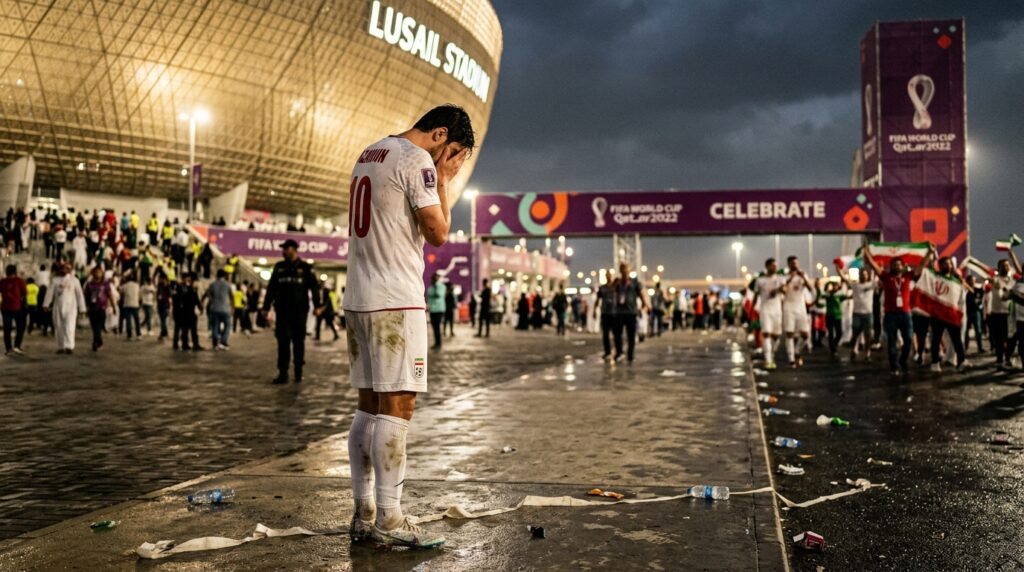
At the 2022 World Cup in Qatar, Iran’s players made headlines around the world when they chose not to sing their national anthem during their opening group match — a silent and powerful act of solidarity with the wave of anti-government protests that had engulfed Iran at the time. That decision, and the courage it required, defined much of the global conversation around the Iranian squad throughout that tournament.
Four years on, the political environment in Iran has changed — but the tension between athletes and the state apparatus that governs them has clearly not disappeared. Azmoun’s omission is a stark reminder that for Iranian footballers, the line between sport and politics has always been dangerously thin. One photograph, in the wrong place, at the wrong time, can end a World Cup dream.
What Azmoun’s Absence Means for Iran
From a purely footballing standpoint, losing a player of Sardar Azmoun’s quality and experience is a significant blow to Iran’s World Cup prospects. His 57 international goals represent a remarkable return for any striker, and his ability to hold up play, link with teammates, and finish under pressure would have been invaluable assets in a competitive group that includes Belgium — a nation with genuine quality throughout its squad.
Coach Ghalenoei now faces the challenge of compensating for that loss through a combination of Taremi’s experience and the energy of younger attacking options. Whether that proves sufficient will become clear over the course of Iran’s three group-stage games.
But beyond the tactical implications, Azmoun’s absence sends a message that extends far beyond football. It signals to every Iranian player — at home and abroad — that their actions, their associations, and even their social media activity are being watched closely, and that the consequences of perceived political missteps can be swift and severe.
Conclusion
The 2026 FIFA World Cup was always going to be an extraordinary occasion for Iran — a nation competing on the soil of its primary geopolitical adversary, operating out of a base in Mexico due to diplomatic tensions with the host nation, and doing so against the backdrop of an active military conflict. That it is now also unfolding without its third-highest goalscorer of all time — dropped not for any footballing shortcoming, but for a photograph — makes the story even more remarkable.
Sardar Azmoun will watch the tournament from the sidelines, his World Cup over before it began. For Iran, the tournament itself is about to start. The football, finally, can begin.