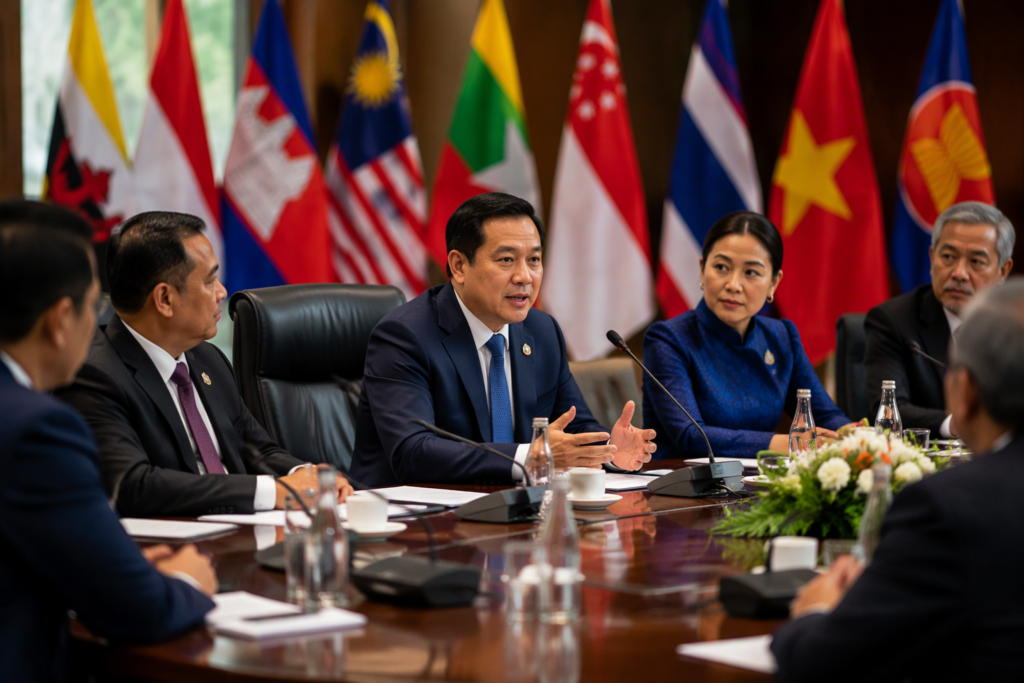
Leaders across Southeast Asia are sitting down in Manila under the shadow of a worsening energy shock triggered by war in the Middle East. With oil cutoffs squeezing national budgets and fresh US trade tariffs rattling regional economies, this year’s ASEAN summit puts 11 nations on the spot to protect their nearly 694 million people from international chaos.
The high-stakes Manila gathering runs from November 15 to 17, drawing heads of state from the Association of Southeast Asian Nations along with global leaders, including US President Donald Trump. While ASEAN strives to operate as a single market, it lacks the legal power to enforce decisions on members. That limitation makes unanimous diplomacy harder just when unity is most urgent.
Also read: Trump, Putin and Xi Meeting Planned for China Summit
Energy shocks and trade friction top the Manila agenda
Southeast Asia is taking heavy blows from oil and gas supply cutoffs linked to the US-Israel war on Iran. Manila already declared a state of national energy emergency in March, while Vietnam and Malaysia face severe vulnerability to Middle Eastern fuel disruptions.
Beyond raw fuel supplies, governments fear the hostilities could disrupt the Strait of Malacca, the critical shipping corridor linking Indonesia, Malaysia, and Singapore. Millions of Southeast Asian migrant workers also live across the Middle East, putting their physical safety and remittances at immediate risk.
Economic pressure is compounded by Washington’s aggressive tariff policies. Since Donald Trump returned to the White House, the US has hit ASEAN exporters with tariff hikes ranging from 10 to 12.5 percent. That squeeze is forcing member states to seek tighter trade relationships elsewhere to keep factories running.
Stalled maritime talks and territorial flashpoints
Security concerns at the ASEAN summit extend directly to local waters. China, Taiwan, and four ASEAN members—Brunei, Malaysia, the Philippines, and Vietnam—remain tangled in long-running territorial standoffs across the South China Sea. The contested waterway holds valuable undersea deposits of oil and gas that every claimant wants to tap.
Negotiations for an official code of conduct with Beijing started back in 2005 to prevent armed clashes at sea. Despite a pledge in 2023 to finalize a draft this year and 10 rounds of talks led by Malaysia through October, deep friction between Manila and Beijing means an agreement is unlikely this week.
Land borders are proving just as volatile. Late last year, fighting erupted along an 800-kilometer contested border between two member states over territory and sacred sites like the Preah Vihear Shiva temple. The clashes killed at least 150 people and displaced nearly one million. While a ceasefire took hold in December after outside mediation, the underlying dispute sits unresolved.
Civil war in Myanmar and environmental devastation
Internal regional instability continues to test the bloc’s diplomatic limits. Myanmar’s ongoing civil war remains a core priority as ethnic armed groups and rebel forces fight the ruling military junta that seized power in February 2021. With violence escalating, the summit keeps Myanmar’s military leaders barred from attending, permitting only non-political representatives.
The bloc’s five-point consensus peace plan, enacted in April 2021 to secure humanitarian access and end bloodshed, has produced little progress on the ground. Millions face severe deprivation while the Rohingya refugee crisis deepens across borders.
Environmental disasters are worsening cross-border strains. Severe drought in Indonesia ignited massive wildfires that burned 2.88 million hectares and claimed at least 3,500 lives. Choking toxic haze now blankets Singapore, Malaysia, the Philippines, and East Timor, drawing sharp criticism toward Jakarta despite thousands of emergency responders fighting the blazes.
What happens next
Officials will wrap up bilateral meetings on November 17, when the final joint communique reveals whether member states can present a united front on Middle East supply shocks or if talks over the South China Sea code will officially spill into next year.
Source: Al Jazeera


