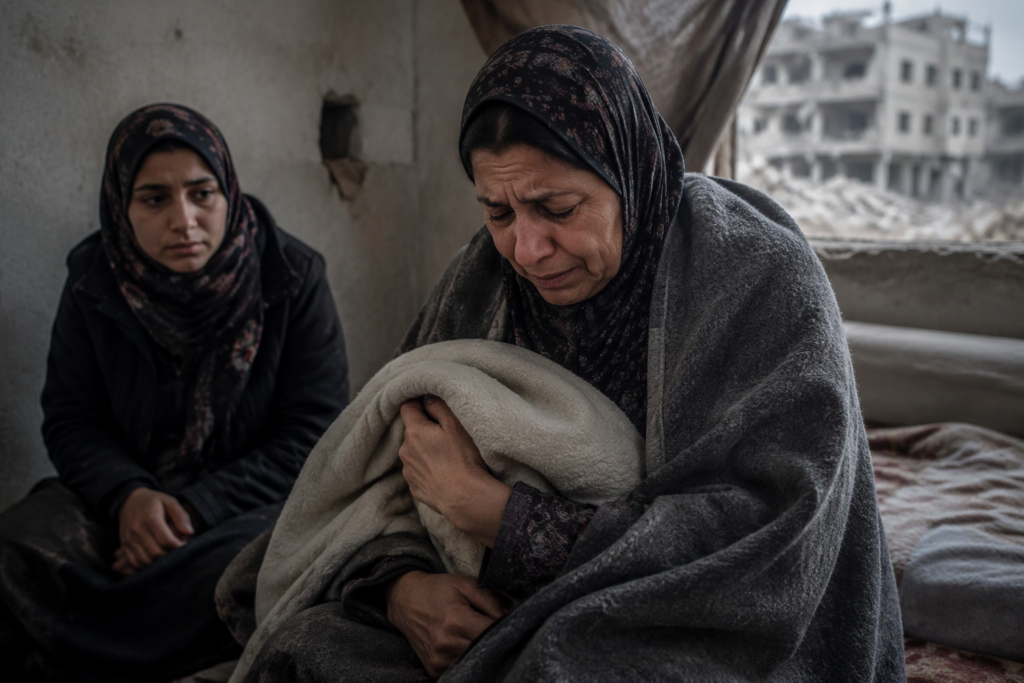
When Susan Arqiq clicked on her phone’s flashlight in the dark of her displacement tent, the beam caught the blue face and stiff hands of her nine-month-old son, Kinan. She had fallen asleep next to him just hours earlier on damp bedding pressed against thin plastic sheeting in southern Gaza.
Kinan’s sudden passing marked the first recorded case where a baby dies from cold in the territory this winter season. Medical staff at the hospital emergency department confirmed the infant died on Thursday, November 12, from a severe drop in body temperature, leaving a family crushed by grief inside a camp that could not keep out the freeze.
Also read: Samir Abu Younis Killed in Israeli Strike on Gaza Camp
For more than 1.4 million displaced Palestinians packed into makeshift tent settlements across the Gaza Strip, the death is an early warning of what the coming months hold. With destroyed housing, collapsed infrastructure, and tight restrictions on shelter materials, hundreds of thousands of families are entering the winter without sturdy walls, heating, or dry ground.
A flashlight beam on frozen skin
Susan, 26, put Kinan down to sleep on Wednesday night inside their worn-out shelter in the al-Mawasi area near Khan Younis. She woke before dawn to change his diaper and immediately sensed that something was terribly wrong.
“My son was pressed against the tent’s tarpaulin. The bedding was still damp,” she said. “I switched on my phone’s flashlight and found that his face was completely blue, his hands were stiff, and his body was like ice. My heart nearly stopped from fear. I immediately woke my husband. I was screaming, ‘Kinan, Kinan!’ I could not understand what was wrong with him.”
Her husband, 33-year-old Ahmed Arqiq, scooped up the baby without speaking a word. Accompanied by other men from the camp, he ran through the dark streets toward the nearest medical facility. Women from surrounding tents rushed into Susan’s shelter to console her, but the message from the emergency room quickly dashed any hope.
Ahmed said Kinan had no known medical conditions before that night. Doctors told him plainly that exposure had stopped his son’s heart.
“At the emergency department, they told me, ‘May God compensate you. The child has died, and the cause is the severe drop in temperature,’” Ahmed said. “I was shocked… My heart is broken, and even now I cannot believe it.”
Tarpaulins that arrived one day too late
The family had spent weeks pleading for aid to weather-proof their tattered tent before the freeze arrived. A fierce storm battered camps across Gaza just days earlier, flooding dirt floors and leaving mattresses soaked through.
Ahmed has been unable to find work since the war began in October 2023, leaving him without cash to buy warm blankets, thick clothes, or dry wood. Essential shelter items remain out of reach for most displaced residents because Israeli siege measures continue to prevent mobile homes, prefabricated shelters, and building materials from entering the enclave.
In a bitter turn of events, aid workers delivered a waterproof plastic sheet to the Arqiq family shortly after Kinan died. The tarpaulin they needed to keep their baby dry arrived hours after his body had already gone cold.
Back in the tent, Kinan’s older brothers—Rami, three, and Ali, two—still search through the bedding for their playmate. “They always ask where he has gone,” Ahmed said. “Whenever they see his belongings, they try to look for him. It is unbelievable.”
Why a baby dies from cold in thin shelters
Medical experts note that infants face severe risks during winter weather because their small bodies lose heat up to four times faster than adults. Without heating, dry layers, or insulation from the wet ground, babies cannot maintain core temperature through long winter nights.
Last winter, at least 11 people died from cold-related complications across the Gaza Strip. The danger has climbed this year because shelters have suffered months of sun and wind damage, leaving fabrics rotted and leaking.
The misery deepened during last week’s downpour, when floodwaters ripped through camps and claimed the lives of at least four children. With roughly 73,600 Palestinians killed since the war began and vast swaths of residential buildings turned to rubble, displaced families have no indoor rooms left to seek refuge in.
Mothers across Gaza stay awake through the freeze
News of Kinan’s death traveled quickly across displacement camps, feeding the dread of mothers trying to protect fragile newborns under nylon sheets. West of Gaza City, 27-year-old Hadeel al-Midana spends her nights checking the skin of her one-month-old baby, Hamza.
“I am always on edge. I cannot leave him,” Hadeel said. Her husband, Ibrahim, has also been unemployed since the war began, leaving the family dependent on used clothes donated by neighbours and four thin camp blankets.
She does not own a separate quilt for her newborn son. “I swear, he doesn’t have a blanket of his own. I wrap him in the blankets that I use myself,” she said.
Two nights ago, Hadeel woke to find Hamza’s hands and feet icy to the touch, sending her into a panic as she piled her own clothes over him. She worries constantly about winter dampness and pests crawling across the dirt floor.
“The tent is not fit for a child’s life, or even an adult’s life. We live in constant fear, and there is nothing we can do to face it.”
With another cold front forecast to push rain and low temperatures across the coastline in the coming days, parents like Hadeel and Ahmed face long, sleepless nights trying to keep their surviving children alive.
Source: Al Jazeera


