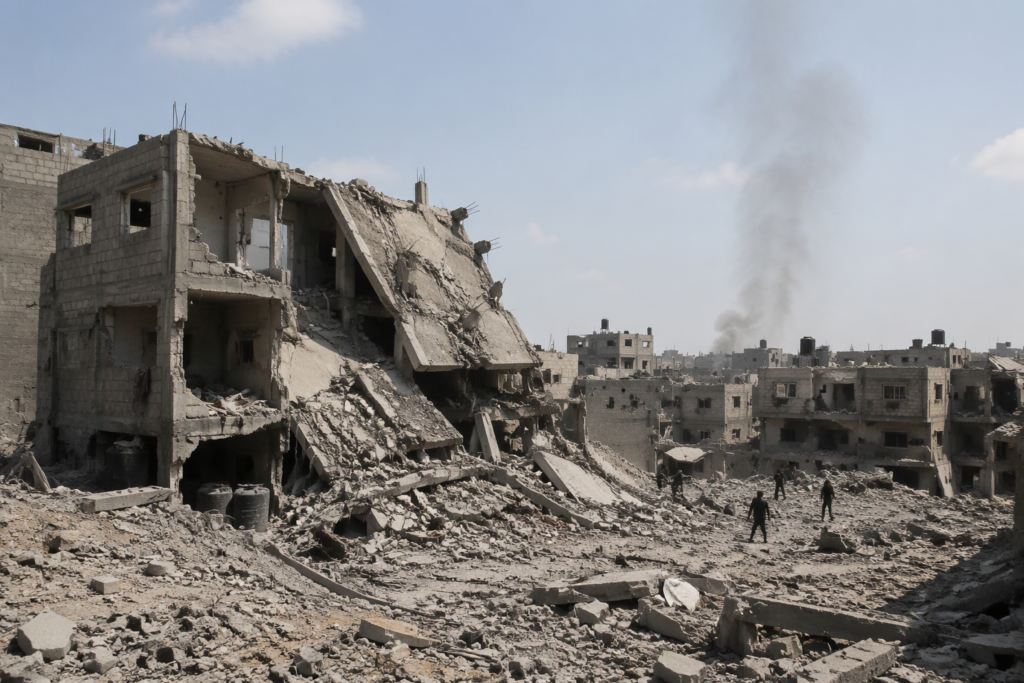
Four missiles slammed into a tent inside a crowded shelter in southern Gaza on Saturday, killing senior Hamas commander Samir Abu Younis in an area packed with displaced families. Both the Israeli military and Hamas officials confirmed the strike in Al-Mawasi, ending the brief tenure of a veteran militant leader accused of helping coordinate the cross-border raids of October 2023.
His death removes one of the few remaining senior operational planners from the group’s southern leadership. For civilians sheltering in coastal camps across Gaza, the strike brings a sharp reminder that safety remains elusive even under an active ceasefire.
Also read: Israeli Strike Kills Hamas Commander Samir Abu Younis in Gaza
The operation also signals Israel’s ongoing intent to track down field commanders who survived earlier offensives, regardless of where they hide.
Four missiles strike a crowded displacement camp
Eyewitnesses reported that four separate missiles struck a single tent in the Al-Waha camp, an encampment inside Al-Mawasi housing hundreds of displaced civilians. The explosions triggered an immediate blaze that tore through the fragile shelters nearby.
Medics at Nasser Hospital in the nearby city of Khan Younis confirmed that one body arrived following the strike, along with three wounded individuals who required urgent treatment. Local emergency crews worked to extinguish the flames before the fire could engulf larger sections of the camp.
The Israel Defence Forces (IDF) and the internal security service, ISA, quickly claimed responsibility for the strike in a joint statement published on Telegram. The military stated that it had “eliminated” the commander, adding that “steps were taken to mitigate harm to civilians” before launching the air raid against the tent.
Who was Samir Abu Younis?
Samir Abu Younis, 53, took control of the Rafah Brigade only months ago on 15 September. He stepped into the leadership role following the death of the previous commander, Nael Abu Obeid, during earlier fighting.
His involvement with the militant movement stretched back more than three decades. Younis first joined Hamas’s armed wing in 1991, rising through the ranks across multiple conflicts to take on various high-level operational duties.
The Al-Qassam Brigades, Hamas’s military wing, acknowledged his death and praised his record in an official statement on Telegram. The armed group stated that he had fought in numerous high-profile operations and stood against military incursions over the years.
Hamas also identified him as “one of the most important commanders involved in planning and overseeing the 7 October attack,” confirming the central role he held in orchestrating the operation that ignited the broader regional war.
Israeli accusations against the Rafah Brigade leader
Israeli intelligence viewed the commander as an active operational threat rather than a retired planner. Officials described Samir Abu Younis as a central figure among Hamas’s senior ranks who worked relentlessly to rebuild the movement’s shattered fighting units in the south.
According to the military’s assessment, Younis dedicated his final months to reorganising broken units and planning fresh attacks against Israeli forces and civilian communities.
“Younis directed the brigade’s terrorists to advance and carry out terror attacks against Israeli civilians and IDF troops.”
The IDF maintains that its forces will continue pursuing leaders who attempt to reconstitute Hamas fighting cells, particularly around the southern border. While Israeli forces pulled back significant ground formations after last autumn’s agreement, targeted airstrikes against identified figures have persisted across southern districts.
The fragile Gaza ceasefire and rising casualty count
If you look at the broader pattern of strikes over recent months, the killing of Samir Abu Younis highlights the fragile nature of the current Gaza ceasefire. A truce took effect last October, yet the Israeli military continues to conduct periodic precision strikes against individuals it identifies as active threats.
Israeli officials maintain that these targeted raids are fully permitted under the terms of the truce agreement to prevent militant regrouping. Hamas and local authorities, meanwhile, argue that strikes inside designated humanitarian zones violate the framework of the halt in fighting.
The ongoing conflict traces back to the Hamas-led assault on southern Israel on 7 October 2023, in which militants killed roughly 1,200 people and abducted 251 hostages into Gaza. That raid prompted an intense Israeli air and ground campaign across the coastal enclave.
More than 74,650 people have been killed in Gaza since the outbreak of hostilities, according to the Palestinian health ministry. Heavy concentrations of families remain stranded in makeshift camps such as Al-Mawasi, where basic services are strained and shelter remains fragile.
Hamas announced that mourners will gather for the commander’s funeral on Sunday afternoon in Khan Younis.
Source: BBC


