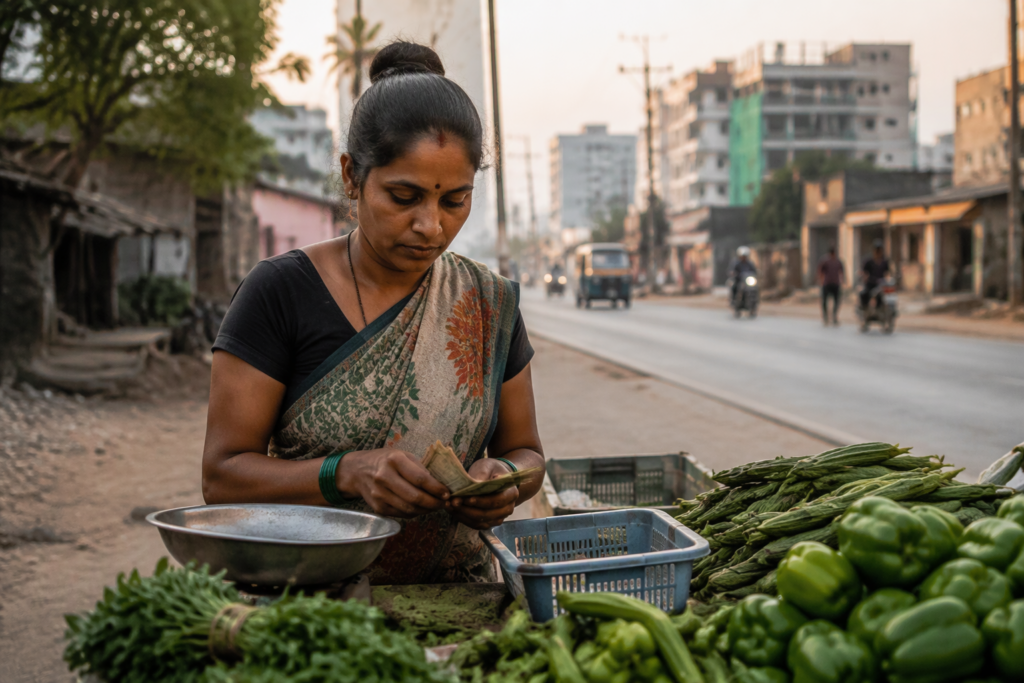
Twenty-five-year-old Hema Prajapat says even thorns growing inside her stomach would not hurt as much as hunger does.
By the end of every month in Rajasthan’s Rajsamand district, her kitchen shelves sit bare, her husband sinks deeper into debt, and she quietly cuts her own meals so their nine-year-old son can eat. She spends roughly 11,000 rupees ($117) each month to keep her three-person household afloat. That sum puts her family nearly 50 percent above the official benchmark for poverty in India, yet dignity remains entirely out of reach.
Also read: Pope Leo Peru Visit Confronts Poverty and Flight in Remote Andes
On paper, the country has achieved an astonishing transformation. Fresh numbers show India lifted nearly 500 million people out of extreme poverty between 2011 and 2023, dropping the national rate from 27.1 percent down to just 2.6 percent. But for the hundreds of millions living just a few rupees above that statistical line, daily survival remains a constant scramble against inflation and debt.
How poverty in India looks beyond the official line
India stopped counting its own poor more than a decade ago. The administration under Prime Minister Narendra Modi has not published an official consumption-based poverty estimate in years. That void forced international institutions to step in, relying on their own formulas and newer consumption surveys.
According to the World Bank poverty line, a family of three requires roughly 7,380 rupees ($78) a month to escape destitution. China stands as the only nation to have moved more people on such a massive scale, pulling over 800 million citizens out of extreme poverty across four decades.
Yet families who technically cleared the bar say the metric bears no resemblance to reality.
“This poverty line, this bar, is very low. No person can live a dignified life [on this amount],” Hema said, looking out over the neighborhood garden where she works as a caretaker.
A crushing cost of living erases household gains
India ranks as the fourth-largest economy in the world by nominal gross domestic product, expanding rapidly despite international shocks. Still, the divide between rich and poor is staggering. The wealthiest 1 percent of the population holds 40 percent of the nation’s wealth.
To cushion the strain, the central government distributes free or subsidised foodgrains to roughly 800 million citizens every month. But food grain handouts cannot outpace a relentless cost of living. Official data shows overall consumer prices jumped at least 51 percent between September 2016 and September 2025, while wages failed to keep up.
Hema’s husband, Hari, previously worked as a traditional clay-pot maker. When pottery could no longer feed them, he launched a street food stall, only to lose it during the pandemic. Hema stepped in to clean houses and wash dishes for 5,000 rupees ($53) a month.
While economists credit rising female employment with reducing extreme poverty, Hema finds the math baffling. Every rupee she earns disappears into grocery bills because the family owns no farmland. When prices for everyday staples multiply, extra work simply buys less food.
The catastrophic toll of a single emergency
Public clinics exist, but long lines and depleted resources drive even the poorest families to private doctors when disaster strikes. Two months ago, when Hema’s son Divyansh fell sick with a severe fever, she skipped the crowded state clinic and rushed him to a private facility. The bill came to 6,000 rupees ($64)—more than her entire monthly earnings.
New Delhi developmental economist Santosh Mehrotra warns that setting the poverty threshold so low creates an illusion of security.
“That shock could be a pandemic, drought, flood, or even a wedding.”
Mehrotra argues the metric also fails because it treats rural and urban families the same, ignoring the vastly different expenses they face.
In the nearby town of Kankroli, 31-year-old Salvi learned that lesson the hard way. For eight years, she saved money by running a one-chair beauty salon to pay for her teenage daughter’s eventual college education. Then she became pregnant with her second child after a 14-year gap.
Unwilling to risk an overburdened government maternity ward, Salvi chose private care. The delivery and checkups cost 65,000 rupees ($695), obliterating her entire savings account. To make ends meet, she had to stop paying for her daughter’s 600-rupee ($6) monthly tutoring sessions.
Toxic air and debt on the capital’s edge
On the outskirts of New Delhi, 37-year-old Seema Kumar spends 20,000 rupees ($214) monthly on her three-person household. Even at nearly triple the international poverty cutoff, she must borrow money whenever an ordinary family event or festival arrives.
After Diwali celebrations filled the capital with record levels of toxic smog, Seema’s entire household fell ill with respiratory trouble. She could not scrape together enough cash to purchase protective masks for her son before sending him to work.
Back in Rajasthan, fuel costs pushed up by conflicts in the Middle East meant Hari could not even put petrol in his motorbike to take their child for a routine medical check. Hema had to dip into her pocket money to fill the tank.
She knows that without steady wages, everything falls apart. As she puts it: “If I do not work for a single day – let alone a month – we can go back to the days of extreme poverty and deprivation.”
The debate over how to measure poverty in India will intensify as economists press the government for transparent household consumption data in 2026.
Source: Al Jazeera


