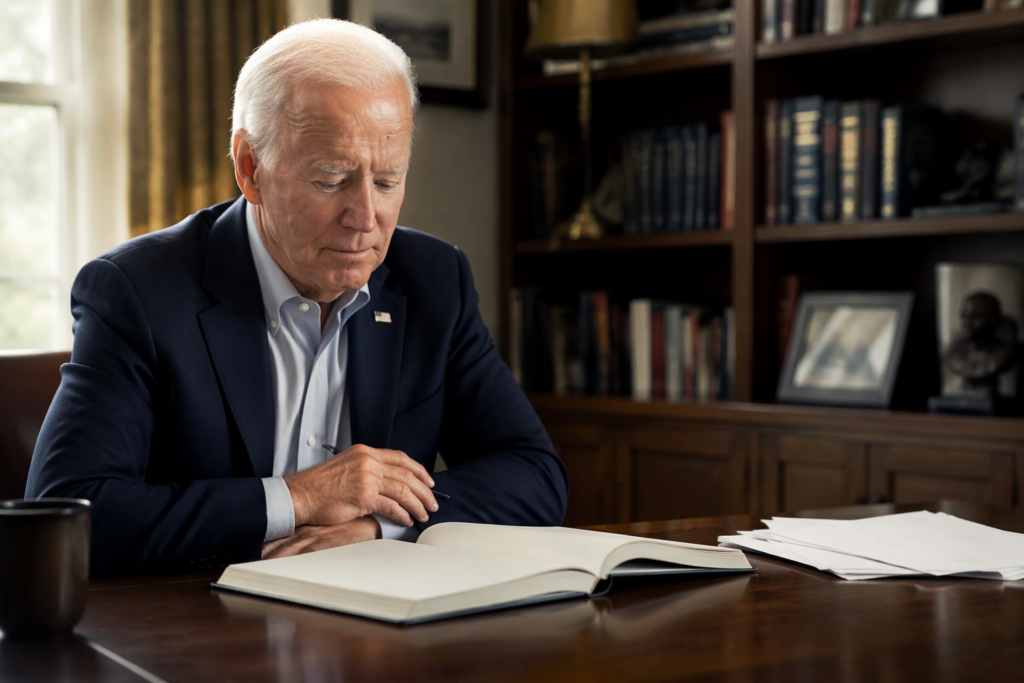
Former President Joe Biden signed 17 executive orders during his first afternoon in the Oval Office, but you will not find the word “equity” anywhere in his new 2024 retrospective. The omission is part of a broader pattern critics say defines the biden memoir, titled “Promise Me, America,” which landed in bookstores on Nov. 17 to an immediate wave of skepticism across the political spectrum.
Reviewers and political analysts argue the book shows a leader detached from the realities that ultimately ended his reelection bid. Rather than offering an unvarnished post-mortem of his single term in the White House, the text mounts an aggressive defense of his record while glossing over his most contentious domestic and foreign policy choices.
Also read: Fani Willis Legal Fees Fight Draws Sharp Rebuke from Judge
Refusing to concede ground on age and 2024
The fiercest literary pushback targets Biden’s insistence that he remained the right candidate to defeat Donald Trump right up until party pressure forced him aside. In his telling, the uncontested Democratic primaries gave him zero indication that his standing with voters had deteriorated.
Critics took issue with that defense. Writing for The New Yorker, Amy Davidson Sorkin argued that the former president remains “stubbornly in denial” regarding voter worries over his age and stamina. Sorkin wrote that the text provides no fresh revelations because Biden refuses to confront the core doubts that eroded public confidence in his physical fitness.
New York Times nonfiction critic Jennifer Szalai echoed that assessment, pointing out that presidential memoirs must eventually reckon with personal failure.
“The true test of a book like this is whether its author will own his losses, too. Biden, for his part, does not.”
Instead of owning those losses, Szalai observed, Biden adopts a passive voice, framing himself as an unfortunate casualty of external pressures rather than an architect of his own political decline.
Blaming Pelosi and explaining the debate stumble
Biden does not hide his resentment toward key party leaders who organized his exit after his catastrophic June debate against Trump. In the pages of the book, he accuses former House Speaker Nancy Pelosi of operating furiously behind the scenes to torpedo his reelection effort.
He also attempts to contextualize his widely mocked debate performance, including his confusing declaration that “we beat Medicare.” While admitting the night went poorly, he downplays suggestions that the performance signaled deeper cognitive decline.
The dispute reveals how deeply the bitter summer exit still stings inside Biden’s circle. Readers expecting remorse will find instead an author who still believes he possessed the strongest path to victory.
Clashing accounts of Gaza and Netanyahu
Foreign policy forms another major flashpoint for reviewers dissecting the biden memoir. Sorkin, Szalai, and commentators at the left-leaning outlet Jacobin argued that Biden rewrites his private dealings with Israeli Prime Minister Benjamin Netanyahu to sound far more combative than they were in practice.
Szalai observed an unsettling contrast in how the book handles victims of the war in Gaza. Biden names individual Israeli victims, she pointed out, but names zero Palestinian victims while describing Palestinian casualties with vague, detached grammar.
Israeli journalist Amit Segal criticized the foreign policy passages from another angle. Segal called Biden’s account of his Middle East strategy “devoid of doctrine or strategy,” arguing that “the only consistent position is inconsistency.”
Silence on Day 1 equity and gender orders
Beyond foreign battlegrounds, domestic omissions have drawn equal scrutiny. Semafor reporter David Weigel found that despite Biden celebrating his immediate wave of 17 Day 1 executive orders, he completely left out his landmark mandate directing every federal agency to implement diversity, equity, and inclusion plans.
The word transgender is entirely absent from the text. Biden previously labeled anti-transgender discrimination “the civil rights issue of our time,” yet his book omits both the subject and the executive order he signed on day one barring discrimination based on gender identity.
When addressing fairness, Biden pivots away from those formal programs entirely. He writes instead that every legislative win his administration achieved had justice baked in automatically, pointing to programs like equal access to vaccines as proof of his civil rights commitment.
Debate over how these omissions will shape Biden’s historical standing now heads to the public, as sales figures and post-presidency panel discussions in Washington test whether voters accept his version of events.
Source: Fox News