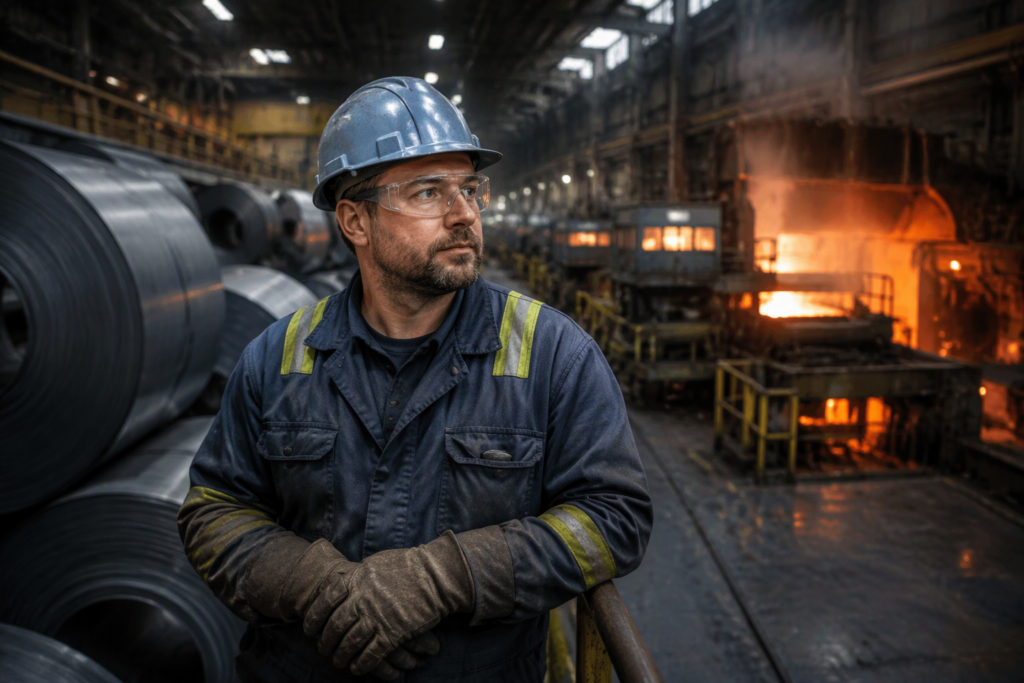

Chelsey Masteij was spending her scheduled vacation days playing with her new dog when the phone rang with orders not to return to the mill. After spending three years operating cranes and working shifts in the coke ovens, the 34-year-old was laid off on October 9. The sudden call upended her life and pushed the fight over Canadian steelworker jobs into a fierce political conflict between Ottawa and corporate leadership in Ohio.
Masteij spent years breaking into the heavy industrial sector before landing a position at Stelco in Hamilton, Ontario. She worked 12-hour shifts, embraced the demanding physical labour, and considered her plant colleagues family. Instead of retiring in the mill as she had planned, she now spends her days at home cutting household expenses and collecting employment insurance.
Also read: Qantas to Outsource 850 Jobs as Tech Roles Move to India
Her sudden departure is part of a much larger battle. Cleveland-Cliffs, the American company that bought Stelco in 2024, announced plans in late September to temporarily idle parts of its facilities in Hamilton and Nanticoke. If you look at the factory floor today, the cost falls entirely on workers caught between multinational corporate strategy and cross-border trade spats.
The impact on the Stelco Hamilton plant
Layoff notices have already gone out to 175 staff members at the Stelco Hamilton plant. Total job losses across the Hamilton and Nanticoke operations could reach 500 workers. The sudden slowdown has left employees reeling from uncertainty about how long the gates will stay shut.
Late last month, around 30 workers gathered in a union hall in Hamilton to ask questions about government benefits and retraining grants. Some had spent decades in the facility and now face searching for work in a modern digital hiring market. Others must choose between uprooting their families to chase industrial work in western Canada or waiting out an open-ended shutdown.
The blow hits deep in Hamilton, an industrial hub where generations of families have earned a living around blast furnaces. Masteij points out that losing experienced staff threatens the trade skills that built the community. She is using her downtime to start heavy equipment training, preparing for a future where her old job may never return.
Why Cleveland-Cliffs blames tariffs and trade
Cleveland-Cliffs points the finger directly across the border, blaming its production cuts on trade policy enacted by United States President Donald Trump. In June 2025, Washington doubled its steel tariffs on Canadian imports to 50 percent, choking off key export routes. Stelco says Canadian exports of cold-rolled and coated steel to the US plummeted by 58 percent during the second quarter of 2026.
Domestic steel demand inside Canada has softened as well. The Canadian auto manufacturing sector consumes large volumes of cold-rolled steel from Hamilton, and tariff disruptions have hit car assembly lines hard. Colin Mang, an economics professor at McMaster University, confirms that orders for Hamilton’s output have indeed dropped.
Yet company executives have also claimed that an influx of cheap offshore steel is drowning Canadian producers. During a July earnings call, Cleveland-Cliffs chief executive Lourenco Goncalves warned he would scale back Canadian production unless federal lawmakers protected the domestic market. He acknowledged that while cuts would hurt workers, they would benefit the company’s financial balance sheet.
The controversy over Canadian steelworker jobs
Union leaders and economic analysts argue that the official corporate explanation does not add up. Mang notes that roughly 80 percent of Canada’s cold-rolled steel imports come from the US, while American producers also account for about half of galvanized imports. The competition arriving at Canadian ports is not coming from Asia or Europe; it originates in the US, where Cleveland-Cliffs operates extensive mills.
Questions about the company’s motives deepened when critics reviewed public statements by Goncalves. While lobbying Ottawa to stop foreign steel, the executive spent months cheering on Trump’s 50 percent border taxes on Canadian metal. In an earlier interview with Politico, Goncalves claimed he had his own “fingerprints” on that exact trade measure.
Late last month, Goncalves offered an unvarnished reason for purchasing the Canadian steelmaker during an interview with CBC:
“I bought Stelco because I could not afford anymore having Stelco flooding the market here in the United States to the detriment of my own company.”
That admission confirmed the worst fears of United Steelworkers Local 1005, which represents the workforce. Local president Ron Wells says employees are being treated as collateral damage in a corporate maneuver to suppress supply. Goncalves recently announced the company’s strongest financial quarter since acquiring Stelco, undermining claims that the business is fighting for survival.
Ottawa launches an investigation
Canadian Industry Minister Melanie Joly has rejected the claim that market hardship forced the company’s hand. When Cleveland-Cliffs acquired Stelco under the Investment Canada Act, it promised to maintain union staffing levels and advocate for shared trade interests. Joly warned the company that it had 15 days from October 22 to honor those binding commitments.
That deadline passed without a resolution. On November 6, Joly formally referred the 2024 acquisition to Canada’s Competition Bureau to determine whether the company acted in bad faith or broke competition law. Ottawa has raised the possibility of forcing Cleveland-Cliffs to sell its Canadian assets if investigators find evidence that the firm purchased Stelco merely to idle its plants.
Goncalves dismissed the government’s threats, declaring himself “persona non grata in Canada” and floating the idea that he might sell the business voluntarily in a year. For now, he insists he wants to recall staff before Christmas, provided domestic buyers step up orders for local metal. Federal competition investigators are now reviewing the buyout records, while union members wait to see whether recall notices or legal sanctions arrive first.
Source: Al Jazeera