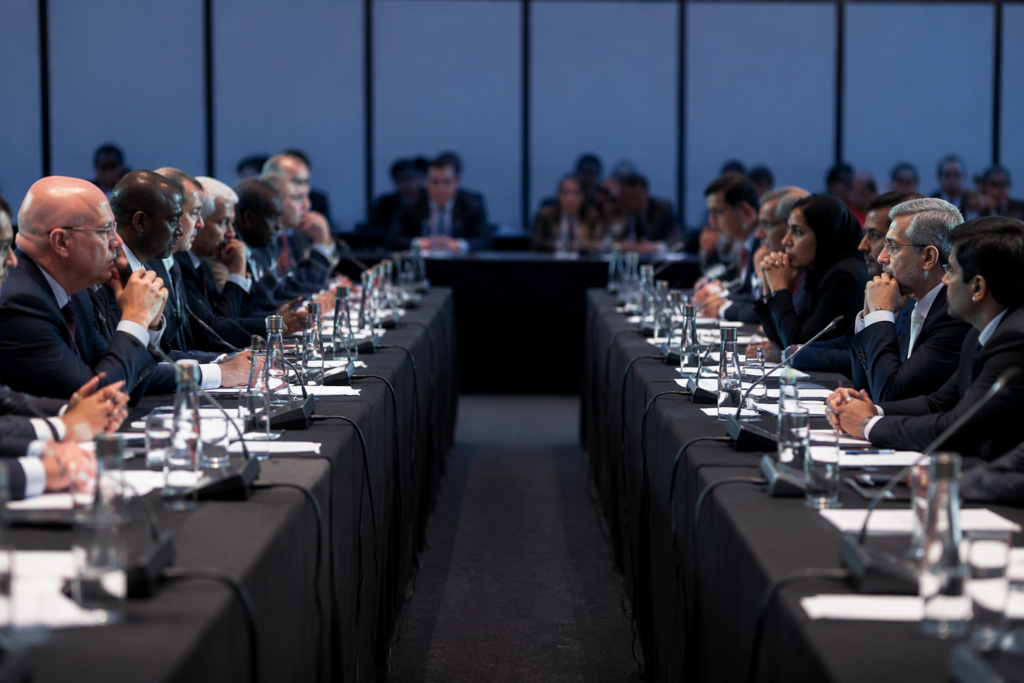
Negotiators inside the summit halls in Antalya worked straight through the night, yet morning brought no breakthrough on the central cause of planetary warming. The latest draft of the global climate agreement omitted any mention of reducing demand for fossil fuels, setting off an immediate clash among delegates representing nearly 200 nations.
That omission provoked sharp resistance from European, Latin American, and low-lying island delegations at the COP31 climate talks in Turkey. They refused to sign a pact that ignores coal, oil, and gas, especially after the draft acknowledged for the first time that the world has missed the target of keeping global temperature rise below 1.5C.
Also read: COP31 Climate Summit in Overtime Over Fossil Fuel Deal
Without a credible plan on fossil fuels or financial aid for vulnerable nations, the talks risk closing without an enforceable compromise. That failure would leave vulnerable populations exposed to escalating heatwaves and sea level rise without the funding promised to protect them.
The rebellion over oil, gas, and coal at the COP31 climate talks
Delegations led by France and Panama launched a late-night pushback against the draft text on Friday. They demanded that commitments to move away from oil, gas, and coal be restored to the final text of what is officially called the Antalya Accords.
Fossil fuel producers led by Saudi Arabia had pushed hard to wipe those commitments clean from the draft. In response, Panama environment minister Juan Carlos Navarro rejected any outcome that hides the driver of climate disasters.
“It is not acceptable to have a COP or a cover decision that does not even mention fossil fuels and we simply will not put up with it,” said Juan Carlos Navarro, Panama’s minister for the environment.
Ministers from Spain, Belgium, Sweden, and Finland joined the coalition demanding explicit language on burning fossil fuels. Island states, whose land faces direct threats from rising tides, stood firmly beside them.
Disputes over carbon capture and the 1.5C target
The draft deal includes an admission that the world has failed to stop global temperature rise from passing 1.5C above pre-industrial levels. Scientists warn that crossing this threshold pushes millions more people into severe heat extremes and coastal flooding.
French Minister of Ecological Transition Monique Barbut criticized the draft text for promoting carbon capture, use, and storage. The technology captures emissions at the source and buries them underground, but Barbut argued it offers polluting states an excuse to burn fossil fuels indefinitely.
“We cannot be announcing to the world that we are now getting to 1.5 increase in the temperature and do business like nothing was happening,” Barbut said.
European unity on the dispute has cracked, however. Several EU countries declined invitations to join the Franco-Panamanian rebellion, warning that confrontation would derail the broader COP31 climate talks.
Australia’s clean energy compromise plan
Australia Climate Change and Energy Minister Chris Bowen, who is leading the high-level negotiations, pushed back against reopening the fight over wording. He maintained that this summit must center on real-world implementation and expanding renewable power.
Under one compromise floating among negotiators, the text would keep fossil fuel phaseout language off the table entirely. In exchange, petro-states including Saudi Arabia would commit to generating 35% of their electricity from clean sources by 2035.
Can a summit tackle climate change without directly addressing what fuels it? That question split ministers as talks stretched into Saturday morning.
African nations fight for lost adaptation finance
The clash over fossil fuels is only half the stalemate in Antalya. Developing nations are furious about the sudden disappearance of climate money from the negotiation texts.
An earlier version of the text committed wealthy countries to increase adaptation funding to $120 billion annually by 2035. Negotiators removed that target from the overnight draft, leaving developing states empty-handed.
Ghana Environment Minister Zanetor Agyeman Rawlings, speaking as chair of the African Group of negotiators, rejected the revised text outright. She insisted that finance is an obligation, not an act of charity.
“We did not come here to beg we came here to claim what is rightfully ours for our people who are suffering the brunt of anthropogenic activities of developed countries,” Rawlings said.
Host officials in Turkey plan to issue a revised draft agreement on Saturday, giving ministers a final chance to accept or reject the Antalya Accords.
Source: BBC


