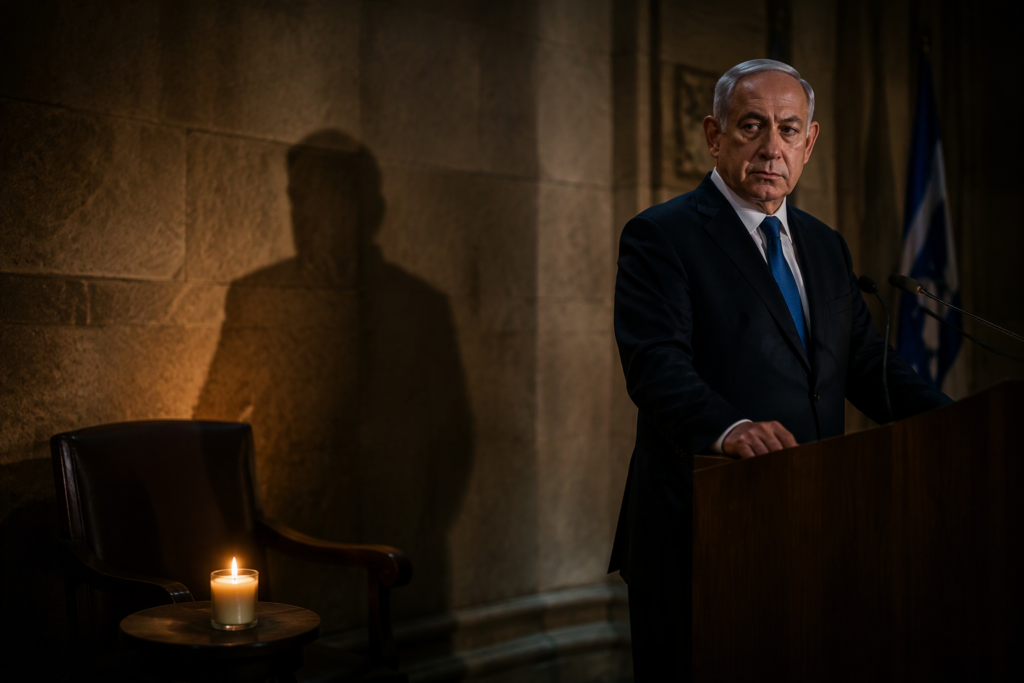
Benjamin Netanyahu took to the Knesset floor and branded all 19 elected Arab lawmakers as supporters of terror, aiming his harshest rhetoric at rivals trying to unseat him. This pattern of fierce Netanyahu political incitement echoes the most dangerous period of domestic unrest in modern Israeli history.
The stakes go far beyond parliamentary posturing. When a sitting prime minister accuses political opponents of collaborating with enemies to destroy the state, words quickly turn into weapons on the street.
Also read: Hussam Abu Safia Detention Extended Six Months by Israeli Court
Netanyahu is fighting to preserve his political career and stave off an ongoing corruption trial. By attacking the legitimacy of Arab lawmakers and anyone willing to govern with them, he is crossing lines that once led directly to bloodshed.
Echoes of the 1995 Yitzhak Rabin assassination
The warnings carry painful weight because Israel has stood at this exact precipice before. Nearly three decades ago, right-wing rhetoric created an atmosphere that culminated in the Yitzhak Rabin assassination on November 4, 1995.
Back then, Netanyahu served as chairman of the Likud party and leader of the opposition. He marched at demonstrations where crowds depicted Prime Minister Rabin in a Nazi uniform for signing the Oslo Accords. Religious-messianic rabbis issued the edict of din rodef against Rabin, accusing him of handing Jewish land to foreigners. Extremist Yigal Amir cited that exact religious ruling when he pulled the trigger.
There was a Likud rally in Jerusalem not too long ago. They put the figure of Yitzhak, my husband, in the uniform of a Nazi leader and Mr Netanyahu was there. He later talked against it, but he was there, and he didn’t stop it.
Rabin’s widow, Leah Rabin, never forgot Netanyahu’s presence at those rallies. Netanyahu never offered an apology, and within months voters elected him prime minister for the first time.
Netanyahu political incitement targets rivals and Arab lawmakers
Today, the playbook looks familiar. Following recent general elections, President Isaac Herzog tasked Gadi Eisenkot with building a viable coalition after he secured majority backing among lawmakers.
Netanyahu responded by unleashing open fury during the swearing-in of the new Knesset. He claimed Eisenkot was forming an administration with partners who actively seek the total destruction of the state. He alleged those factions merely argue over whether to create an Islamic state modelled on Hamas or a nationalist one modelled on Fatah.
Such rhetoric effectively labels Arab Knesset members as an internal fifth column. It also treats Jewish politicians working alongside them as traitors to their own people. This aggressive Netanyahu political incitement denies basic legitimacy to nearly a fifth of the country’s population.
A track record of cynical alliances
Netanyahu’s sudden outrage over Arab participation in government rings hollow when compared to his own past maneuvers. Not long ago, he openly courted Mansour Abbas and the Ra’am party to prop up his own coalition hopes.
When reaching across the aisle suited his personal ambitions, Netanyahu viewed those same politicians as acceptable negotiating partners. Yet the moment rivals consider an identical path, he paints the prospect as national suicide.
His rhetoric during campaigns regularly questions Arab voter turnout. Following the latest vote, his political camp amplified unfounded claims of polling irregularities in minority towns, attempting to plant doubts about the integrity of Israeli democracy.
Normalising the messianic fringe
The difference between 1995 and today is that the fringe figures of that era now hold the keys to state power. Netanyahu brought ultra-nationalists into the core of his cabinet to secure his governing majority.
His government elevated Itamar Ben-Gvir to the post of national security minister, overseeing police forces across the country. Ben-Gvir holds a prior conviction for incitement to racism and supporting a terrorist organization. Weeks before Rabin was killed in 1995, a young Ben-Gvir famously stole the emblem from Rabin’s official car and boasted on television that extremists would reach the prime minister next.
By placing such figures in high office, Netanyahu erased the boundary between mainstream politics and radical agitation. The ongoing surge in Netanyahu political incitement signals to followers that extremist behavior carries official backing.
The immediate peril of communal violence
Security analysts warn that persistent incitement leaves Israel teetering on the edge of renewed internal conflict. Zealots who absorb daily warnings of national doom may decide that violent action is their patriotic duty.
A single extremist could target an elected lawmaker or attack minority neighborhoods, sparking widespread communal clashes. When leaders declare that an incoming government will destroy the country, radicalized followers listen.
All eyes now turn to whether Gadi Eisenkot can finalize a coalition agreement before deadlines expire and whether legal authorities will curb inflammatory speech from the Knesset floor.
Source: Al Jazeera


