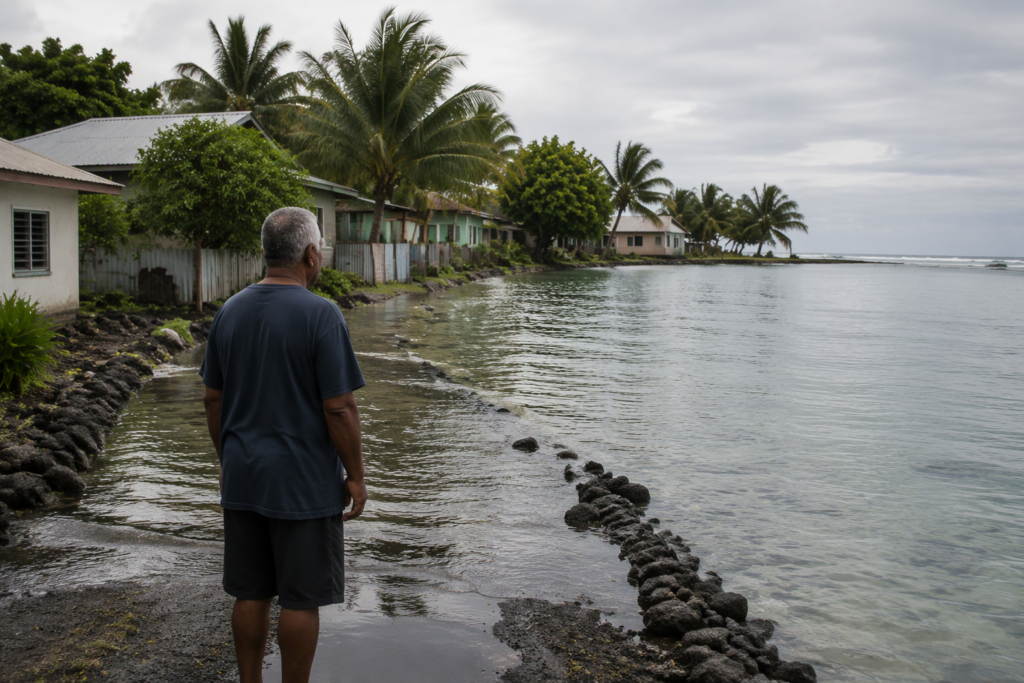
For the 11,000 people living across the remote atolls of Tuvalu, the ocean is no longer just a shoreline, but an encroaching boundary threatening to erase their homeland. Tuvalu rising sea levels now pose an existential threat to the archipelago, leaving families to confront a future where their nation may become entirely uninhabitable.
The issue goes far beyond shifting coastlines. If the rising Pacific swallows the land, it will take centuries of culture, traditions, and an entire society along with it. What happens to Tuvalu will signal what awaits low-lying island nations across the globe.
Also read: COP31 Climate Summit in Overtime Over Fossil Fuel Deal
An island paradise under immediate pressure
Tuvalu sits roughly midway between Australia and Hawaii, surrounded by the deep blue expanse of the Pacific Ocean. Its white sandy beaches and palm-lined islands match every postcard definition of paradise. Yet the reality of living in Tuvalu today is defined by water creeping into communities, eroding shorelines, and spoiling soil.
The physical layout of the nation leaves residents with nowhere to retreat. With islands barely rising above the tide, climate change in Tuvalu is an immediate physical emergency rather than an abstract forecast.
Tuvalu rising sea levels put everyday life at risk
Rising waters dictate how people live, gather, and plan for their families. For the roughly 11,000 inhabitants sharing the islands, daily routines are tied to tides that creep higher every year. Communities face tough questions about food production, housing stability, and whether their children will be able to build lives in their birthplace.
These harsh pressures have pushed three young women to speak out about their personal experiences of living through the Tuvalu climate crisis. Their accounts describe a population holding tight to community routines even as the ground beneath them shrinks.
Preserving language and customs when land disappears
Beyond physical homes, the creeping water threatens centuries of unwritten tradition and identity. For Tuvaluan families, cultural survival is tied directly to the land where their customs evolved.
One resident, Moeli, explained that maintaining heritage depends on raising children within the rhythms of the community. She expressed deep concern over whether future generations will know their ancestral tongue and values if the population is forced to scatter.
“To know more about Tuvalu, you have to sit down, respect the elders, no talking when elders are talking, everything like that.”
Pacific island sea levels threaten to dismantle these communal structures. When families are displaced, passing down oral history, customary respect for elders, and the native language becomes far more difficult.
The urgent stakes at the UN COP31 climate talks
The stories from Tuvalu arrive as international delegates and heads of government gather to negotiate at the UN COP31 climate talks. Small island states continue to push high-emitting countries for real emissions cuts and dedicated climate financing to protect vulnerable coastlines.
For Tuvalu, negotiations over global emissions are not theoretical policy debates. The talks represent a direct vote on whether their territory remains above water.
All eyes now turn to the formal negotiations at COP31, where negotiators face firm deadlines to reach binding climate financing pacts for frontline island nations.
Source: BBC


