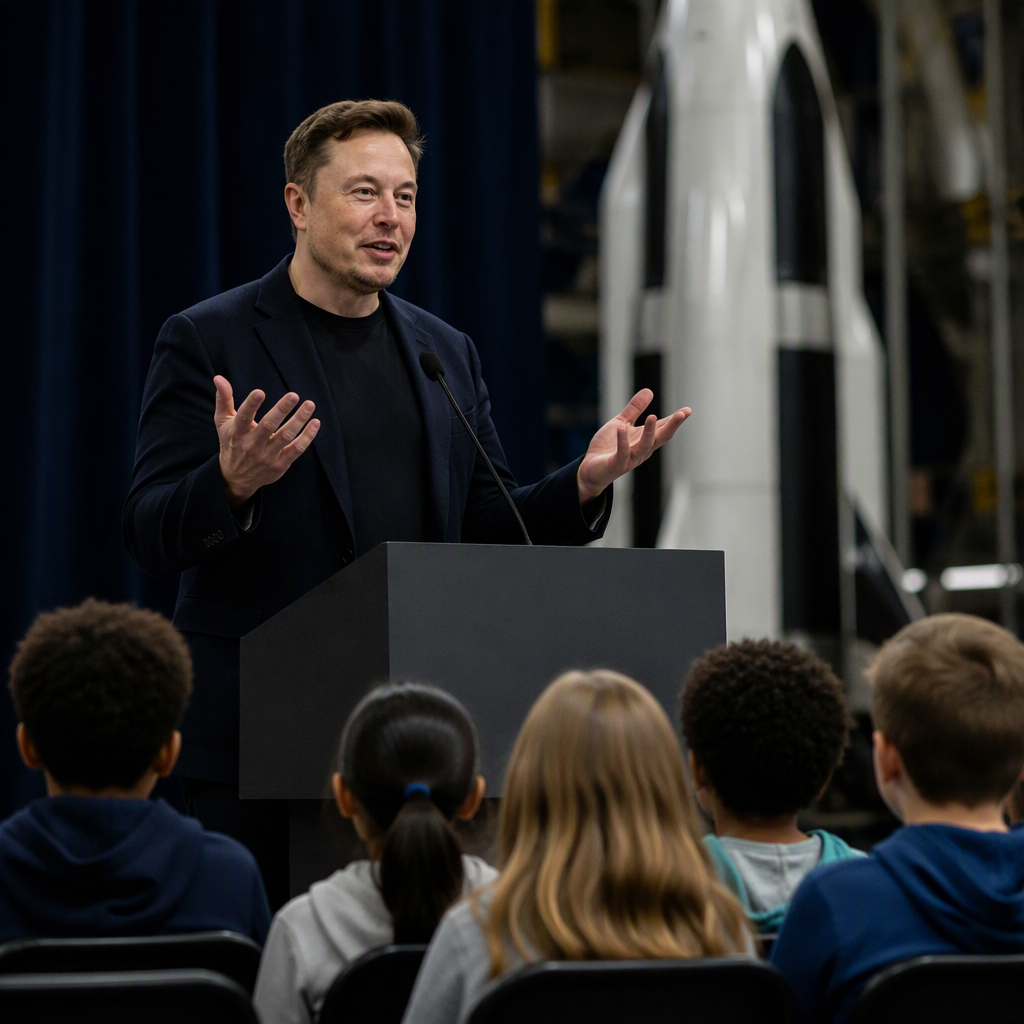

Elon Musk Vows to Give Every US Child SpaceX Stock in Bold Proposal
Tech billionaire Elon Musk has sparked widespread debate across the financial and political landscapes after vowing to distribute SpaceX stock to every child in the United States. The unexpected pledge, floated across public forums and social media, envisions granting America’s youth a direct ownership stake in one of the world’s most valuable private aerospace enterprises.
While the announcement captured immediate attention, it has also raised fundamental questions regarding regulatory feasibility, corporate governance, and how equity in a closely held private company could legally and practically be transferred to tens of millions of minors.
Also read: Musk Explains Why SpaceX Restricted Ukraine Starlink Connection as Service Continues
The Vision: Democratizing Space Wealth for the Next Generation
Under the conceptual framework outlined by Musk, providing equity to young Americans is designed to give the next generation a personal, vested interest in space exploration and long-term technological advancement. Musk argued that tying youth economic security to humanity’s expansion beyond Earth could foster widespread interest in science, technology, engineering, and mathematics (STEM) while simultaneously building generational wealth.
The proposal parallels broader discussions surrounding national sovereign wealth funds, “baby bonds,” and universal asset-building programs that aim to reduce wealth inequality by providing every citizen with an investment portfolio at birth or during childhood.
Understanding the Current Valuation of SpaceX
SpaceX, formally known as Space Exploration Technologies Corp., remains one of the world’s most valuable privately held companies. Recent secondary share sales and insider transactions have valued the aerospace giant in excess of $200 billion, driven primarily by the commercial success of its reusable Falcon 9 launch systems, defense contracts, and the rapidly growing Starlink satellite internet constellation.
Unlike publicly traded corporations such as Tesla, SpaceX shares are tightly controlled. Participation in funding rounds and tender offers has historically been limited to institutional investors, venture capital funds, and accredited employees under strict transfer restrictions.
Regulatory Challenges of Distributing SpaceX Stock to Minors
Securities analysts point out that giving SpaceX stock to an estimated 73 million children across the United States faces unprecedented legal and structural hurdles.
- Private Company Shareholder Limits: Under United States securities laws enforced by the Securities and Exchange Commission (SEC), private companies face statutory limits on the number of non-accredited shareholders they can maintain before being compelled to register as a public reporting company.
- Custodial Accounts and Legal Capacity: Minors cannot legally hold securities in their own names in most jurisdictions. Establishing tens of millions of Uniform Transfers to Minors Act (UTMA) or custodial trust accounts would require massive administrative coordination across federal and state agencies.
- Tax Consequences: Distributing valuable shares to individuals often triggers immediate taxable events unless structured through a tax-exempt legislative vehicle or specialized trust system.
- Equity Dilution and Governance: Issuing new shares to tens of millions of recipients would dramatically dilute existing stakeholders, including venture capital funds, early employees, and Musk himself.
Market Analysts and Legal Scholars React
Reaction across Wall Street and Silicon Valley has ranged from skepticism to cautious curiosity. Some economists praise the ambition behind universal capital endowment concepts, noting that giving children an early financial foundation could transform domestic wealth creation.
Conversely, corporate governance attorneys emphasize that private equity ownership is ill-suited for retail distribution without a formal public offering. If SpaceX were to proceed with widespread share grants, analysts suggest the company might need to establish an intermediate trust, a dedicated tracking fund, or consider an eventual initial public offering (IPO) for Starlink or the parent corporation.
What Happens Next
Neither SpaceX corporate representatives nor the SEC have issued formal filings outlining concrete implementation plans. Observers expect that any operational rollout would require extensive coordination with federal financial regulators and potential congressional involvement if public mechanisms or tax incentives are deployed.
For now, the initiative remains a public commitment that must navigate substantial regulatory, logistical, and corporate hurdles before any American child receives an official certificate or digital allocation of private aerospace equity.
Conclusion
Elon Musk’s pledge to allocate SpaceX stock to every American minor highlights an unconventional approach to closing economic divides and cultivating public enthusiasm for aerospace achievement. Whether the initiative evolves into a viable financial program or remains an ambitious thought experiment will depend on how company leadership and federal regulators address the complex legal realities of private equity distribution.