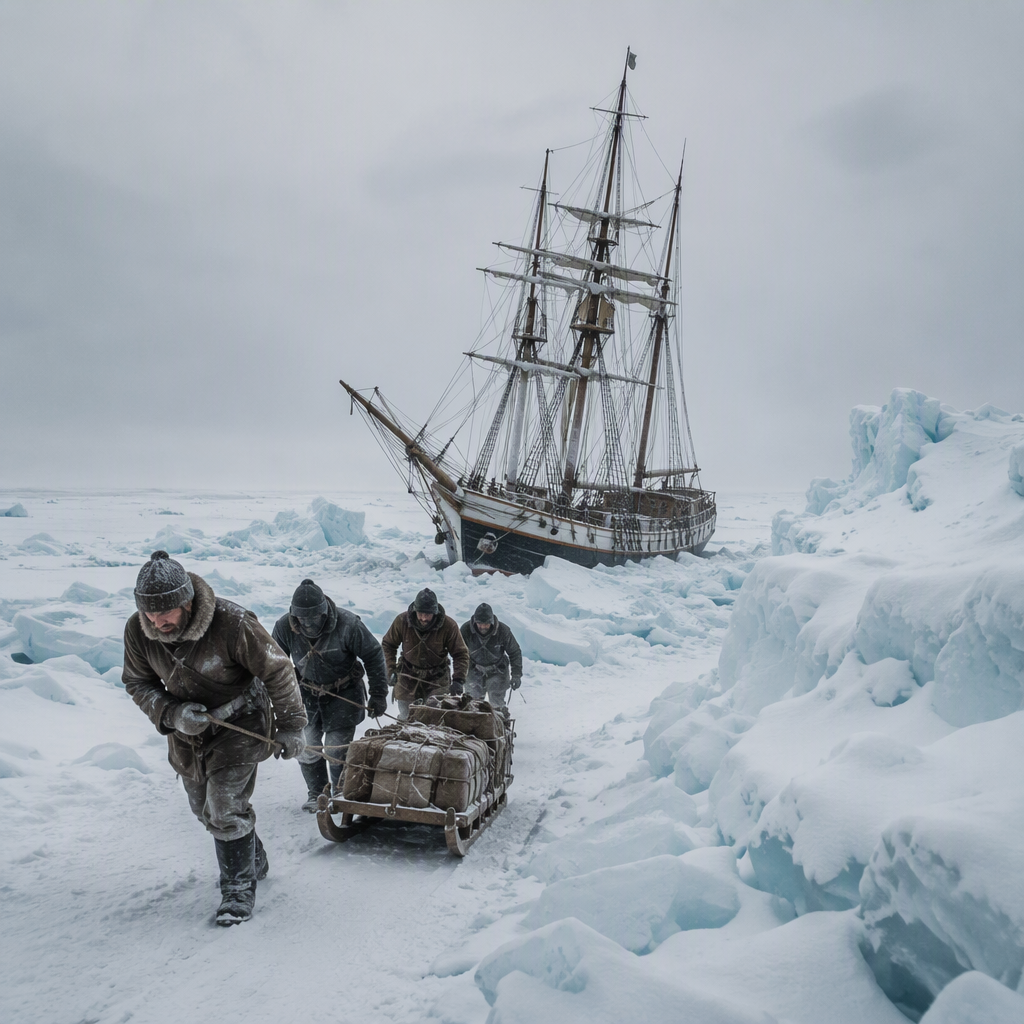

The First Doomed Attempts to Reach the North Pole: How Early Arctic Expeditions Ended in Tragedy
For centuries, the top of the world remained one of the planet’s most dangerous geographic obsessions, luring navigators into frozen waters with promises of glory and scientific triumph. Long before modern navigation and satellite tracking conquered the Arctic, the first doomed attempts to reach the North Pole claimed dozens of lives, shattered ships against moving pack ice, and left entire crews stranded in lethal subzero wilderness.
Driven by Victorian-era nationalism, scientific curiosity, and flawed geographical theories—such as the myth of a warm, ice-free “Open Polar Sea”—explorers from Britain, the United States, and Scandinavia repeatedly launched ambitious missions northward during the 19th century. Instead of finding navigable waterways, these early pioneers faced scurvy, starvation, frostbite, and psychological collapse.
Also read: How to Find Your Motivation: Science-Backed Strategies for Sustainable Drive
The Illusion of the Open Polar Sea
In the mid-19th century, prominent cartographers and geographers theorized that once a vessel pierced the ring of Arctic ice barriers, it would find an open, temperate ocean surrounding the North Pole. This unproven hypothesis emboldened governments and wealthy patrons to fund expeditions that sailed straight into deadly ice traps.
Navigators soon discovered that the reality was far more unforgiving. Polar ice was not a static highway or a narrow ring; it was a dynamic, shifting labyrinth of pressure ridges capable of crushing iron-reinforced hulls like matchsticks. Unprepared for multi-year strandings, several prominent expeditions unraveled into catastrophic human disasters.
The USS Jeannette Disaster (1879–1881)
Among the most agonizing doomed attempts to reach the North Pole was the 1879 voyage of the USS Jeannette, commanded by U.S. Navy officer George Washington De Long. Backed by wealthy newspaper magnate James Gordon Bennett Jr., De Long attempted to reach the Pole by sailing through the Bering Strait, banking on warm Pacific currents to clear a path through the ice.
The theory failed almost immediately. In September 1879, the Jeannette became solidly trapped in pack ice near Herald Island off the Siberian coast. For nearly two years, the ship drifted helplessly, locked in the frozen crust.
In June 1881, catastrophic ice pressure breached the hull, sinking the vessel and stranding the 33-man crew on floating sea ice more than 500 miles from the Siberian mainland. De Long and his men mounted a desperate retreat across hummocks of shifting ice, hauling heavy sledges and three small lifeboats. While some crew members ultimately reached safety after sailing to the Lena River delta, De Long and a dozen of his companions succumbed to cold and starvation in the desolate tundra.
The Lady Franklin Bay Expedition: Survival and Collapse (1881–1884)
Around the same time, the United States Army launched the Lady Franklin Bay Expedition under Lieutenant Adolphus Greely as part of the First International Polar Year. Based on Ellesmere Island in northern Canada, Greely’s team successfully set a new “Farthest North” record in May 1882.
However, the mission soon turned into a desperate fight for survival when consecutive supply ships failed to break through heavy pack ice in 1882 and 1883. Following pre-arranged orders, Greely led his 25 men south to Cape Sabine to await rescue, bringing only minimal provisions.
Over the brutal winter of 1883–1884, the team withered away from frostbite, hypothermia, and starvation. By the time relief ships arrived in June 1884, only six men—including Greely—were found alive among their perished comrades. Later historical accounts revealed that members of the dying party had resorted to cannibalism to stay alive.
S. A. Andrée’s Tragic Hydrogen Balloon Flight (1897)
By the close of the 19th century, surface vessels and dog sledges had repeatedly failed, prompting Swedish engineer Salomon August Andrée to propose an audacious aerial plan. In July 1897, Andrée and two companions, Nils Strindberg and Knut Frænkel, launched the hydrogen balloon Örnen (The Eagle) from Svalbard, intending to float directly over the North Pole to Russia or Canada.
The journey was doomed from the start:
- Heavy ice weighed down the balloon’s canopy within hours of liftoff.
- Drag-ropes designed for steering detached almost immediately, leaving the balloon uncontrollable.
- After drifting blindly for just 65 hours, the aircraft crash-landed on the pack ice hundreds of miles from land.
Equipped with inadequate gear and heavy sledges, the three men endured a grueling three-month trek across drifting ice floes toward safety. They managed to reach the uninhabited Arctic island of Kvitøya in October 1897, where all three perished within weeks. Their frozen bodies, along with intact diaries and developed film, remained undiscovered until a Norwegian seal-hunting expedition stumbled upon their final camp 33 years later in 1930.
Legacy of Early Polar Tragedies
While these voyages ended in disaster, they fundamentally dismantled centuries of geographical myths and revolutionized survival strategies in extreme environments. Later explorers, such as Fridtjof Nansen and Roald Amundsen, recognized that European naval tactics were ill-suited for the Arctic.
Instead of battling nature with heavy military formations, successful 20th-century polar expeditions adopted Indigenous Inuit practices, utilizing lightweight dog sledges, fur clothing, and seasonal hunting techniques to endure the elements.
Conclusion: The Enduring Lessons of Arctic Exploration
The first doomed attempts to reach the North Pole stand as sober testaments to the perils of arrogance in the face of nature. In their pursuit of the geographical crown, early explorers paid the ultimate price, leaving behind cautionary tales of endurance, systemic failure, and scientific sacrifice that paved the way for modern polar exploration.




1 Comment
Comments are closed.