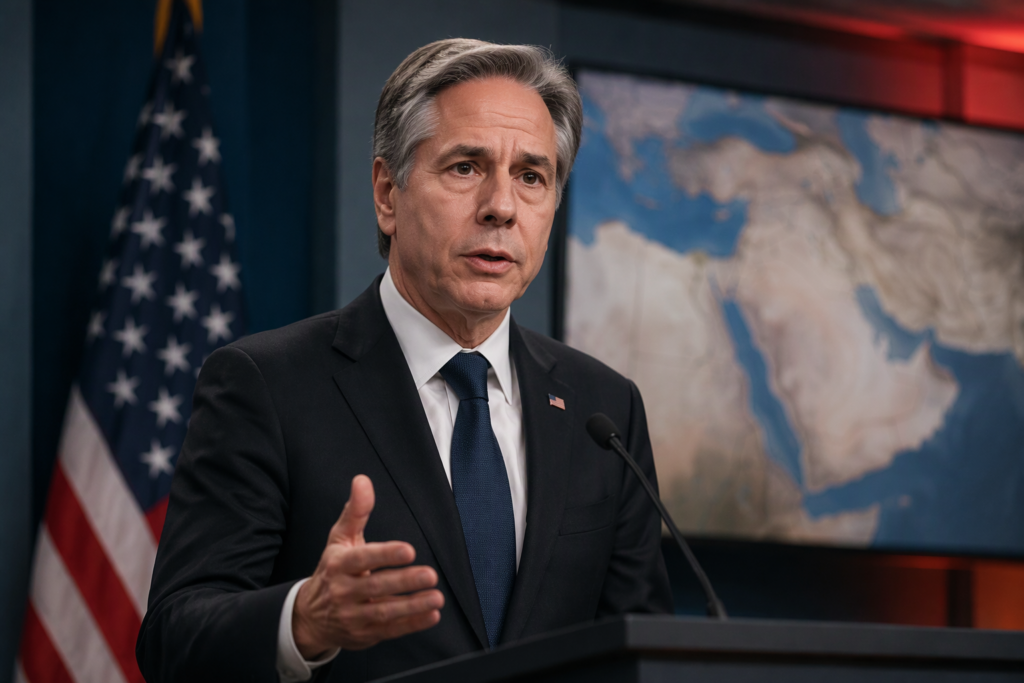
Airstrikes alone cannot wipe out Tehran’s arsenal, yet any full-scale ground invasion of Iran would quickly spiral into an “absolute disaster” for American forces, former Secretary of State Antony Blinken warned at a policy summit in New Delhi. His assessment laid bare the military dilemma facing Washington as direct confrontations between American forces and Iranian-backed groups spread across multiple borders.
Speaking at the 24th Hindustan Times Leadership Summit on Saturday, Blinken argued that Iran’s physical size and deep weapons manufacturing network make a clean military victory through air power impossible. Dismantling that infrastructure would require infantry troops on Iranian soil, an undertaking he characterized as catastrophic for the United States.
Also read: Iran Targets US Radar in Bahrain with Swarm of Drones
The stakes escalated immediately after his remarks. On Sunday, Iran’s Islamic Revolutionary Guard Corps fired six attack drones at an American air defense radar installation at the Al-Rifaa helicopter base in Bahrain. While Bahraini air defenses intercepted the drones before impact—marking their first recorded aerial intercepts since September—the incident demonstrated how quickly Tehran can strike American assets across the Persian Gulf.
Why a ground invasion of Iran would face geographic reality
American strategists face a geographic barrier that air campaigns simply cannot solve. Iran spans roughly four times the land area of California, populated by approximately 90 million people. Its defense industry is tucked away in subterranean bases and mountain redoubts deep within the interior.
“The weapons that it continues to produce are back far enough, the range is great enough that you can’t just take everything out,” Blinken said.
Blinken emphasized that reaching those facilities from the air would require thousands of strike sorties, yet production would likely continue underground. Eliminating them entirely would demand ground forces marching across hostile topography against an entrenched national army. The rugged terrain, combined with an exposed coastline along the Strait of Hormuz that “goes on forever,” gives defenders an immense home-turf edge against invading units.
The trap of horizontal escalation
While the Pentagon holds total conventional superiority, Blinken explained that modern asymmetry balances the equation in Tehran’s favor. Washington possesses the firepower to “escalate vertically” by dropping heavier munitions and hitting hardened targets harder. Tehran, by contrast, responds by escalating horizontally across the map.
Instead of matching American firepower jet for jet, Iran targets regional partners, commercial shipping, energy terminals and isolated American bases. It activates allied militias across Lebanon, Syria, Iraq and Yemen, overwhelming missile defense grids with simultaneous, multi-front drone and rocket salvos.
“Even though we’re much more powerful, that asymmetry in their ability to escalate horizontally as opposed to vertically is not to our advantage,” Blinken said. That dynamic played out this weekend as Houthi forces launched fresh ground gains against Saudi-backed units in Yemen, widening the conflict zone south of the Gulf.
Iraq caught in the middle of war preparations
Anxiety over a potential ground invasion of Iran has already rattled leadership in neighboring Iraq, which shares a porous 1,000-mile border with the Islamic Republic. Tehran has grown alarmed that American forces could attempt to use Iraqi territory as an assembly area for an offensive drive into southwestern Iran.
Iraqi Prime Minister Mohammed Shia al-Sudani privately briefed senior political figures on Nov. 9 regarding an alleged American operational outline involving ground combat, according to Baghdad newspaper Al-Mada. Iraqi Foreign Minister Fuad Hussein rejected the idea that his country could absorb another regional war.
Hussein confirmed in an interview with France 24 that the region’s current state of “no war and no peace” cannot hold. Baghdad has launched diplomatic outreach to Tehran, including talks with Iranian Parliament Speaker Mohammad Bagher Ghalibaf, seeking to cool tensions before they trigger open combat.
Border disputes and task force crackdowns
Baghdad has also pushed back against direct pressure from Washington to seal off movement between Iraq and Iran. American officials demanded that Iraq shut down all but two of its official border crossings to choke off smuggling networks, but Hussein flatly dismissed the request as an impossible demand that functions as an economic sanction against ordinary Iraqis.
Washington has taken independent steps to squeeze supply corridors across the region. U.S. Central Command recently mobilized Task Force Iron Gate, an interagency military initiative created to block illicit supply routes. The operation focuses on halting the transit of several sensitive materials:
- Advanced missile and drone guidance systems
- Dual-use precision manufacturing equipment
- Sanctioned components moved through the Caspian Sea
- Illicit cash flows funding regional militia networks
With border tensions mounting and diplomatic talks stalling, Baghdad’s mediators face a narrow window to broker terms before winter operations begin.
Source: Fox News


