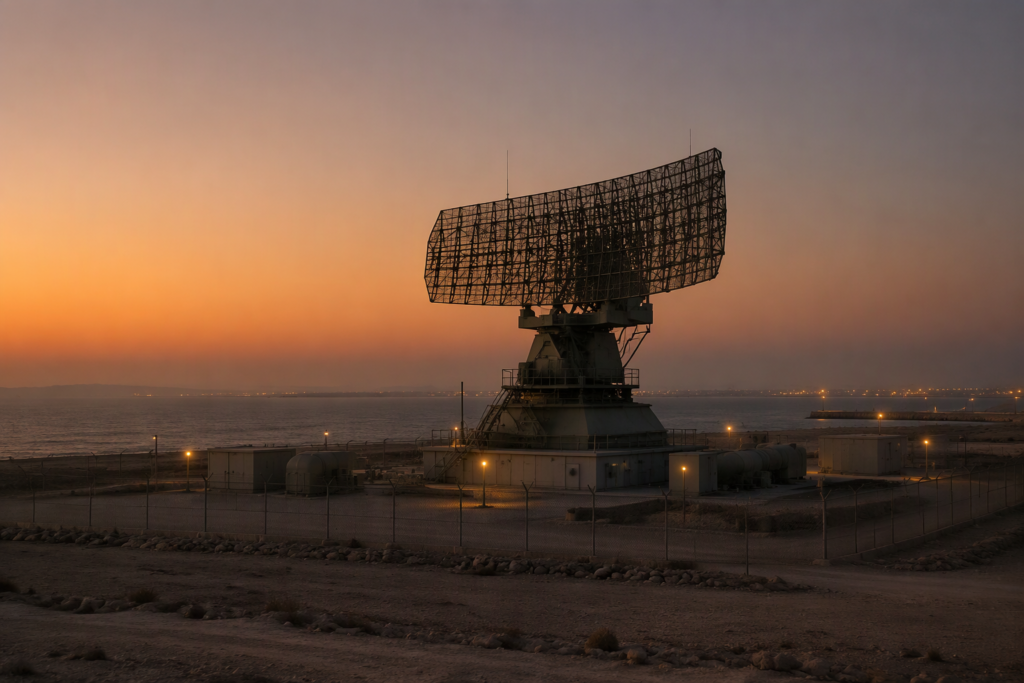
Emergency sirens woke residents across Bahrain before dawn on Sunday as six Iranian drones headed directly for an American military installation on the island. Iran’s Islamic Revolutionary Guard Corps announced it had struck a US radar in Bahrain stationed at Riffa Air Base, marking the second time in three days that Tehran claimed to hit American air defence assets in the Gulf kingdom.
Bahrain’s Ministry of Interior sounded alarms at 4:30 a.m. local time, warning civilians of an incoming threat and urging everyone to move immediately to the nearest safe location. While the Bahrain Defence Force confirmed that its interceptors shot down multiple aerial attacks, the barrage pushes the Gulf region closer to direct escalation between Washington and Tehran.
Also read: Strait of Hormuz: 25 Seafarers Killed as Tanker Attacks Surge
What happens on this small island matters far beyond its borders. Bahrain hosts the headquarters of the US Navy’s Fifth Fleet, which oversees American naval activity throughout the Persian Gulf, Red Sea, and Arabian Sea. Striking radar infrastructure there directly challenges American early-warning networks at a moment when maritime traffic through the Strait of Hormuz is already grinding to a halt.
Two strikes in three days on Riffa Air Base
Sunday morning’s drone launch follows a disputed exchange on Friday, when the IRGC claimed it wiped out an American early-warning radar system in Bahrain. Iran stated that the Friday operation was direct retaliation for an airstrike that hit a telecommunications tower in southern Iran.
The US military’s Central Command flatly denied any radar destruction on Friday, stating that American forces intercepted two Iranian drones without suffering injuries or structural damage. Washington has not yet issued an official assessment of Sunday’s six-drone wave.
Through its affiliated Fars and Tasnim news agencies, the IRGC described the strikes as a serious warning over aerial provocations and alleged oil smuggling. Reuters noted that Friday’s strike was the first time since early September that Tehran publicly claimed responsibility for attacking American military hardware inside a Gulf Cooperation Council state.
Sirens over Manama and the defence response
Bahrain’s Interior Ministry issued two separate public alerts within three hours on Sunday morning. Civil defence officials instructed the public to remain calm while emergency teams monitored the airspace above urban centres and military perimeters.
Military spokesmen for the Bahrain Defence Force announced that national air defence batteries intercepted several hostile targets before they reached their objectives. Even so, the repeated attempts on Riffa Air Base show that Iranian forces are testing gaps in regional air defence networks.
Bahrain has demanded the enforcement of United Nations Security Council Resolution 2817, which condemned attacks on the kingdom and called on Iran to halt cross-border strikes immediately. Tehran, meanwhile, wrote to the Security Council to assert that it will hit back against any Gulf nation that assists American or Israeli combat missions.
Mine strikes and tanker standoffs in the Strait of Hormuz
The aerial assault on the US radar in Bahrain coincides with severe disruptions on the water. The IRGC declared on Sunday that the Strait of Hormuz remains shut, claiming that American naval efforts to escort commercial cargo have completely broken down.
On Saturday, two commercial oil tankers struck naval mines while attempting to transit the narrow waterway. Iranian state media reported that both ships had turned off their tracking transponders and drifted outside authorised shipping corridors. Iranian maritime traffic controllers turned away two other commercial tankers, forcing them to reverse course back into the Gulf.
Iran claims that it exercises joint regulatory authority over the strait alongside Oman, a claim the United States and international maritime bodies reject. With the number of mine detonations climbing, commercial shipowners are refusing to risk crews and vessels in contested waters.
The stalled seven-point peace proposal
Diplomatic talks between Washington and Tehran are deadlocked. Iranian parliamentary speaker and top negotiator Mohammad Bagher Ghalibaf revealed that Tehran submitted a seven-point ceasefire framework through Qatari mediators, seeking an end to what he termed an unstable state of neither war nor peace.
Iran’s demands require the United States to meet specific terms:
- Lift the US naval blockade on Iranian ports.
- Dismantle economic sanctions and unfreeze foreign currency reserves.
- End military strikes on all regional fronts and sign a formal conclusion to the war.
President Donald Trump’s administration has taken the opposite path, enforcing a tighter naval perimeter around Iranian ports and layering on fresh financial penalties. A Pentagon inspector general report published in September revealed that Iranian attacks had already damaged or ruined buildings at American military sites across eight countries since fighting erupted on February 28.
University of Tennessee at Chattanooga associate professor Saeid Golkar warned that limited skirmishes often spiral out of control:
“Both sides may prefer to avoid a full-scale war, but the danger lies in miscalculation.”
All eyes now turn to the United Nations Security Council and the White House, where military planners must decide whether to launch retaliatory strikes against drone launch sites inside Iran or respond through regional diplomatic channels in Doha.
Source: Al Jazeera


