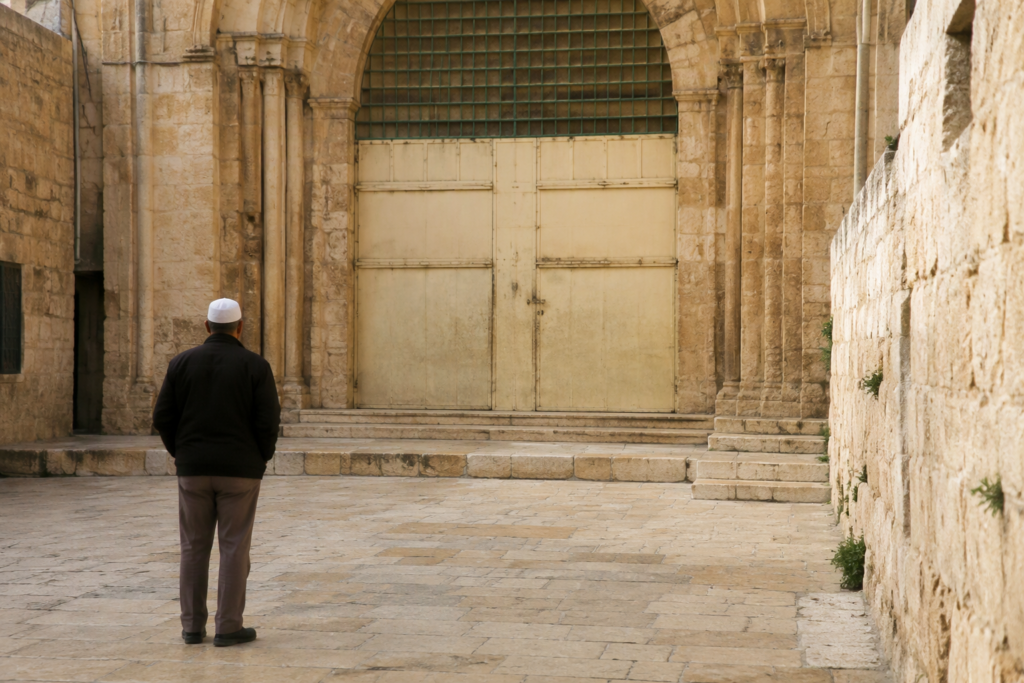

Israeli authorities have ordered the closure of the historic Ibrahimi Mosque in the occupied West Bank city of Hebron to Palestinian worshippers to facilitate access for Jewish visitors marking a holiday.
The decision prevents Muslim worshippers from entering the sacred complex or holding regular daily prayers, while opening the entirety of the holy site exclusively to Jewish visitors and settlers under heavy security arrangements.
Also read: Israel’s President Herzog to Name Candidate to Form Government on Sunday
Impact of the Ibrahimi Mosque Closure on Palestinian Worshippers
The Ibrahimi Mosque, revered by Muslims and known to Jews as the Cave of the Patriarchs, has long served as a focal point of religious and political tensions in Hebron. The complex is divided into separate Muslim and Jewish prayer spaces following security arrangements established decades ago.
Under these regulations, Israeli authorities routinely alter access to the complex during major religious observances. During designated Jewish holidays, the entire holy site is temporarily placed under exclusive access for Jewish worshippers, entirely barring Palestinian residents and Muslim worshippers from entering the grounds.
Heightened Security and Tensions in Hebron
The shutdown is accompanied by tightened military measures, including reinforced checkpoints and strict movement restrictions for Palestinians living in Hebron’s historic Old City. Palestinian officials and religious custodians have consistently condemned such closures, arguing that they constitute an infringement on the fundamental freedom of worship.
Hebron remains one of the most volatile areas in the West Bank, where hundreds of Israeli settlers reside in heavily guarded enclaves within the city center, surrounded by tens of thousands of Palestinian residents. This dynamic frequently results in sharp friction and stringent security measures imposed on local civilian movement.
Ongoing Concerns Over Access to Sacred Sites
Disputes surrounding access to venerated landmarks across the West Bank and East Jerusalem remain a persistent driver of regional tension. Palestinians view the recurring shutdowns of sacred sites as an ongoing effort to alter the religious and cultural status quo of historic heritage locations.
Human rights monitors and local authorities continue to call for international oversight to protect freedom of worship and ensure unhindered access for worshippers at shared religious sanctuaries across the region.
Source: Al Jazeera