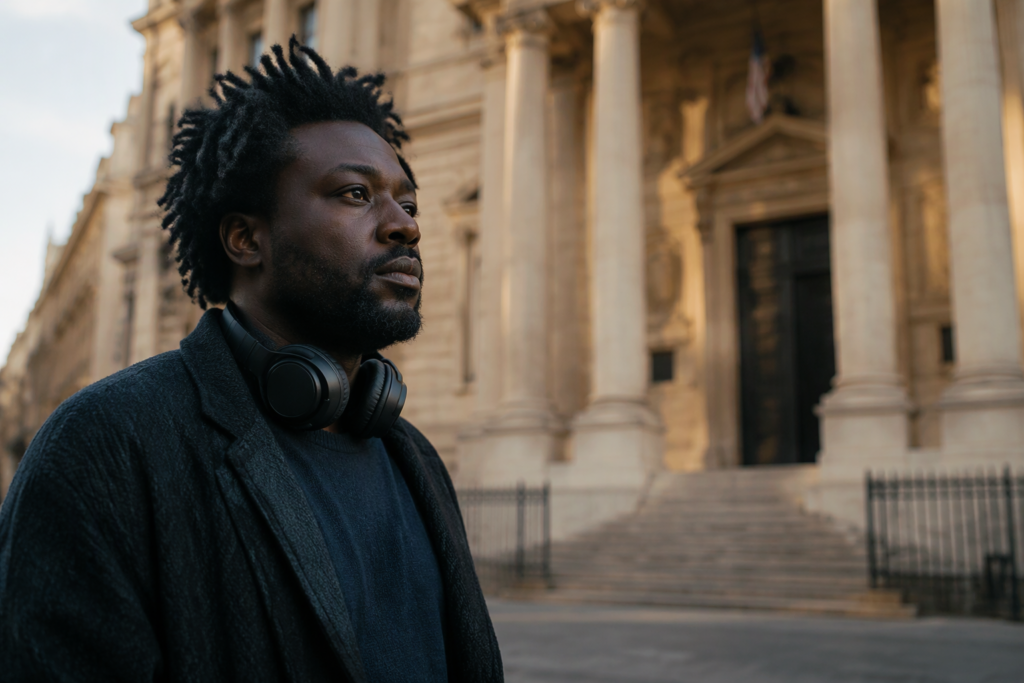
Inside his Paris music studio, Michel Zecler absorbed 29 blows in four minutes, followed by six punches to the face after officers had already snapped handcuffs onto his wrists. Six years after surveillance cameras exposed the assault, France is waiting for judges to deliver their decision in the Michel Zecler trial.
The beating of the Black music producer on November 21, 2020, demolished official accounts within hours once the security recording surfaced online. French football star Kylian Mbappe shared a photograph of Zecler with blood streaming down his face, branding the footage intolerable. The case quickly turned into a national reckoning over police brutality, race and official accountability.
Also read: US Iran Conflict Nears Breaking Point After Gulf Strikes
Now, the court must decide whether to send three officers to prison or endorse what civil rights advocates describe as a pattern of systemic impunity in French law enforcement.
What the security cameras caught inside the studio
The violence began when officers Aurelien Lapersonne, Pierre Plantier and Philippe Tondeux forced Zecler inside his recording studio. The video captured the officers striking him repeatedly until other musicians in the building stepped in to stop the attack.
After the incident, all three officers signed an official report claiming Zecler had attacked them and struck out with his arms and legs. That claim fell apart entirely once investigators reviewed the studio’s security tapes.
During court proceedings, the presiding judge asked Lapersonne directly whether he had invented the story of Zecler attacking police. Lapersonne admitted on the stand that he made it up, adding that he deliberately hid the strikes landed on Zecler out of fear. The officers also face accusations of directing multiple racial slurs at the producer throughout the assault.
Prosecutors demand prison time in the Michel Zecler trial
Public prosecutors told the court that symbolic penalties cannot answer crimes involving violence, racial abuse and an attempted cover-up. They requested permanent professional bans for all three defendants alongside immediate custodial sentences.
The state asked for six years in prison without parole for Lapersonne, who launched the initial identity check and drafted the falsified police document. Prosecutors sought five years for Tondeux, the senior officer leading the group, and four years for Plantier.
“We are talking about crimes, violence and racial slurs. About a complete lack of control over what was done and an absolute determination to get away with it in the end.”
Legal experts argue the case reached trial only because the camera never blinked. Rim-Sarah Alouane, an associate researcher in public law at the University of Toulouse Capitole, pointed out that without the video recording, the falsified paperwork would have shielded the officers from prosecution entirely.
A pattern of profiling across French courtrooms
The fallout from the assault mirrors a longer struggle over discrimination within the French police force. European and domestic tribunals have repeatedly cited state services for biased identity checks.
The record of official findings includes several high-profile rulings:
- The European Court of Human Rights condemned France over officers stopping Karim Touil, a French citizen of North African descent, three times within a single ten-day stretch.
- In 2021, French judges faulted the government for gross negligence over identity checks conducted on three high school pupils at Paris’s Gare du Nord rail station.
- France’s high court acknowledged in October 2023 that racial profiling happens during street stops, though it stopped short of ordering concrete administrative overhauls.
Tactics against street demonstrations have brought fresh scrutiny as well. During recent student protests, a 15-year-old lost a hand to a police stun grenade, while another officer fired a tear gas canister at close range, shattering the jaw and teeth of a 14-year-old.
How a proposed firearm law could shield future officers
The pending ruling in the Michel Zecler trial arrives while French lawmakers debate sweeping legal protections for armed security forces. The National Assembly passed a measure in July that establishes a legal presumption of self-defence whenever police officers or gendarmes fire their service weapons.
The bill now sits before France’s Senate. Critics warn that shifting the burden of proof onto injured citizens and grieving families will foster dangerous impunity and close courtroom doors to victims. Alouane warned that had such rules applied in November 2020, Zecler’s complaint would have been thrown out long before reaching judges.
The Paris court is expected to issue its formal ruling and determine the prison terms for all three officers in the coming days.
Source: Al Jazeera


