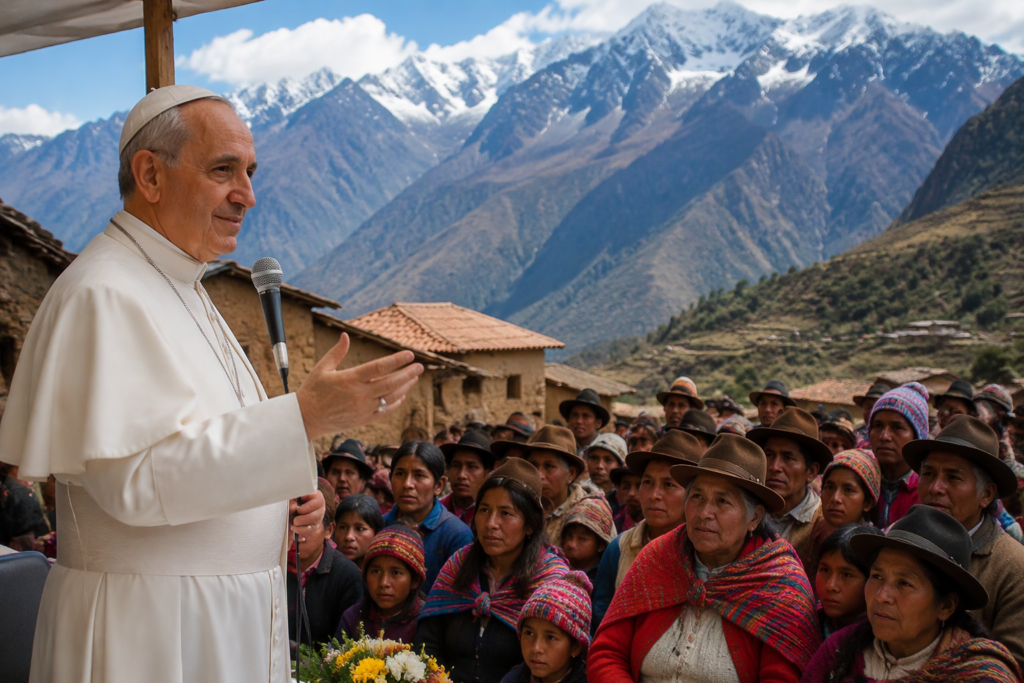

Twenty thousand people packed into an Andean town built for 6,000 on Saturday during the Pope Leo Peru visit, waiting for a white helicopter to land where an American priest once drove a pick-up truck along winding mountain roads.
The homecoming returned the pontiff to the northern communities he guided as a bishop before moving to the Vatican. Pope Leo XIV did not return to Santa Cruz de Succhabamba for an easy celebration. He came to confront the surge of violence in Peru and urge citizens not to answer injustice with brutality.
Also read: US Proposed Ukraine NATO Membership for Ceding Donbas Land
For everyday Peruvians, personal safety has deteriorated sharply across cities and provinces alike. Homicides have nearly doubled over the past five years, while extortion cartels increasingly prey on ordinary shopkeepers and families. By speaking directly from the rural highlands, Leo addressed a population caught between violent criminal syndicates and aggressive state security crackdowns.
A homecoming in Santa Cruz de Succhabamba
The outdoor gathering in Santa Cruz de Succhabamba carried deep personal roots for the visiting pope. A local band greeted his helicopter arrival by singing “Pope Leo, welcome home,” welcoming back a pastor who spent two decades ministering across Peru.
Born Robert Francis Prevost in Chicago, Leo holds dual citizenship in both the United States and Peru. He led the diocese of Chiclayo from 2015 to 2023, frequently driving himself through rugged mountain roads to visit remote Catholic parishes.
On Saturday, Leo stepped before an outdoor congregation that outnumbered the town’s entire population more than three times over. His message focused squarely on resisting the urge to match criminal violence with equal savagery.
“Selfishness, injustice and evil are not overcome by brutality, but by prayer, patience and perseverance in denouncing what is wrong, by making our pleas with determination and working diligently to bring about the necessary changes.”
He told worshippers that lasting reform requires persistent moral action rather than vengeance. When communities meet brutality with brutality, he warned, they risk deepening the cycle of fear that already grips the country.
A country reeling from extortion and rising murders
The pontiff delivered his starkest warnings against the backdrop of alarming crime statistics. Official data cited by The Associated Press shows that Peru’s homicide rate surged from 5.8 to 10.7 per 100,000 people over the last five years.
Extortion has grown at an even more staggering speed across the nation. Reported cases jumped from 2,421 in 2019 to 26,734 reported cases in 2025, leaving small business owners and neighborhood workers vulnerable to constant threats.
Leo addressed that shared fear during an earlier stop at his former cathedral in Chiclayo. He made clear that the Catholic Church shares the pain of citizens living through this breakdown in peace.
“We feel threatened by the uncertainty of widespread violence and by the unspeakable suffering that continues to afflict so many of our brothers and sisters,” Leo told the Chiclayo congregation.
What the Pope Leo Peru visit means for crime policy
Public fear over crime turned security into the dominant issue of the last presidential election. Conservative President Keiko Jujimori took office in July after pledging an uncompromising fight against organized crime.
Her administration immediately rolled out strict emergency measures across major hubs:
- A declaration of a state of emergency across Lima in August
- Emergency prison lockdowns in September targeting facilities holding organized crime figures
- Entry into the US-led Shield of the Americas military coalition to target drug cartels
The partnership with Washington involves joint military operations against cartel networks across the region. Still, Leo’s homilies presented a distinct alternative to relying entirely on armed intervention.
Can militarized crackdowns protect communities without trampling basic civil protections? As the Pope Leo Peru visit made clear, church leaders fear that heavy-handed tactics could punish innocent citizens while failing to cure the roots of lawlessness. If you ignore the social decay beneath the crime wave, brute force will offer only a temporary shield.
The quiet emptying of Andean villages
Alongside street crime, Leo turned attention to the demographic crisis hollowing out the Andes. Falling birth rates and persistent rural isolation have emptied out entire farming towns across the highlands.
Fewer young people remain in the villages where Leo once ministered. Many residents pack up their lives and migrate toward massive coastal metropolises in search of work.
“Let us think, for example, of the suffering of those who are forced to leave their homeland in search of a better future for themselves and their families in the great coastal cities,” Leo said during his Andean Mass.
When villages lose their youth, local economies collapse and leave remaining elders isolated. The pope stressed that regional neglect leaves rural Peru vulnerable to displacement, abandonment, and organized crime syndicates.
As military units prepare joint operations under the Shield of the Americas pact, all eyes turn to whether Jujimori adjusts her hardline security strategy after the pontiff’s direct warning against brutality.
Source: Al Jazeera