

MAPPED: The Critical States Trump and Democrats Are Targeting Before Election Day
As the race for the White House enters its decisive final stretch, the specific states Trump and Democrats are targeting reveal exactly where the presidential election will be won or lost. Both campaigns have narrowed their focus to a handful of battleground states, deploying hundreds of millions of dollars in advertising, intense candidate travel, and mobilized ground operations to secure the 270 electoral votes needed for victory.
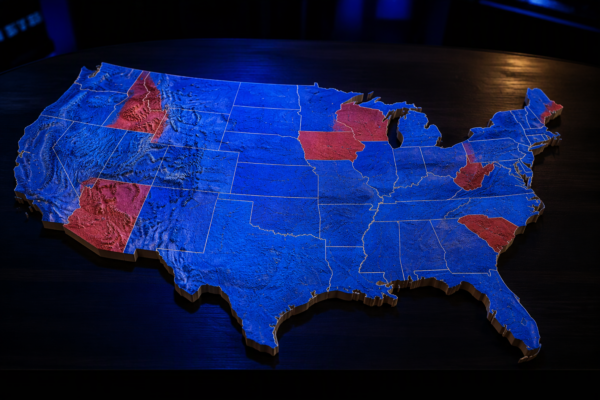
Former President Donald Trump and Democratic nominee Vice President Kamala Harris are concentrating their final campaign blitz on seven pivotal swing states: Pennsylvania, Michigan, Wisconsin, Georgia, North Carolina, Arizona, and Nevada. With national polls showing a razor-thin contest, every stop on the campaign trail reflects a surgical strategy designed to turn out base voters and persuade undecided moderates in key suburban counties.
Also read: Democrats Break Through in Red States From Texas to Kansas
The Seven Core Battlegrounds on the Electoral Map
While the United States spans 50 states, the math of the Electoral College has concentrated the general election into two geographic regions: the northern industrial “Blue Wall” and the rapidly evolving Sun Belt.
- Pennsylvania (19 Electoral Votes): Viewed by both parties as the single most critical prize. Pennsylvania offers the largest electoral vote haul among all traditional swing states.
- Michigan (15 Electoral Votes): A vital industrial battleground where economic concerns, manufacturing, and key suburban constituencies drive turnout.
- Wisconsin (10 Electoral Votes): Decided by less than a single percentage point in four of the last six presidential elections, making turnout in rural communities and suburban counties decisive.
- Georgia (16 Electoral Votes): A Sun Belt battleground where rapid growth in metro Atlanta balances strong rural conservative participation.
- North Carolina (16 Electoral Votes): A perennial target for Democrats seeking an offensive flip, while Republicans fight to protect their southern stronghold.
- Arizona (11 Electoral Votes): Border policy, independent voters, and shifting demographics make this southwestern state a central focus.
- Nevada (6 Electoral Votes): Dependent on service-industry union mobilization in Clark County and working-class economic sentiment.
The Key States Trump and Democrats Are Targeting in the Final Stretch
Campaign schedules and media buys show that both operations are pouring the vast majority of their resources into these seven states. According to ad tracking data, over 90 percent of general election advertising expenditure is flowing directly into these select media markets.
The Northern “Blue Wall” Strategy
For Democrats, retaining the Great Lakes trio of Pennsylvania, Michigan, and Wisconsin provides the clearest and most direct mathematical path to 270 electoral votes. The Harris campaign and high-profile Democratic surrogates have made frequent stops across Philadelphia’s collar counties, Detroit’s automotive hubs, and the Fox Valley in Wisconsin. Their message centers on reproductive freedom, middle-class tax relief, and manufacturing investments.
Conversely, the Trump campaign has focused heavily on blue-collar communities throughout western Pennsylvania, rural Michigan, and small-town Wisconsin. The Republican ticket emphasizes inflation, the cost of living, energy independence, and international trade tariffs to peel away traditionally union-aligned working-class voters.
The Sun Belt and Southwestern Contests
In the Sun Belt, both campaigns are fighting for dynamic, fast-growing electorates. Donald Trump has held massive rallies across Georgia and North Carolina, aiming to reclaim Georgia after narrowly losing it four years ago. The Republican ground game focuses on driving massive turnout in exurban and rural areas to offset Democratic strength in major metropolitan centers.
Democrats, meanwhile, see Arizona and Nevada as vital components of an alternative path to the presidency. Ground teams in Phoenix, Tucson, Reno, and Las Vegas are prioritizing outreach to Latino voters, young voters, and suburban women, focusing heavily on abortion rights and protections for local workers.
Ground Games, Microtargeting, and Ad Spending
Beyond rallies, the strategic battle is defined by sophisticated field operations. Campaign headquarters have deployed thousands of field organizers and tens of thousands of volunteers to knock on doors, send text messages, and coordinate mail ballots.
Early voting and mail-in balloting periods have transformed Election Day into an election month. Both parties are closely tracking early return ballots in key counties such as Maricopa in Arizona, Fulton in Georgia, and Allegheny in Pennsylvania. By securing early votes, campaigns can focus their remaining volunteer power on turning out lower-propensity voters on Election Day itself.
What Happens Next
In the remaining days before polls close, candidate travel will intensify across local airport hangars, university campuses, and local businesses in these target areas. Surrogates, including former presidents and popular state governors, will saturate regional media markets. As final ad reservations lock in, neither campaign can afford to overlook any precinct across these pivotal states.
Conclusion
The race for the presidency has converged on a clear map. As voters cast their ballots, the critical states Trump and Democrats are targeting will ultimately decide who secures the 270 electoral votes required to lead the nation for the next four years.


1 Comment
Comments are closed.