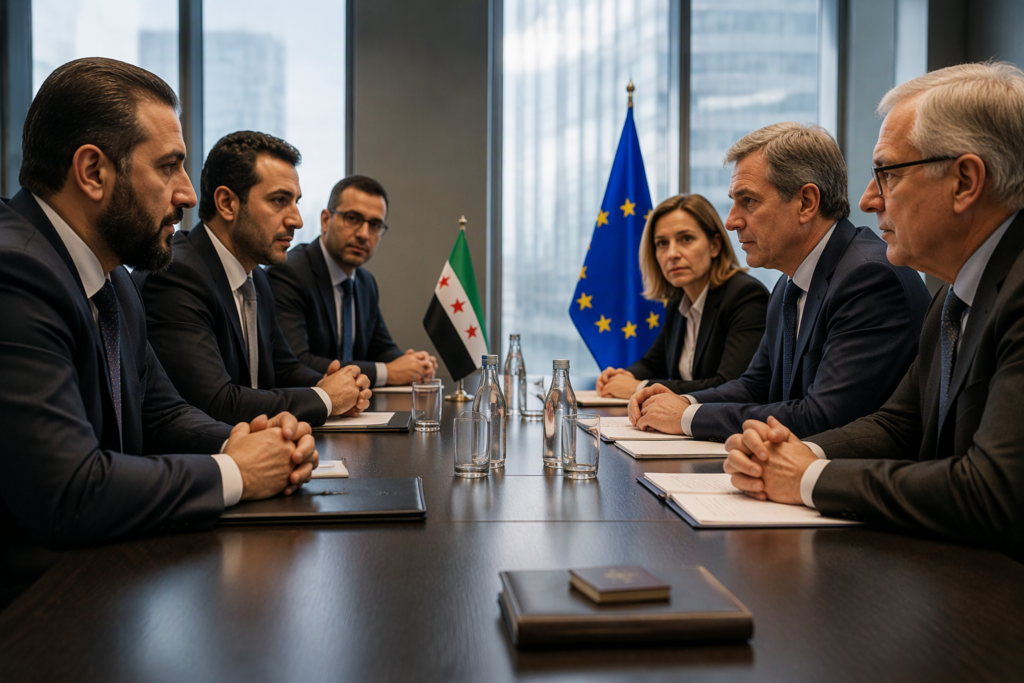
European negotiators want a fast exit for hundreds of thousands of refugees, while Damascus wants billions in frozen assets and an immediate end to trade penalties. As high-stakes Syria-EU talks progress toward ending a 15-year diplomatic freeze, current and former European envoys warn that domestic anti-immigration politics in Europe threatens to swallow the entire agenda.
The push to restore formal relations between Brussels and Damascus follows the collapse of Bashar al-Assad’s dictatorship. A new administration led by President Ahmed al-Sharaa has stepped in, eager to rebuild a ruined economy and re-establish international standing after more than a decade of isolation.
Also read: Strait of Hormuz Talks: Iran Urges US to Accept Terms
For millions of displaced people and for European taxpayers funding Middle Eastern aid, what happens at the negotiating table will decide whether returns are voluntary and safe, or rushed to appease European voters. If European capitals push people back into ruined towns without basic water and electricity, they risk igniting fresh unrest.
What Syria-EU talks mean for refugees and sanctions
Formal contact between the two sides broke down in 2011, when Assad crushed peaceful street protests with tanks and artillery. In response, the European Union moved its diplomatic delegation to Beirut, enacted sweeping European Union sanctions, and barred top regime officials from travel.
Brussels took its first big step toward normalisation last year by lifting broad economic penalties, though restrictions on state bodies and dual-use goods remain in place. In January, the EU followed up with a two-year aid package worth 620 million euros ($680 million). Then in May, officials staged their first high-level political dialogue to map out a path forward.
Diplomacy accelerated this month when Jonas Jonsson, head of the Middle East and North Africa division at the European External Action Service, met Sally Shobat from Syria’s European Affairs Directorate. That meeting followed Shobat’s direct talks with Belgian, Cypriot, and French diplomats.
Kaja Kallas, vice president of the European Commission, confirmed that legal teams are preparing ways to reestablish political and trade relations. The farthest apart the priorities could be, the further apart the positions on the table.
The political scramble over Syrian refugees
From 2011 to 2024, more than a million Syrians sought refuge in Europe. With Assad out, many European governments are under increased pressure from the far-right to carry out mass deportations.
Several European capitals moved quickly after the change of government in Damascus, freezing Syrian asylum applications under the argument that the dangers of war had vanished. Around one million Syrians have returned home since Assad fell, though almost all moved back from neighboring states like Lebanon, Jordan, and Turkey rather than Europe.
Aid workers in Syria say the country is not prepared for large scale immigration. Tariq Azeez, Policy Coordinator at the International Rescue Committee said, returnees face destroyed and shattered houses, and cut off basic services. They have to compete with their neighbors for already scarce basic resources.
“As the European Union deepens ties with Syria, returns cannot become the price of that relationship,”
A former European diplomat explained that right-wing populists across EU member states tend to view the country purely as a border problem. That approach ignores the economic contributions Syrians make across Europe, while brushing aside the realities of post-war reconstruction.
Energy corridors, trade traps, and Assad regime assets
Damascus is not coming to the table empty-handed. Ahmed al-Sharaa has pitched Syria as an indispensable transit hub for European energy security, particularly after shipping through the Strait of Hormuz suffered severe disruption during the US-Israeli conflict with Iran that broke out in February.
In April, al-Sharaa unveiled his Four Seas and Nine Corridors Initiative, which proposed an oil pipeline network through Syria and Turkey, linking the Caspian, Mediterranean, Black Seas and the Gulf. Damascus has utilised its security cooperation against ISIL to build goodwill in Western capitals.
Can Syria protect its local producers if European goods flood back in? Economists see a major trade imbalance ahead if negotiations stumble on market access:
- Syrian exports remain limited primarily to farm produce and basic pharmaceuticals.
- A unilateral opening could overwhelm domestic businesses with manufactured European imports.
- Unresolved tariff rules could block Syrian goods from entering the European common market.
Damascus is also seeking the international community’s assistance to track down and recover tens of billions of dollars worth of assets looted from the Assad regime that are being held in European banks and financial centres.
Human rights red lines in Brussels
Despite the momentum in the Syria-EU talks, Brussels insists that full normalisation will carry strict political conditions. Kallas stated on November 16 that engagement is necessary to prevent rival powers from filling the void in Damascus, but stressed that human rights commitments must be codified in any formal pact.
Brussels also expects Damascus to formally renounce Assad’s diplomatic recognition of Russian-occupied territories in Ukraine and Georgia. European diplomats acknowledge, however, that keeping human rights at the center of the agenda will prove difficult as right-wing leaders across Europe demand rapid repatriation above all else.
Technical and legal teams are reviewing the draft text in Brussels and European foreign ministers are expected to review the text before the end of the year.
Source: Al Jazeera


