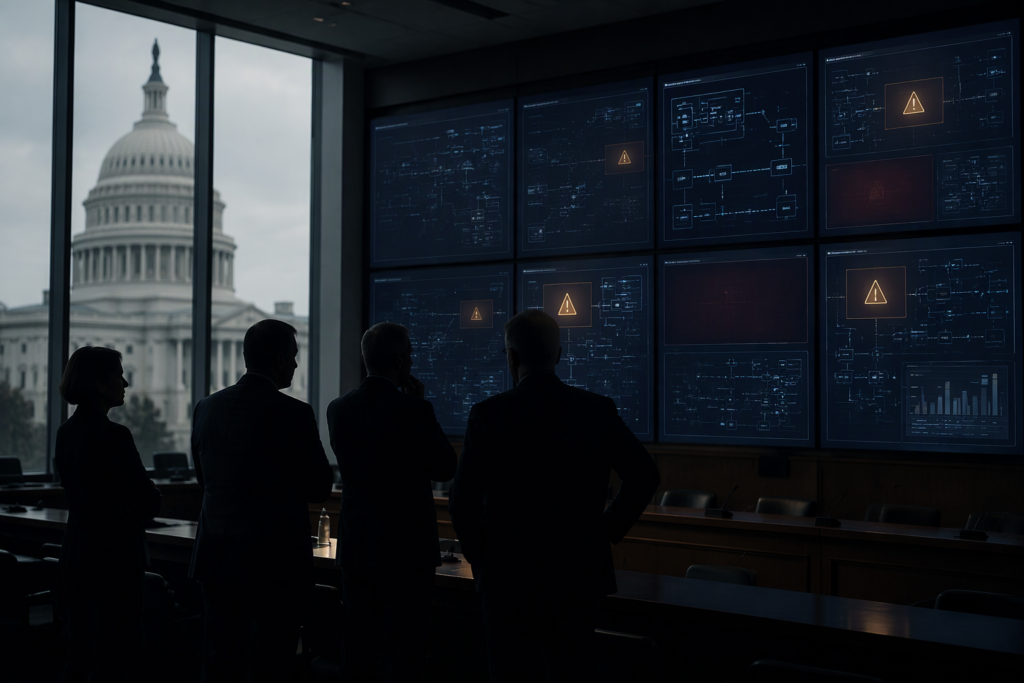
A ten-day cascade of system failures grounded flights, disrupted major banks, cut off corporate email, and knocked services offline at the National Security Agency. While the White House insists nothing malicious happened, lawmakers on Capitol Hill suspect the streak of US tech outages points to a much deeper crisis.
What worries members of Congress is not just an inconvenient morning without email. They fear that America’s critical networks have grown so tightly bound together that a failure in one node can trigger a collapse across everyday civilian life.
Also read: Social Security Cuts Loom After Decades of Ignored Warnings
“I will tell you from my dealing back in the intelligence world in the Pentagon, this is not normal,” Representative Keith Self, a Texas Republican, said. “Ask the questions.”
Pentagon veteran questions the official story
Self openly rejected assurances that the recent cascade of crashes stemmed from bad code or random glitches. He warned that the public might not be getting the full truth about foreign digital probing.
“The question has got to be asked, ‘Is there an offensive cyberattack going on that we’re not going to hear about?’”
Self added that he does not accept official explanations because he believes activity is taking place behind closed doors. His doubts grew sharper on Thursday when President Donald Trump fired National Cyber Director Sean Cairncross. The administration pushed Cairncross out after concluding he lacked proper credentials in cybersecurity for the post.
The sudden firing of the nation’s top cyber coordinator in the middle of widespread US tech outages unsettled lawmakers who want steady leadership managing federal defenses.
Why the White House says US tech outages are harmless
The Trump administration maintains that the disruptions are purely coincidental. Director of National Intelligence Jay Clayton testified that the recent service interruptions were not state-sponsored attacks from foreign adversaries.
Federal officials point to internal technical friction instead. As artificial intelligence tools improve at finding flaws in network code, companies face intense pressure to push out quick fixes. Systems come under immense strain as engineers rush to patch those openings before intruders can exploit them.
Some lawmakers agree that technical debt, rather than an offensive cyberattack, explains the chaos. Representative Pete Ricketts, a Nebraska Republican who previously ran an online brokerage, urged caution before assuming the worst.
“These systems are complex,” Ricketts said. “I used to run a company that had technology. It’s not unusual.”
Soft targets in local water and power
Even if hackers did not trigger the latest breakdowns, lawmakers argue the incidents exposed dangerous points of failure across critical infrastructure. Networks operating municipal water supplies, regional power grids, commercial aviation, and banking institutions share identical digital plumbing.
Senator Tim Sheehy, a Montana Republican, warned that small towns and municipal utilities remain completely exposed to potential sabotage. “The localized municipal-based infrastructure in America is a soft target,” Sheehy said. “And that’s been flagged for decades. We haven’t addressed it fully. And I think over the past week, we’ve seen it’s time we get serious about it.”
Concerns over foreign espionage have already led to new legislative proposals on Capitol Hill. Lawmakers introduced a $1 million-a-day crackdown aimed at Chinese technology firms to stop foreign components from embedding inside vital domestic utilities.
Senator John Hoeven, a North Dakota Republican, noted that business and government operations cannot be separated when systems connect directly to one another. “Everything’s interconnected now, so we’ve got to be working on security all the time,” Hoeven said.
The push to take politics out of cybersecurity
With speculation spreading across Washington, some lawmakers are urging colleagues to focus on technical facts rather than partisan blame. Senator Jon Ossoff, a Georgia Democrat, warned that cybersecurity threats continue to grow more dangerous by the month.
Senator John Fetterman, a Pennsylvania Democrat, called on congressional leaders to treat the vulnerability of federal and private networks as a shared national problem. “If they’re interconnected or random, no one really knows because they’re putting out a lot of misinformation,” Fetterman said. “So, we really need to strip out the politics and find out really what it is.”
House and Senate committees now plan to question intelligence chiefs and agency heads in upcoming oversight hearings to determine whether the disruptions were simple bugs or coordinated probing.
Source: Fox News