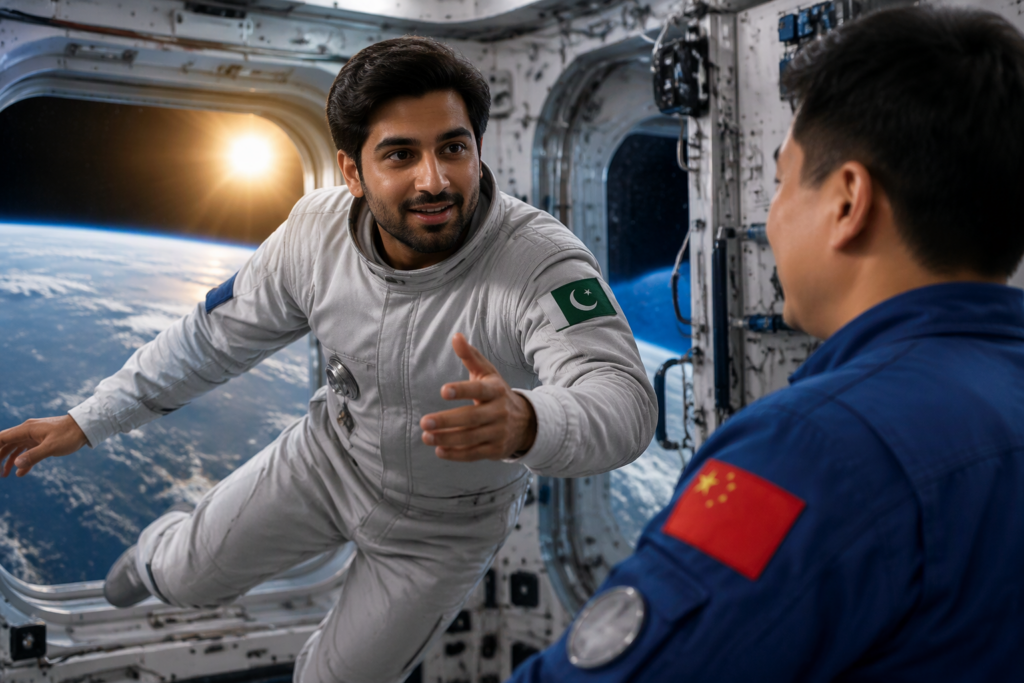

In a historic development for South Asian aerospace ambitions, a Pakistani astronaut is set to join an upcoming mission to China’s space station. The planned voyage marks a significant step forward in bilateral relations and signals expanding international participation in Chinese space exploration initiatives.
Historic Milestone for a Pakistani Astronaut
The selection and deployment of a Pakistani astronaut to the Chinese orbital facility represents a landmark achievement in the country’s scientific history. It paves the way for Pakistan’s direct presence in human spaceflight and highlights the growing maturity of its national space program.
Also read: ‘Alien-Cortical’ Mice: Can Human Brain Cells Grow Inside Animals?
Crew members traveling to the station undergo extensive preparation to handle microgravity environments, operational protocols, and orbital procedures. By sending a national representative to an active orbital laboratory, Pakistan joins a select group of nations whose citizens have engaged in human space missions.
Strengthening China-Pakistan Aerospace Cooperation
The mission builds on decades of strategic collaboration between Islamabad and Beijing, which has increasingly extended into advanced technology, satellite development, and scientific research. China’s aerospace authorities have consistently indicated a willingness to open their space station to international partners, scientific payloads, and foreign crew members.
Collaborative efforts between both nations have previously produced communications and remote-sensing satellites. The inclusion of a crew member on a human spaceflight mission takes this technical relationship to a new level, reinforcing long-standing diplomatic and strategic ties through cutting-edge science.
Scientific Research and Mission Objectives
While in orbit, the space crew is anticipated to participate in scientific experiments, technical demonstrations, and routine space station operations. The Chinese orbital laboratory provides a state-of-the-art environment for microgravity science, life sciences, materials research, and Earth observation.
The research carried out during the mission could provide valuable data for institutions in Pakistan and contribute to broader global understanding in specialized scientific domains. Technical teams on the ground will also gain critical experience in managing human spaceflight operations and ground-to-space coordination.
Looking Ahead in Global Space Exploration
As international partnerships in low Earth orbit evolve, missions that bring together multiple countries are becoming essential for sustainable space exploration. Pakistan’s involvement in China’s space station reflects a broader trend of developing spacefaring nations gaining access to space infrastructure through multilateral pacts.
The upcoming mission is expected to inspire future generations of engineers, researchers, and students across Pakistan while solidifying the role of international cooperation in unlocking scientific progress beyond Earth.
Source: Al Jazeera