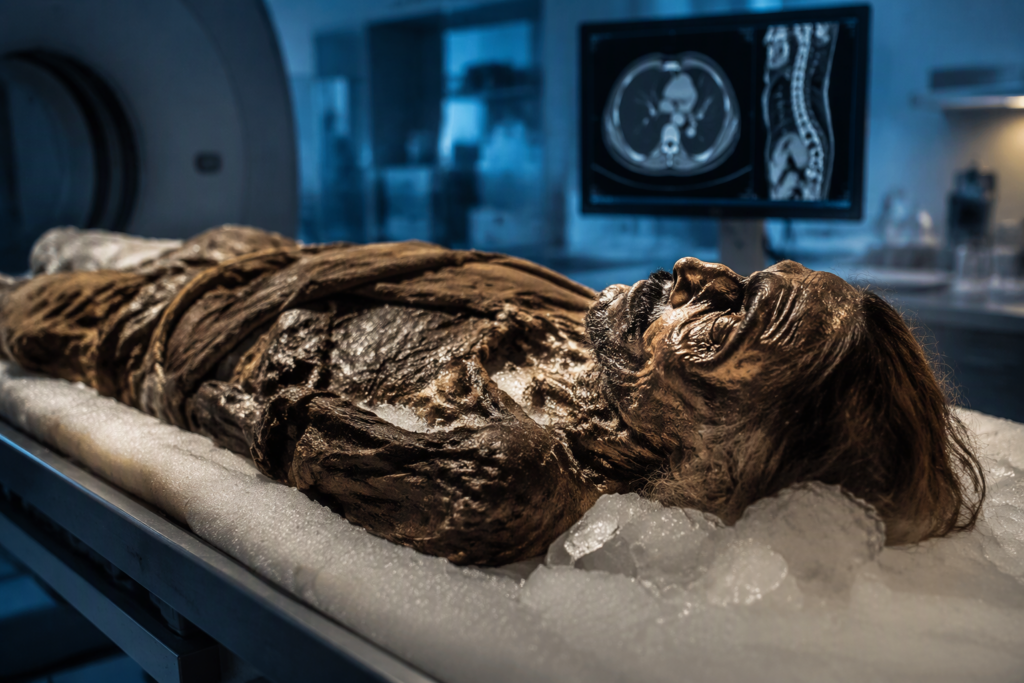

When Ötzi the Iceman died high in the Alps more than 5,000 years ago, he carried a personal supply of medicinal fungi that acted as an early pharmacy. As Europe’s oldest naturally preserved human mummy, his frozen body has given researchers direct proof that ancient Europeans understood how to treat sickness with nature. This kit shows how Copper Age travelers managed illness and pain on unforgiving terrain long before written records existed.
His gear was not limited to weapons and cold-weather clothing. Among his possessions, scientists identified specific fungi known to carry antiviral and antibacterial properties. The discovery reveals that early humans did not just survive day to day; they actively treated infections and physical ailments with tailored prehistoric medicine.
Also read: Mysterious Carvings Found in Queen Charlotte’s Palace Reveal Historic Secrets
The prehistoric medical kit hidden in the ice
Researchers studying Ötzi’s belongings describe his gathered supplies as one of the oldest known prehistoric medical kits. The fungi he carried were carefully prepared and kept on leather cords, proving he packed them deliberately rather than gathering them by accident.
These wild mushrooms provided active remedies against pathogens. Modern laboratory analyses of these species confirm they possess strong antibacterial compounds. Ötzi likely ingested or applied them to fight stomach parasites and intestinal bugs that troubled him during his trek across the mountains.
Tattoos matching modern acupuncture sites
The remedies extended beyond what Ötzi carried in his pouch. His skin features dozens of distinct tattoos, primarily simple lines and crosses grouped around his lower back, knees, and ankles. Rather than being ornamental, these marks closely match modern acupuncture sites used to treat joint strain and chronic pain.
This correlation suggests Ötzi received targeted therapeutic medicine to soothe physical wear from climbing alpine ridges. Medical scans show he suffered from severe joint degeneration in his spine and legs. The placement of the tattoos indicates that prehistoric healers recognized nerve pathways and pressure points thousands of years before formal acupuncture systems were recorded in Asia.
What Ötzi tells us about ancient healthcare
Ötzi’s preserved body challenges the idea that Stone and Copper Age people relied solely on superstition to treat physical sickness. Instead, his equipment shows an empirical approach to survival:
- Carrying specific dried fungi with verified antiviral and antibacterial properties.
- Using targeted skin markings over arthritic joints to alleviate inflammation.
- Packing survival tools alongside natural treatments to endure harsh high-altitude travel.
Researchers studying the mummy continue to analyze his tissue and belongings for chemical residues of other plants. Their next focus is mapping the precise chemical compounds within his fungal remedies to see if ancient mountain communities cultivated specific fungal strains for targeted healing.
Source: BBC