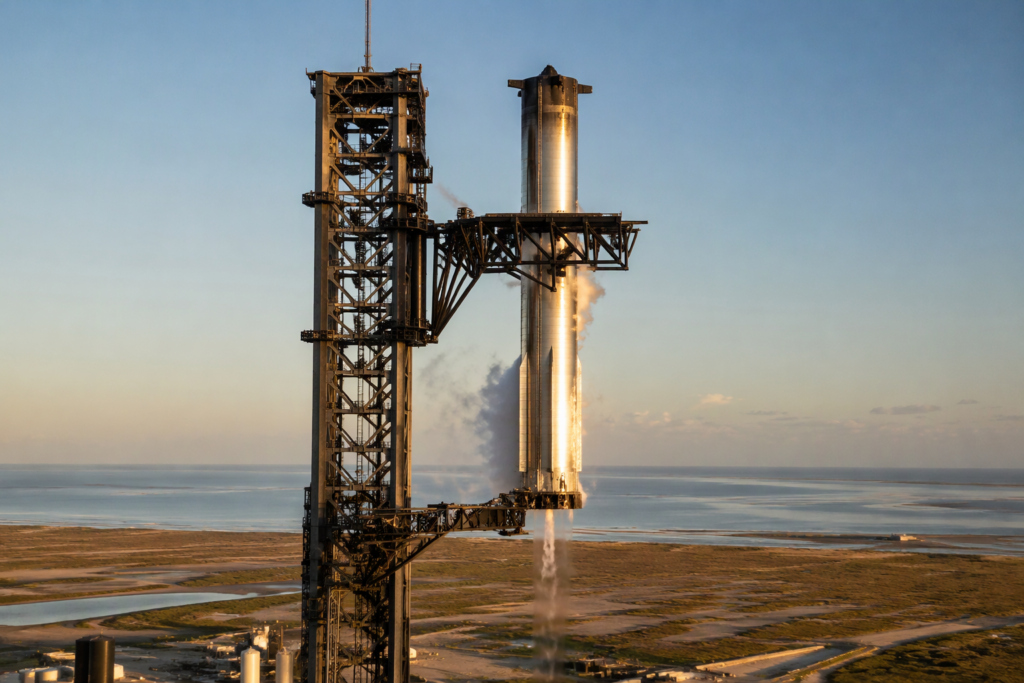

A spacecraft plummeted toward Earth through scorching heat before settling directly into a pair of steel pincers at the launch tower. The historic SpaceX Starship catch proved the company can snag its massive returning spacecraft directly out of midair rather than ditching it in the water.
For space travel economics, catching vehicles on the pad eliminates splashdowns, ocean recovery ships, and weeks of refurbishment. If engineers can reuse both stages quickly, launch turnaround times shrink from months to days.
Also read: Starship Flight 15 Launches for First Dual Catch Attempt
The recovery did not go completely to plan, however. While the upper stage survived, the massive booster failed its own return sequence earlier in the mission.
How the SpaceX Starship catch unfolded
The mission marked the 15th Starship test flight and represented the company’s first bid to recover both parts of the vehicle in a single launch. As the upper stage, known simply as the Ship, descended toward the base, launch personnel tracked its trajectory back to the pad.
The tower caught the craft using giant mechanical arms chopsticks fans have come to watch closely. The metal claws closed around the vehicle as it hovered near the launchpad structure, securing it in place intact.
Over the official broadcast feed, engineers celebrated the touchdown while the 1970s soft-rock hit “Baby Come Back” by Player blared in the background.
Why the booster recovery was aborted
Flight controllers faced trouble during the early minutes of the flight. The mission called for capturing the heavy rocket booster on the same launch tower arms shortly after liftoff.
Technicians called an abort on that first attempt just minutes into the launch. Automated safety protocols immediately diverted the booster away from the facility and out over the open ocean.
The rocket booster burst into flames just above the sea surface before crashing into the water. Flight engineers accepted the loss to keep the ground infrastructure safe from a catastrophic pad impact.
What Dan Huot and SpaceX said about the catch
Despite the booster loss, SpaceX leadership treated the upper-stage capture as a historic breakthrough for space exploration. Company spokesperson Dan Huot put the technical achievement in perspective immediately after the clamp shut.
“That was the Holy Grail of space flight, plummeting through fire to be snatched out of the air by steel. We caught a Starship and now everything changes,” AFP reports SpaceX spokesman Dan Huot as saying.
The capture validated years of risky pad engineering designed to catch falling hardware before it strikes the ground. Reusable flight hardware has long stood as Elon Musk’s primary goal for lowering the cost of reaching orbit.
What happens next for the Starship test flight program
Engineers now turn their attention to inspecting the recovered Ship for thermal damage, structural warping, and engine wear. Teams must examine whether the airframe sustained severe stress while decelerating through the atmosphere before the mechanical arms chopsticks secured it.
SpaceX will also analyze telemetry data to pinpoint why the initial booster attempt aborted over the water. Technicians need to fix the booster guidance problem before they try another dual recovery.
The company will prepare another prototype at its Starbase facility in Boca Chica, Texas, for the 16th test flight in the coming months.
Source: BBC