
European delegates will finally have a seat at the table in upcoming Russia-Ukraine peace talks, following an intense day of cross-continental shuttle diplomacy by American envoys.
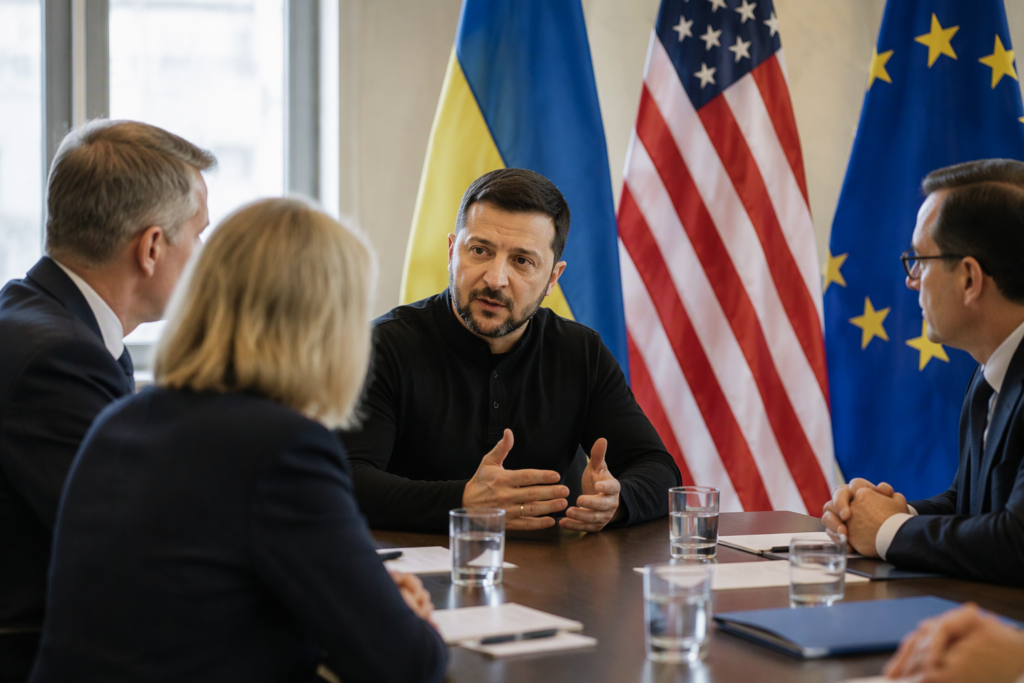
Ukrainian President Volodymyr Zelensky confirmed the shift late Thursday in Dublin after meeting US representatives Jared Kushner and Steve Witkoff. The pair flew into Ireland fresh from discussions in Moscow with Russian President Vladimir Putin, who told them his territorial demands remain entirely unchanged. For leaders in Kyiv and across Europe, securing a direct voice in these discussions addresses months of quiet dread that Washington might broker a settlement over their heads.
Also read: Ukraine and Russia Drone Race Accelerates Across Eastern European Skies
The stakes could hardly be higher for the continent. With Russian forces holding roughly one-fifth of Ukraine and regular cross-border incursions rattling front-line states, European capitals view the outcome of any negotiated settlement as an existential question for their own borders.
Why Europe pushed for a seat in Russia-Ukraine peace talks
Zelensky has lobbied for European representation in peace negotiations for years. His reasoning is straightforward: Ukraine plans to eventually join the European Union, meaning any post-war security framework will directly intertwine with Brussels.
Kushner noted on Thursday that Washington has been coordinating with European allies over recent months to prepare for this step. He said he made the case directly to Putin in Moscow that European delegates must participate in the process.
Moscow has historically brushed off European involvement in diplomatic efforts, preferring bilateral discussions with the United States. Yet top EU officials see the new invitation as a sign that the diplomatic terrain is shifting.
European Commission Vice President Kaja Kallas, the bloc’s foreign policy chief, observed that having European delegates at future sessions shows Moscow has finally recognised that Europe cannot be sidelined. Even so, Kallas cautioned that she sees little evidence of genuine Russian willingness to conclude a lasting peace deal.
A massive prisoner swap after stalled Abu Dhabi meetings
The sudden diplomatic movement in Dublin follows discussions held in Abu Dhabi last week, which ended without any breakthrough on ending the fighting. Despite the deadlock on core territorial disputes, the negotiations did produce one tangible result: a massive new prisoner exchange.
Both sides agreed to what officials describe as the largest prisoner swap since Russia launched its full-scale invasion in February 2022. Kushner confirmed the agreement on Thursday, stating the arrangement would return thousands of people to their families.
Neither Washington, Moscow, nor Kyiv released a specific timetable or confirmed the exact headcount of detainees included in the trade. Still, the swap represents a rare instance of functional coordination between the warring nations amid continuous battlefield clashes.
Growing alarm among EU leaders meeting in Dublin
While the US envoys briefed Zelensky in Dublin, European heads of government gathered in the Irish capital were sounding direct alarms about regional stability. Irish Prime Minister Micheál Martin told reporters that the invasion has fundamentally reordered continental defense.
“Many member states feel an existential threat because of what has happened in Ukraine and the potential, if Ukraine was to fall, for further aggression on the European continent.”
That worry has driven European governments to demand oversight of any American-led diplomatic tracks. European leaders have watched Washington closely, harboring concerns about whether future American commitments to continental defense might soften.
Tensions over Starshield satellite access on the front lines
Diplomatic handshakes in Dublin did not completely hide the real strains running between Kyiv and Washington. Just hours before sitting down with Kushner and Witkoff, Zelensky voiced public frustration over sudden operational hurdles on the battlefield.
Zelensky revealed that Ukrainian forces are dealing with systematic service limits on Starshield, the military-grade satellite network run by Elon Musk’s SpaceX. The satellite network provides critical communication links for troops and government offices across the country.
Because of these growing curbs, Ukrainian air defense units have faced steep challenges tracking and shooting down Russian jet-powered strike drones. The issue exposes how dependent Kyiv remains on private and foreign technical infrastructure while trying to hold the line.
Negotiators have not yet set a public date or location for the next formal round of Russia-Ukraine peace talks that will include European Union representatives.
Source: BBC