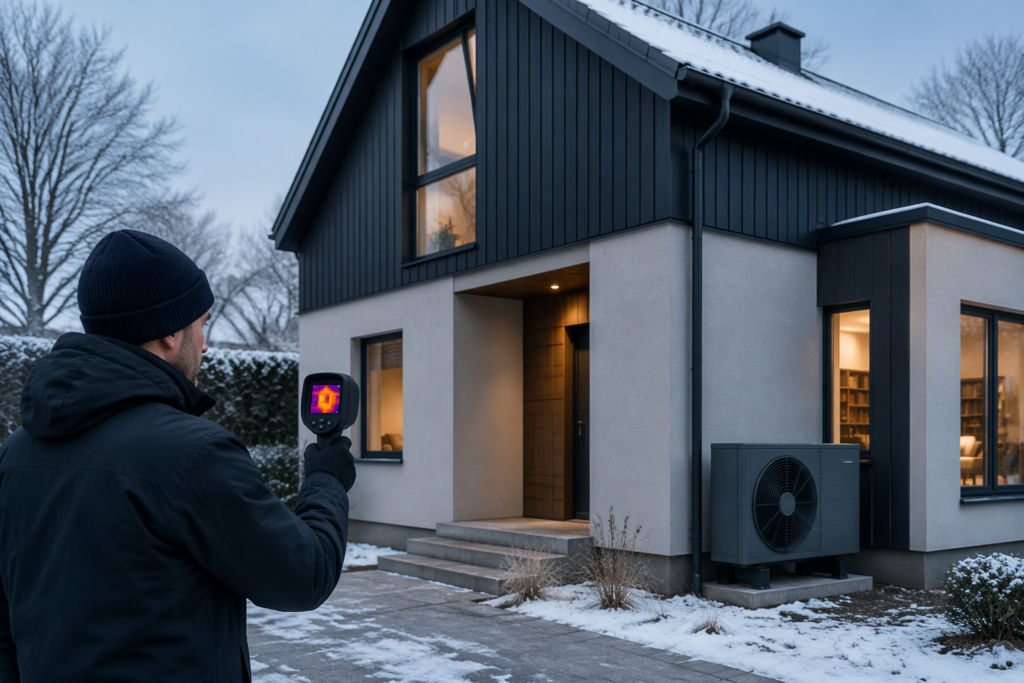

Heating engineers routinely double the amount of heat a home actually loses, sticking property owners with oversized equipment and huge utility bills. A proper heat loss calculation is meant to measure exact room-by-room demand in cold weather, yet research shows professional estimates frequently miss the mark by alarming margins.
For anyone switching away from fossil fuels, that discrepancy is expensive. A heat pump requires precise sizing to work efficiently; if an installer overestimates your property’s heat demand, you end up paying for machinery that wastes electricity, wears out prematurely, and never quite keeps you comfortable.
Also read: Microsoft AI Beats Doctors in Simulated Diagnosis Test, Study Shows
Now, skeptical homeowners are taking measuring tapes and thermal software into their own hands to challenge the quotes landing on their kitchen tables.
Why contractors double the numbers
Researchers at Purdue University discovered that heating contractors in the United States often overestimate a home’s heat needs by a factor of two or more. Kevin Kircher, who led an unpublished study reviewing surveys delivered to roughly 75 homeowners, found widespread inflation in design heat loads.
Those inflated assessments do not come cheap. Homeowners in the study reported paying more than $1,000, and in one instance up to $2,500, simply for a contractor to conduct an on-site survey.
Installers often add heavy safety margins out of habit. Older gas and oil furnaces could easily overpower a home without immediate operating penalties, but heat pumps do not forgive that kind of guesswork. When installers apply old habits to new technology, the buyer pays the penalty twice: once for an oversized unit, and repeatedly on monthly electric bills.
The hidden cost of an oversized system
Buying more heating power than your home demands does not make the house cozier. In fact, it often makes living spaces noticeably less pleasant.
Dan Dempsey, a former senior engineering fellow for a major heating and cooling equipment manufacturer, spent five years tracking performance data from smart thermostats installed in homes across Indiana. He saw firsthand what happens when an installer botches the math.
“I spent five years manually downloading everything, every week.”
Dempsey observed that oversized machines cycle on and off constantly rather than running at a steady, efficient pace. This rapid cycling prevents rooms from holding a stable temperature, causing rooms to swing above and below a target setting like 20C. The constant starting and stopping also strains mechanical components and cuts the equipment’s lifespan.
Homeowners turning to DIY apps and software
Confronted with high quote prices and dubious estimates, property owners are calculating thermal numbers on their own. Cool Calc, a software tool designed to assess property heating demand, now registers about 150 new users every day. More than a third of those signups come directly from private property owners rather than heating professionals, according to founder and chief executive Bill Fiore.
Fiore notes that while homeowners want reliable data, many turn to unvetted sources first. Generic artificial intelligence chatbots frequently generate inaccurate numbers because they lack validated engineering inputs, prompting Cool Calc to develop direct chatbot integrations to provide verified figures.
In the United Kingdom, similar platforms are catching on. Andy Rankin, managing director of Midsummer Energy, reports that thousands of users log into their Heatpunk design software monthly to map floor plans, match radiator sizes, and review equipment options. Another British installation outfit, Dwellow, recently introduced its own estimation tool.
Dwellow co-founder Ian Mclaren says preliminary homeowner surveys could streamline initial site visits into half-hour verification checks, trimming time and labor expenses.
Why a heat loss calculation misses what hides behind walls
Taking over the engineering work carries serious pitfalls of its own. Some industry specialists argue that pushing heat loss calculation tasks onto residents is a recipe for frustration.
Maurizio Sibilla, an engineering researcher at the University of the West of England in Bristol, stresses that fixing the industry requires better installer training and post-installation monitoring, not leaving consumers to double-check structural engineering on their weekends.
Hidden building defects can also scramble software calculations instantly. Adam Chapman of the installer network Heat Geek argues that do-it-yourself modeling often overlooks invisible flaws that only experienced technicians catch on site.
- Retrofit window installations that lack insulating foam around the frame gaps
- Cavity walls that builders never actually filled with insulation
- Undersized existing distribution pipework and hidden drafts
These structural defects will completely throw off a DIY heat loss calculation, leaving you with an underperforming system even after hours of careful measuring. For now, Purdue University researchers are preparing their complete survey data for formal publication, while heating networks push for stricter audit rules across the trade.
Source: BBC