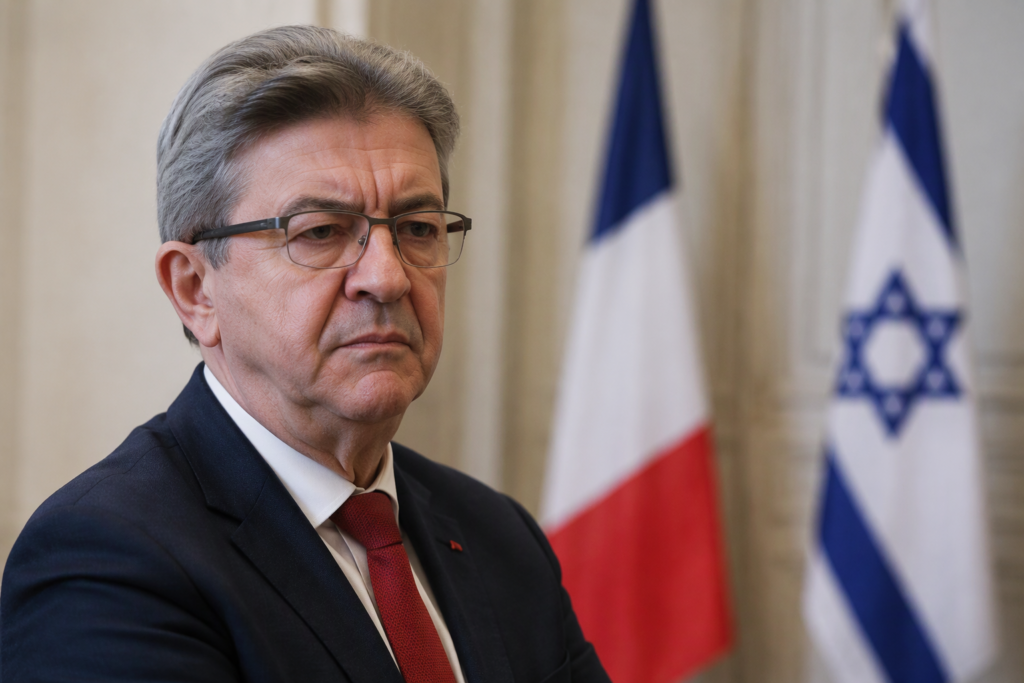

French opposition firebrand Jean-Luc Melenchon found himself barred from entering Israel this week, only to respond that Israeli authorities had turned him away from a country he had never even asked to visit. The decision quickly escalated into a diplomatic spat between Paris and Jerusalem, with French officials fiercely denouncing the move.
The French foreign ministry reacted late Thursday, labeling the Melenchon Israel ban as a demagogic political ploy. The diplomatic friction shows how deeply the war in the Middle East continues to roil domestic French politics and strain ties between European capitals and Prime Minister Benjamin Netanyahu’s administration.
Also read: Houthi Strikes on Saudi Arabia Hit Oil Hubs as UN Extends Ban
For French voters and diplomats, the clash exposes an increasingly volatile relationship between Paris and Jerusalem. While President Emmanuel Macron’s centrist coalition often clashes fiercely at home with Melenchon’s left-wing party, France Unbowed, the government moved swiftly to condemn Israel for blacklisting an elected French lawmaker.
Why Israel ordered the Melenchon Israel ban
Israeli officials barred Melenchon alongside Mathilde Panot, who leads the parliamentary group of France Unbowed in the National Assembly. The Israeli Foreign Ministry defended the decision by citing the French party’s sharp criticism of Israeli military actions and accusations that party leaders made unacceptable anti-Israel remarks.
Israeli diplomats accused both figures of circulating “blood libel” rhetoric against the state. The foreign ministry issued a blunt defense of its border restrictions:
“Israel will respond firmly to those who seek to harm it and will not allow individuals who act against Israel and incite against its citizens to enter the country.”
Tensions spiked over the weekend after Melenchon announced a confrontational foreign policy pledge. The leftist leader said that if he wins the French presidential election scheduled for April 2027, he will order French naval vessels to escort humanitarian aid flotillas directly to Gaza. Israeli armed forces have repeatedly intercepted such maritime missions and detained activists trying to break the coastal blockade.
Barrot delivers a stinging rebuke from Paris
French Foreign Minister Jean-Noel Barrot, who represents the centrist government in Paris, publicly rejected Jerusalem’s justification. While Barrot has no political loyalty to France Unbowed, he argued that Israel’s retaliation plays directly into the hands of political extremes.
Barrot posted on social media that the decision came from a government that has repeatedly flouted international law. He argued that banning foreign politicians simply feeds domestic polarization in France, giving opposition figures more political ammunition.
Barrot reiterated that France remains committed to securing a negotiated two-state solution between Israelis and Palestinians. French diplomacy, he stressed, intends to pursue peaceful coexistence rather than participate in symbolic border feuds.
Airport turnarounds and settler sanctions
The diplomatic freeze between Paris and Jerusalem did not begin with the Melenchon Israel ban. Just days earlier, French border police at Charles de Gaulle International Airport in Paris stopped and expelled prominent Israeli settler leader Yossi Dagan.
Dagan, a figure in Netanyahu’s Likud party who chairs a regional council in the occupied West Bank, was turned away immediately after his flight landed. The French Foreign Ministry confirmed that officials denied Dagan entry because of his active promotion of West Bank settlements, which violate international law.
Paris has toughened its stance against hardline settlement expansion throughout the year, joining other European governments in sanctioning radical figures. France earlier barred two far-right members of Netanyahu’s cabinet, National Security Minister Itamar Ben-Gvir and Finance Minister Bezalel Smotrich, after both ministers backed aggressive settlement construction and pogroms against Palestinian towns.
What comes next for French diplomacy
You can expect bilateral ties between Paris and Jerusalem to remain chilly as European capitals re-examine their visa policies toward Israeli officials. With both governments trading travel bans and French domestic politicians debating foreign policy ahead of the April 2027 presidential race, diplomatic communication between the two countries faces its toughest test in years.
Source: Al Jazeera