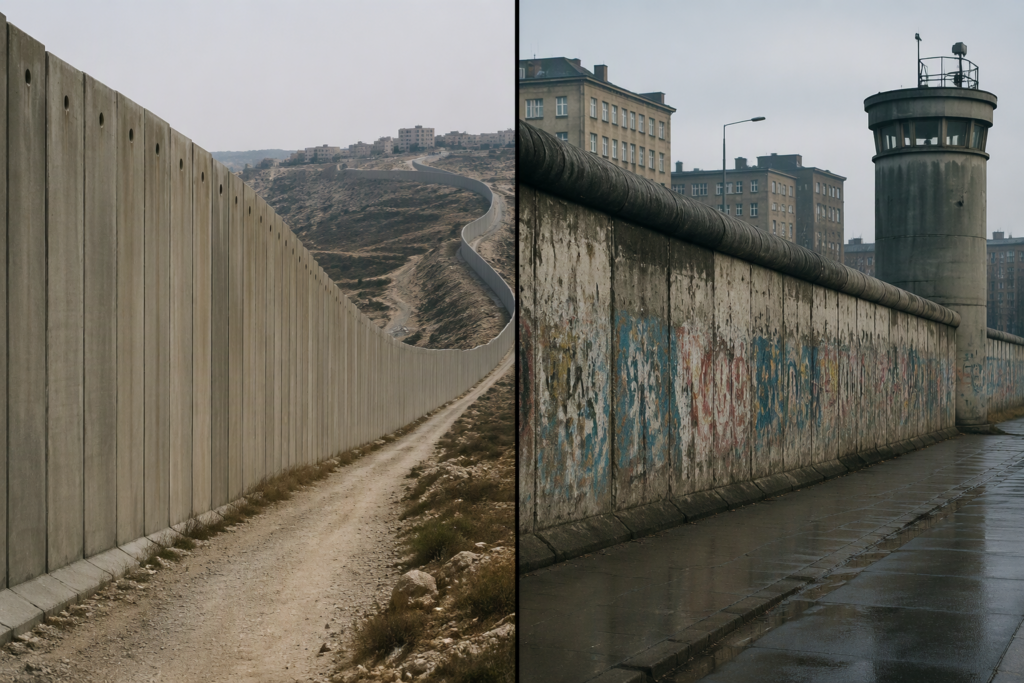

The comparison between Israel’s separation wall and the historic Berlin Wall frequently surfaces in geopolitical analysis and international human rights debates. Both structures represent powerful physical manifestations of deep political division, yet their origins, physical scales, and strategic intentions present significant contrasts.
Historical Origins and Strategic Motivations
The Berlin Wall emerged during the Cold War in August 1961, constructed by East German authorities to halt mass migration from the communist East to the capitalist West. It stood primarily as a tool of containment, designed to prevent citizens from fleeing Soviet-aligned territory rather than defending against foreign invasion.
Also read: Palestinian Boy Killed in West Bank by Israeli Forces, Officials Say
By contrast, Israel began constructing its barrier in 2002 during the Second Intifada. Israeli officials presented the structure as an imperative security measure designed to protect citizens from suicide bombings and armed attacks originating from the West Bank. However, Palestinian officials and international observers argue that its path extends beyond security, effectively carving deep into occupied land.
Scale, Structure, and Geography of Israel’s Separation Wall
In terms of physical dimensions, the differences between both barriers are striking. The Berlin Wall stretched roughly 155 kilometers around West Berlin, dividing an urban population within a single city. It consisted of concrete segments alongside watchtowers, trenches, and heavily patrolled containment zones.
Israel’s separation wall encompasses a projected route of more than 700 kilometers, more than four times the length of the Berlin barrier. Rather than following the internationally recognized 1949 Armistice Line (Green Line), approximately 85 percent of its route runs inside the West Bank. The infrastructure consists of concrete walls up to eight meters high in urban areas, flanked elsewhere by electronic fencing, trenches, patrol roads, and military buffer zones.
Humanitarian and Daily Life Consequences
Both barriers radically altered the daily lives of the populations they touched. The Berlin Wall split families, dismantled neighborhood networks, and led to dozens of deaths as people attempted perilous escapes over nearly three decades.
In the West Bank, the barrier isolates Palestinian towns and villages from farmland, schools, workplaces, and medical facilities. Checkpoints and permit regimes govern passage, causing severe economic disruption and fragmenting Palestinian territorial continuity. International humanitarian organizations have long documented the cumulative strain on civilian freedom of movement.
International Law and Global Standing
The Berlin Wall stood for 28 years until peaceful popular protests triggered its historic collapse in November 1989, symbolizing the end of Cold War divisions. During its existence, Western democracies condemned it as a violation of basic human rights and freedom.
Israel’s barrier faced a landmark legal assessment in 2004, when the International Court of Justice issued an advisory opinion declaring construction within occupied territory contrary to international law. The court called for the dismantling of sections built inside the West Bank and reparations for affected Palestinians, an opinion Israel rejected on security grounds.
Conclusion
While the Berlin Wall remains an enduring symbol of Cold War ideological confrontation, Israel’s separation wall represents an active, ongoing fixture of the Israeli-Palestinian conflict. Understanding the distinctions in their geography, political function, and legal status remains essential when evaluating their broader impact on modern world history.
Source: Al Jazeera