
A government patrol sent to shut down informal gold pits in northeastern Guinea ran straight into street barricades this week, setting off a deadly shootout that left at least 10 people dead and three trucks in flames. The clashes in Balato, a mining town in the Siguiri region, show just how explosive the government’s sudden halt on artisanal gold extraction has become along the West African gold belt.
Guinea’s Ministry of Territorial Administration confirmed late Thursday that five of those killed were foreign nationals whose identities remain unconfirmed. Another 13 people suffered injuries during the Wednesday skirmish, with both civilian demonstrators and uniformed security officers among the wounded.
Also read: France Slams Melenchon Israel Ban as Travel Row Deepens
What began as an environmental enforcement drive has now triggered an international crisis on Guinea’s borders. With military patrols sweeping the goldfields and mass trials already underway for hundreds of detained diggers, the confrontation threatens to upend rural trade across Guinea, Mali and Burkina Faso.
Gunfire at the barricades in Balato
The violence erupted on Wednesday when joint defence and security forces drove into Balato to verify that local sites had complied with a blanket shutdown on unlicenced digging. Instead of finding abandoned pits, the patrol encountered crowds of protesters who had dragged obstacles across the roadway to block their passage.
According to the territorial administration ministry, the confrontation quickly escalated from a standoff into direct fighting and an exchange of live gunfire. Government officials did not specify who pulled the trigger first, but the fighting turned destructive within minutes.
Demonstrators set fire to two civilian pick-up trucks and torched a heavy security forces transport vehicle. Protesters also disarmed at least one officer, making off with a military firearm and an official motorcycle before reinforcements could restore order.
By Thursday evening, Guinea’s central judicial authorities had formally instructed state prosecutors to open an investigation into the Balato bloodshed. Investigators must now identify the five foreign victims, determine which side initiated the shooting, and establish criminal responsibility for the torched vehicles and seized weapon.
Why Guinea banned gold mining in Siguiri
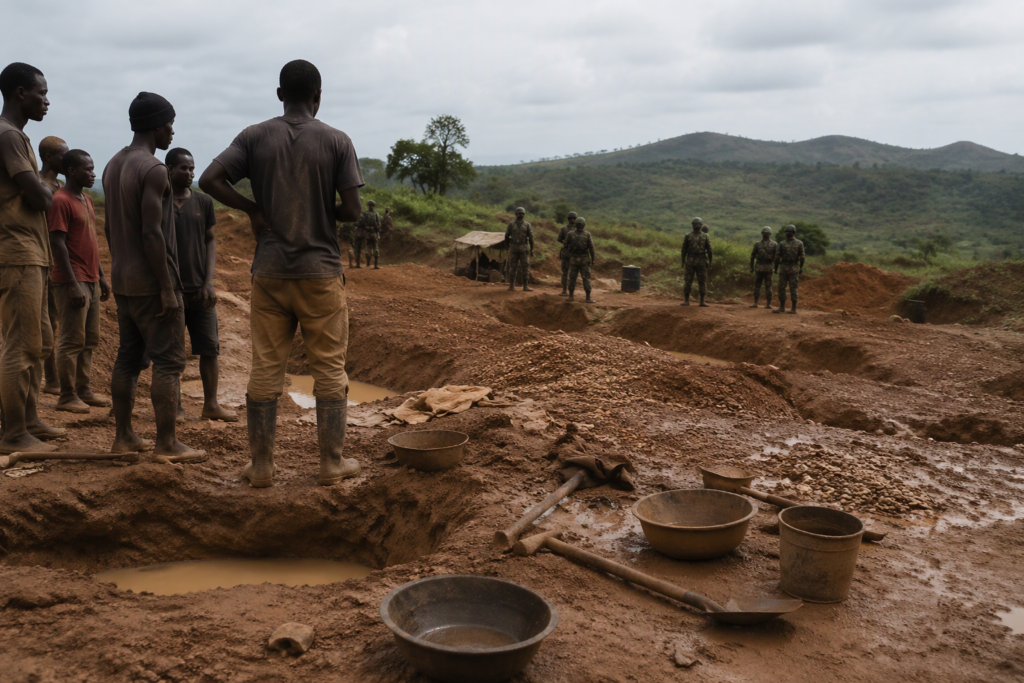
The roots of Wednesday’s deadly clash trace back to November 2, when national authorities ordered an immediate halt to all informal gold extraction across Siguiri. The district forms the core of Guinea’s gold reserves, drawing tens of thousands of itinerant workers seeking cash as bullion prices hit historic highs.
Government ministers defended the decree by pointing to catastrophic environmental damage across the countryside. Unregulated diggers had brought heavy excavation machinery onto prime agricultural plots, stripping topsoil, ripping out native vegetation cover and leaving deep, uncovered trenches across farming communities.
Even more alarming for regional planners was the chemical contamination seeping into local waterways. Informal washing operations routinely wash silt, mercury and other extraction agents straight into rivers that supply drinking water and fishing stock to surrounding villages.
Yet wiping out the sector with a single pen stroke hit a massive economic wall. Data from the UN Environment Programme indicates that artisanal and small-scale gold mining directly supports more than 300,000 livelihoods in Guinea. For whole communities with few alternative jobs, the pits represent the only cash economy available.
Mass expulsions hit Mali and Burkina Faso
Because the gold rush in Siguiri long pulled in migrant labour from across the Sahel, the November mining prohibition unleashed an immediate migration shock outside Guinea’s borders. Hundreds of thousands of foreign miners found themselves abruptly evicted or pressured to flee the country.
Malian authorities reported last week that roughly 100,000 displaced workers had arrived in the capital, Bamako, after being forced out of Guinea. Another 60,000 displaced people gathered just across the frontier in the Malian border settlement of Kouremale, overwhelming local resources.
Burkina Faso reported an equally stark exodus. On Friday, officials in Ouagadougou announced that the government had already coordinated the repatriation of 45,406 Burkinabe citizens who had been compelled to leave Guinea following the decree.
This displacement explains why half of those killed in Balato were foreign nationals. While officials sort through the aftermath of the Wednesday clashes, foreign embassies are pressing Guinean authorities to identify their dead citizens and account for those detained in the surrounding bush camps.
Over 1,200 arrested as mass trials open
Wednesday’s firefight was not an isolated operation. Earlier this month, state security personnel arrested more than 1,200 people during sweeping sweeps targeting unpermitted mining encampments throughout Siguiri.
The state has moved with unusual speed to prosecute them. Judicial officials opened the first series of mass public trials this week, putting scores of accused informal miners in front of judges on charges of illegal mining and environmental destruction.
The crackdown reflects a broader policy dilemma playing out across West Africa. Soaring global demand for precious metals continues to lure millions of independent workers into unlicenced panning, even as governments try to protect river basins and claw back tax revenues lost to black-market metal smuggling.
In Siguiri, the state has shown no willingness to soften its ban despite the body count and regional friction. Investigators are now reviewing ballistics evidence from Balato, while judges continue processing hundreds of jailed miners who face verdict hearings in the coming days.
Source: Al Jazeera