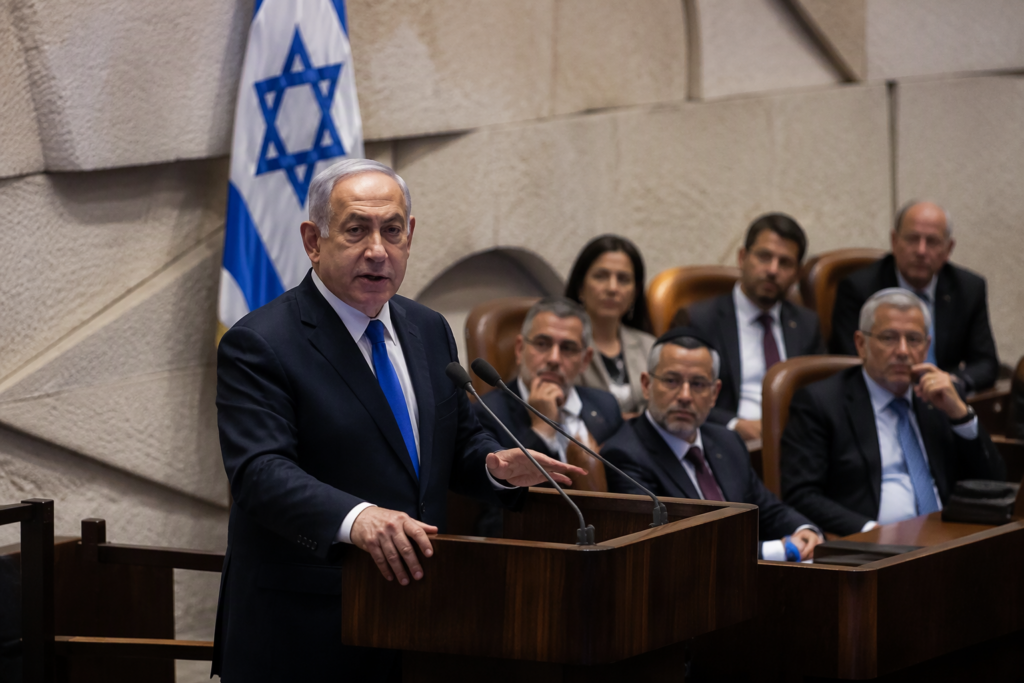

Benjamin Netanyahu warned on Saturday that Tehran would not hesitate to launch nuclear strikes against Israel, using the threat to demand an emergency coalition with his main political rival. But his push for an Israel national unity government hit an immediate wall when Gadi Eisenkot dismissed the plea as an insincere political stunt from a leader who knows he lost.
The exchange comes after the October 27 election left the 120-seat Knesset split without a clear majority. Netanyahu’s right-wing and religious bloc secured 53 seats, while Eisenkot’s four-party alliance won 48, and Arab-led parties took a record 19 seats.
Also read: Israel Far-Right Built a Legacy That Outlasts Netanyahu
President Isaac Herzog gave Eisenkot the first chance to build a coalition after 67 lawmakers backed him for the mandate, compared to 46 who endorsed Netanyahu. Eisenkot now has 28 days to strike a deal, with the option of a two-week extension.
Why Netanyahu insists on an Israel national unity government
In a video statement released on Saturday, Netanyahu pointed to a face-to-face meeting he held with Eisenkot on Thursday. He argued that their discussion reinforced his belief that only a joint administration could guarantee national security and eliminate the Iranian threat once and for all.
Netanyahu proposed an alliance that would gather Jewish parties from the centre and right while shutting out Arab factions entirely. He and his allies have repeatedly alleged without evidence that Arab-led parties stole the recent vote, warning that any government dependent on them would trigger Israel’s collapse.
Eisenkot calls the offer a political trick
Eisenkot, a former army chief of staff, rejected the appeal within minutes of the broadcast. He pointed out that formal coalition negotiations were already moving forward under his presidential mandate.
“Netanyahu is calling for negotiations while they are already underway. These tricks don’t work on me.”
On Friday, Eisenkot called Netanyahu’s rhetoric against Arab parties racist. While Eisenkot has ruled out inviting Arab-led parties into his cabinet, his path to power relies on their quiet cooperation from the sidelines.
How Eisenkot plans to build a minority cabinet
Rather than entering an Israel national unity government on Netanyahu’s terms, Eisenkot wants to pass a minority national emergency administration. Under this strategy, his 48 allied lawmakers would vote in favour, outnumbering the 46 Netanyahu loyalists.
To cross the finish line without an outright majority, Eisenkot needs the remaining 26 lawmakers from Arab and ultra-Orthodox factions to abstain during the confidence vote. That formula would allow him to swear in a cabinet without holding 61 seats.
Eisenkot has said he is open to working with members of Netanyahu’s Likud party and Bezalel Smotrich’s Religious Zionism if their desire for partnership is genuine. Still, he drew a hard line against far-right factions, demanding a clean break from supporters of minister Itamar Ben-Gvir.
The first test for the Knesset
The competing factions face an immediate floor battle on Tuesday, when the Knesset meets to elect its speaker. The position is held by Netanyahu ally Amir Ohana, but the opposition has fielded Matan Kahana, a former military officer, to challenge him for the gavel.
Source: Al Jazeera