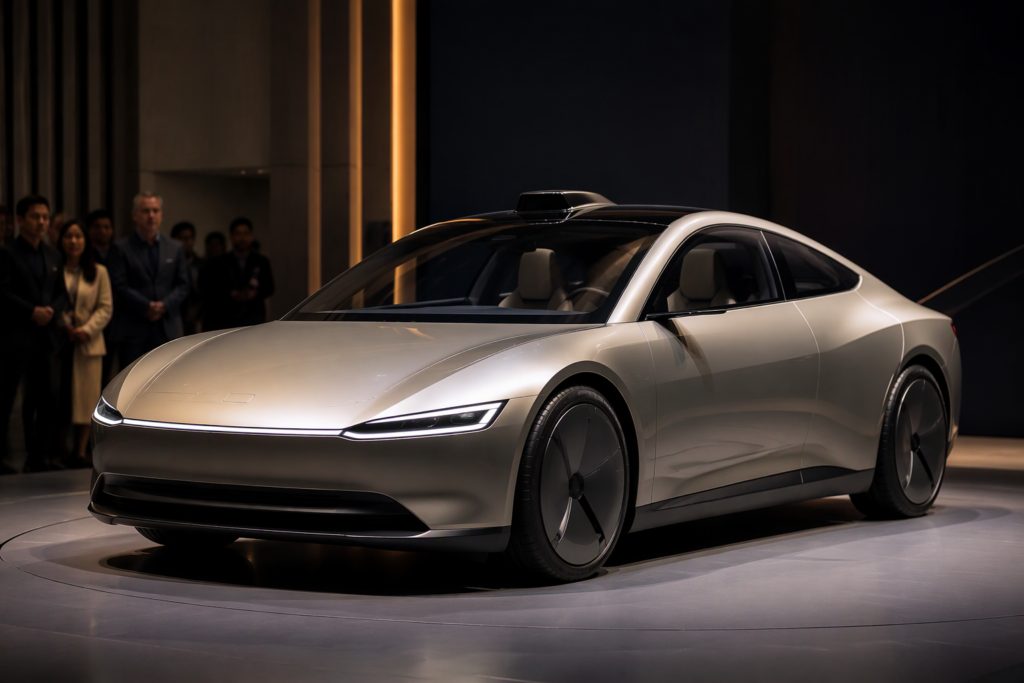

Tesla has started inviting select customers to buy a car that comes without a steering wheel, pedals, or a human backup driver. The two-seat Tesla Cybercab carries an upfront price tag of $29,990, but early buyers will also face a mandatory $299 monthly fee for an autonomy subscription to keep the car running on public streets.
Selling a purely driverless car directly to the public pushes autonomous vehicles out of commercial test fleets and into private garages. Tesla announced on X that chosen drivers can now order the vehicle for personal use, moving beyond its previous trials where the car operated strictly as a robotaxi.
Also read: Prehistoric Medical Kit Found on 5,300-Year-Old Mummy Ötzi
You will not be able to take the wheel if anything goes wrong because the cabin design completely excludes manual controls. Butterfly doors open into a gold-colored cockpit made for two passengers, relying entirely on onboard computers and cameras to handle road trips, traffic, and parking.
Two seats, no pedals, and a disputed fee
The upfront cost puts the vehicle near entry-level electric cars, but the recurring software charge has already caused friction. Tesla chief executive Elon Musk admitted on X that the $299 monthly subscription cost is “too high” for ordinary drivers.
Musk argued the monthly charge should match the combined cost of Tesla’s Full Self-Driving software and connectivity plans on other vehicles, which works out to roughly $115 each month. Lars Moravy, Tesla’s vice president of vehicle engineering, had targeted the end of this year to begin direct sales, and the initial wave of customer invites meets that timeline.
The car maker listed an installed annual factory capacity of more than 125,000 units for the model. Production started earlier this year, though output remains modest while Tesla tests software performance with real passengers.
Why Gigafactory Texas will stop building the Cybertruck
Tesla is rearranging its factory floors to make room for the two-seater. Musk announced earlier this month that the company will shut down Cybertruck assembly lines at Gigafactory Texas around the middle of next year to redirect manufacturing resources toward the new driverless model.
That factory shift underscores how central artificial intelligence and automated robotics have become to Tesla’s core business model. The company intends to link private vehicles and company-owned models into a broader commercial network, turning parked cars into revenue-generating autonomous vehicles whenever owners choose to share them.
From eight test cities to a wider rollout
Getting a Cybercab in your driveway depends entirely on local laws and municipal permits. Musk stated that the vehicle will expand nationwide only as state and federal transportation agencies sign off on the technology.
Tesla’s head of artificial intelligence confirmed the rollout will track the company’s active robotaxi fleet. That service currently focuses on eight southern metropolitan markets:
- Austin, Dallas, Fort Worth, Houston, and San Antonio in Texas
- Miami, Orlando, and Tampa in Florida
Austin served as the initial real-world testing ground in September, when Tesla started offering paid passenger rides in a small pool of vehicles. Expanding outside those regional hubs requires clearing local traffic rules that still demand a licensed human behind an operational steering column.
Safety regulators examine the Tesla Cybercab
Federal officials are taking a close look at how the car was approved for road use. The National Highway Traffic Safety Administration launched an audit in September to investigate whether Tesla properly self-certified that the vehicle satisfies federal motor vehicle safety standards.
Because the car lacks traditional safety components like physical brake pedals and driver-side steering inputs, regulators want verification that passenger protection matches standard automobiles. Tesla told NHTSA that the car fully complies with all existing safety rules, but federal inquiries into automated driving systems can trigger mandatory software changes or physical recalls.
Federal safety regulators are expected to deliver findings on the certification audit as Tesla prepares to widen deliveries beyond its private test list next year.
Source: Fox News