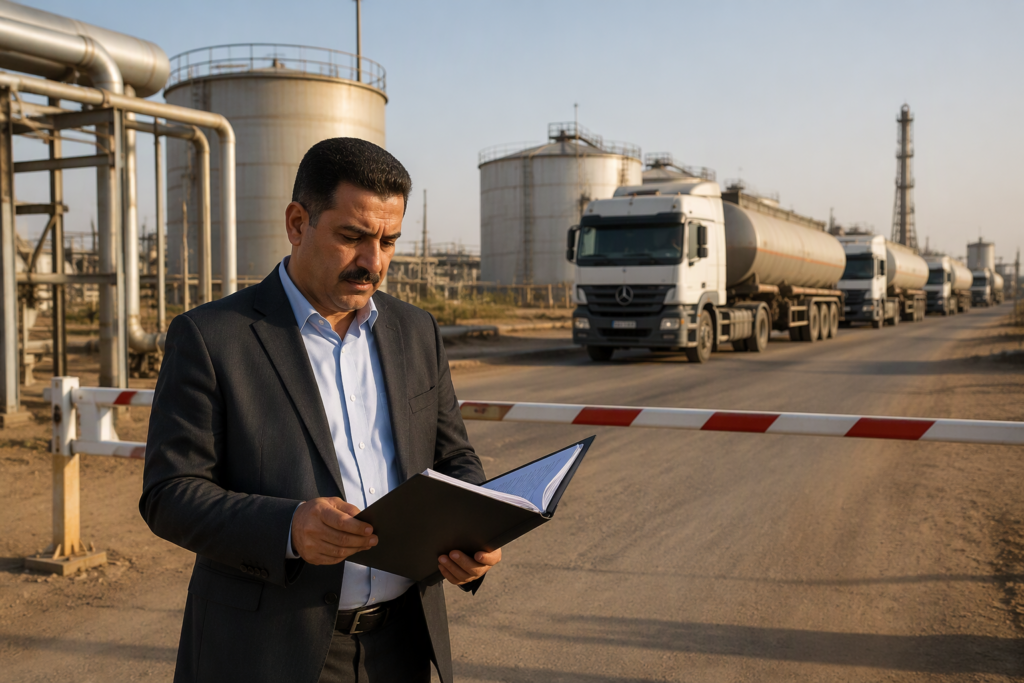

A black-market racket siphoning up to $30 million every month just collided with federal authority in Baghdad. Prime Minister Ali al-Zaidi has dismissed nine senior security and energy officials, taking direct aim at systemic Iraq oil smuggling operations running through Jurf al-Nasr, a fortified stronghold of the Iran-backed Kataib Hezbollah group.
The purge strikes at an illicit enterprise that previous Iraqi governments avoided confronting for years. By firing regional security leaders and oil directors while sending criminal files to prosecutors, al-Zaidi is challenging an entrenched armed faction on its home turf.
Also read: Russian Casualties Top 450,000 in Leaked State Agency Data
For Iraqis, this move shifts the balance between state institutions and autonomous paramilitary groups that have long operated above the law. If Baghdad can successfully cut off this lucrative revenue stream, it strips one of the country’s most heavily armed factions of the cash it uses to defy government authority.
How siphoned pipelines funded a shadow state
The illicit operation targeted two strategic crude pipelines running south of Baghdad through Babil province. Smugglers tapped directly into these state lines, drawing out crude oil and refined petroleum products before moving them through illicit refineries hidden across the Jurf al-Nasr district.
Military spokesperson Sabah al-Numan confirmed that an official investigative committee reviewed evidence detailing hidden refining sites and deliberate pipeline tampering. Leaked intelligence files, backed by satellite imagery, proved that an armed group systematically extracted crude and derivatives to supply black-market buyers.
Jurf al-Nasr has functioned almost entirely outside normal government oversight. Until this week, security agencies treated the area as an untouchable enclave, leaving fuel theft unchecked even as state revenues suffered massive losses.
Al-Zaidi made it clear after an emergency security review that the enclave will no longer enjoy immunity, stating that no corner of the country will be permitted to harbor illicit energy rackets.
Sacking commanders and oil directors in Babil
The dismissals reached across multiple ministries rather than stopping at low-level field operators. The sacked officials include the police chief of Babil province, high-ranking provincial intelligence and security officers, an Interior Ministry commander, and the director of the state-owned Oil Pipelines Company inside the Ministry of Oil.
Al-Numan told the Iraqi News Agency that the prime minister took immediate punitive steps once the investigative committee substantiated the intelligence reports.
“In light of the investigation’s findings, [the prime minister] ordered that all individuals accused of involvement in oil smuggling operations be referred to the judiciary.”
Those firings eliminate the administrative cover that allowed crude siphoning to continue at an industrial scale. Transferring these dossiers to the courts puts top regional commanders directly in front of criminal judges.
The clash with Kataib Hezbollah
Disrupting this fuel trade immediately escalates political friction in Baghdad. Jurf al-Nasr is the primary bastion of Kataib Hezbollah, one of Iraq’s most heavily armed paramilitary forces, which has grown increasingly hostile toward the current cabinet.
The group has released scathing public statements directed at al-Zaidi in recent weeks, leveling corruption accusations against his administration and issuing explicit warnings to his ministers. Senior political figures have confirmed that al-Zaidi previously told associates he is prepared to confront any armed faction that refuses to surrender its heavy weapons.
While the group frames its resistance in political rhetoric, the loss of Jurf al-Nasr’s fuel revenue threatens its day-to-day autonomy. Striking the network forces the paramilitary leadership to choose between backing down or directly challenging the state security apparatus.
Why dismantling Iraq oil smuggling targets militia arms
Fuel theft across southern Iraq has historically generated commercial wealth rather than serving purely tactical goals. Political groups and regional militias have routinely tapped state pipelines to fund their party apparatuses and personal patronage networks.
Akeel Abbas, a senior non-resident fellow with the Atlantic Council’s Iraq Initiative, pointed out that the government is utilizing economic enforcement to advance a broader strategic agenda. By casting the operation as an anti-corruption cleanup, al-Zaidi secures wide public backing while isolating his opponents.
The fundamental goal is advancing militia disarmament by eliminating the cash that sustains independent military structures. Abbas observed that leaking the intelligence findings days before the dismissals helped build momentum to sever the financial pipeline of a group that has repeatedly resisted government integration.
All eyes now turn to Iraq’s judicial branch as it prepares formal charges against the dismissed commanders, while security forces face the test of entering Jurf al-Nasr to dismantle the remaining illicit refineries.
Source: Al Jazeera