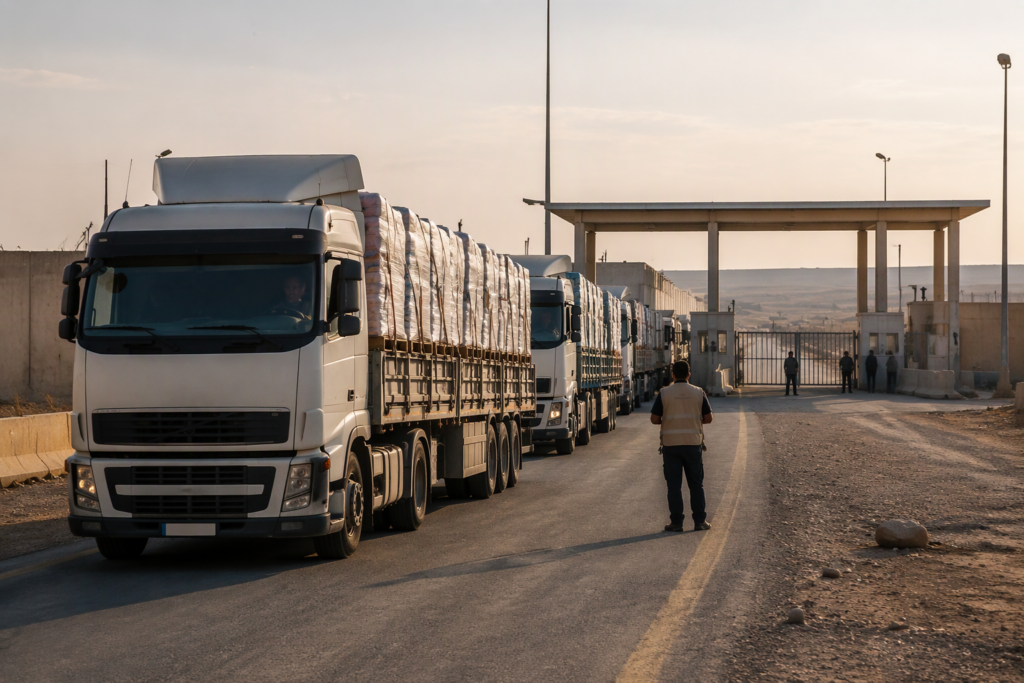
Roughly 150,000 emergency tents and survival supplies sit stalled at the border while winter rainstorms submerge makeshift camps across the Gaza Strip. The blockage prompted Australia, Canada, Italy and the United Kingdom to issue a joint diplomatic demand on Sunday, warning that Israel must immediately permit aid into Gaza before freezing conditions kill more displaced families.
The coordinated plea from the four foreign ministers follows a disastrous month of weather that has battered more than 350,000 people. Recent flash floods washed away thousands of fragile tarpaulins and makeshift shelters across the besieged strip, leaving parents and children shivering in standing water with nowhere left to flee.
Also read: Gaza Floods Submerge Makeshift Camps as Winter Sets In
For the ministers, the humanitarian catastrophe unfolding along the Mediterranean coast is not an unavoidable natural disaster. The diplomats made clear that the border bottlenecks are deliberate political choices, arguing that the crisis can be stopped before sub-zero temperatures arrive.
“We today urge the Government of Israel to stop the delays now and allow immediate, rapid and unimpeded humanitarian access throughout Gaza.”
Why 150,000 tents remain stuck at the border
Israel has strictly controlled the flow of goods and people across Gaza borders for years, but it tightened those controls into an outright siege after October 2023. Food shipments, fuel deliveries and clean water have been reduced to fractions of what the local population needs to survive.
Aid groups report that trucks packed with cold-weather kits, shelter tarps and sleeping equipment continue to wait outside crossing terminals. The four allied governments warned that holding back essential supplies directly intensifies the misery of more than 2 million civilians trapped inside the strip.
“People in Gaza desperately need shelter and humanitarian assistance,” the joint ministerial statement said. The diplomats insisted that the seasonal threat is entirely reversible if Israeli authorities clear the logjam of relief trucks waiting outside inspection gates.
Rainstorms leave 350,000 people fighting winter floods
Living conditions across the Palestinian territory have collapsed after months of relentless bombardment that levelled entire urban centres. The United Nations calculates that more than 1.9 million people are currently displaced in Gaza, with many families forced to pack up their belongings and move multiple times.
Those who survive the bombing often end up in ruined structures or waterlogged tent clusters pitched on bare sand. As of November 1, the Global Shelter Cluster, which works alongside the Red Cross and the UN, calculated that civilians across the territory require at least 121,000 tents and 1.7 million mattresses to endure the coming winter.
Remaining concrete buildings offer little genuine safety. In September, a damaged multistory building used as an informal shelter collapsed entirely, killing at least 20 people sheltering inside. Rising floodwaters have further weakened cracked foundations across several devastated towns.
What international law says about blocking aid into Gaza
The refusal to let emergency supplies through border checkpoints carries severe legal consequences for military commanders and political leaders. Under the Geneva Convention, intentionally depriving a civilian population of relief supplies and humanitarian assistance can constitute a war crime.
International courts have already stepped in to address the conduct of the war. Prime Minister Benjamin Netanyahu and his former defence minister, Yoav Gallant, face arrest warrants issued by the International Criminal Court for alleged war crimes and crimes against humanity. Israel also faces an ongoing genocide case brought before the International Court of Justice.
On Friday, the UN Humanitarian Country Team of the Occupied Palestinian Territory issued a scathing review of the conditions on the ground. The team pointed out that children and adults died during the storm because administrative barricades halted basic relief supplies, not simply because of bad weather.
Diplomatic pressure builds across Europe and the UN
The European Union joined the diplomatic chorus on Saturday, expressing grave concern over the collapsing living standards and demanding the immediate reopening of all border corridors. European officials insisted that humanitarian workers need rapid, unhindered pathways to deliver food, clean water and medical supplies.
Sunday’s four-nation appeal also urged regional leaders and combatants to enact the Comprehensive Plan for Gaza. Unveiled in 2025, that diplomatic roadmap outlines an immediate ceasefire between Israel and Hamas alongside a structured exchange of captives and prisoners.
Yet military operations show no sign of pausing on the ground. An Israeli air strike struck Gaza’s Nasser Hospital on Thursday, killing six Palestinians and damaging an already fractured healthcare system. With rainfall forecast to continue across the coast, humanitarian agencies are watching border terminals daily to see whether Israel will finally let the convoy of 150,000 tents move through.
Source: Al Jazeera


