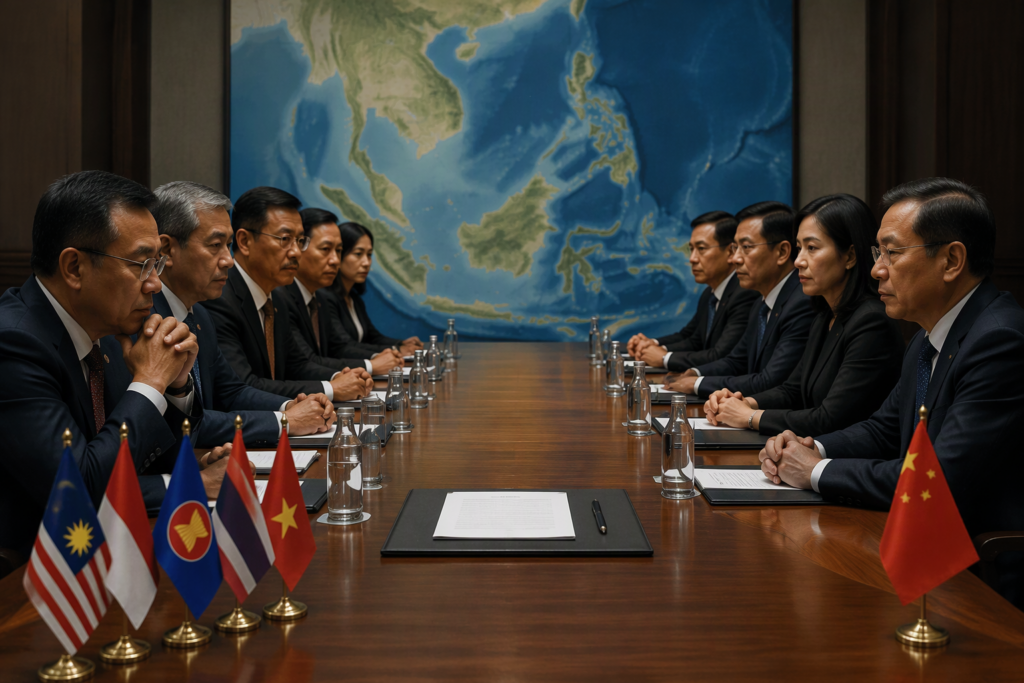
Twenty years of talks and an agreed draft of roughly 80 percent were still not enough to break the deadlock in Manila. China and Southeast Asian leaders walked away from weekend summit meetings without a finished South China Sea code, leaving contested waters without clear rules to prevent military miscalculations.
Philippine Foreign Minister Theresa Lazaro told reporters on Sunday that negotiators could not clear the final hurdles. “There is no conclusion yet,” Lazaro said, explaining that deep disagreements persist over whether any signed agreement would carry real legal weight.
Also read: ASEAN Summit Opens in Manila as Energy and Trade Shocks Bite
The failure matters directly for commercial shipping crews, naval vessels and fishermen operating across one of the busiest trade corridors on the planet. Without binding guardrails, near-daily standoffs between Chinese coast guard cutters and Southeast Asian supply vessels will continue unchecked.
Stumbling over legal teeth
The Association of Southeast Asian Nations and Beijing have chased a working maritime treaty since 2002. The Philippines held the rotating 11-nation ASEAN chair this year and had set a firm target to lock down an accord before January.
That deadline has now slipped away. Negotiators reached tentative consensus on about 80 percent of the working text, but the remaining fifth contains the hardest disputes. Member states want a South China Sea code anchored in international maritime law with enforceable dispute mechanisms. Beijing has consistently pushed back against legal constraints on its naval presence.
Lazaro acknowledged that member states and Chinese diplomats still see basic facts through different lenses. She expressed hope that Singapore can push the pact across the finish line when it assumes the ASEAN chairmanship next year.
Why Beijing and Manila keep colliding
Tensions on the water explain why finishing the South China Sea code has proved so difficult. China claims historic sovereignty over almost the entire sea, overlapping the recognized exclusive economic zones of Brunei, Indonesia, Malaysia, the Philippines and Vietnam.
The friction has turned especially sharp between Manila and Beijing since Philippine President Ferdinand Marcos Jr took office in 2022. Philippine sailors have faced water cannon blasts, aggressive blocking manoeuvres and ramming attempts while delivering supplies to remote outposts.
Beijing insists its forces act lawfully and professionally to defend Chinese territory from Philippine trespassers. Manila counters that Chinese vessels operate deep inside waters granted to the Philippines under global treaties. Months of bitter diplomatic exchanges set a tense backdrop for the talks in Manila.
The shadow of the 2016 arbitration ruling
At the heart of the deadlock sits a landmark international ruling that Beijing refuses to recognize. In 2016, an international arbitration tribunal concluded that China’s sweeping historic claims had no legal standing under the United Nations Convention on the Law of the Sea.
Southeast Asian governments insist any future South China Sea code must reflect that verdict. Beijing dismissed the tribunal from the start and treats the decision as invalid. That fundamental disagreement leaves diplomats trying to write rules for waters where the two sides do not even agree on who owns what.
Myanmar junta leader barred once again
The maritime dispute was not the only point of friction inside the Manila summit rooms. ASEAN leaders also voted to extend an outright ban on Myanmar military chief Min Aung Hlaing attending high-level bloc summits.
The general led the February 2021 military coup that ousted the elected government of Nobel laureate Aung San Suu Kyi. The coup sparked mass protests, lethal crackdowns and an armed civil war that now covers much of the country. Under summit rules, Myanmar can send only lower-level career diplomats.
ASEAN stripped Myanmar of its turn to chair the bloc this year, handing the role to the Philippines. Leaders reviewed the military regime’s total lack of compliance with the 2021 Five-Point Consensus peace plan, demanding an immediate halt to attacks on civilians.
“There are still certain bombings and displacement of Myanmar people, so step-by-step, we give it to them, how they’re going to tackle this issue, and we’ll monitor that,” said Lazaro.
Min Aung Hlaing recently took the presidency following elections widely condemned as fraudulent and has conducted bilateral visits with several ASEAN neighbors. Yet the bloc declared that its stalled peace framework remains the main reference for handling the crisis.
Diplomatic attention now shifts to Singapore, which takes over the ASEAN chair on Jan. 1 with both the Myanmar conflict and the stalled maritime treaty at the top of its docket.
Source: Al Jazeera


