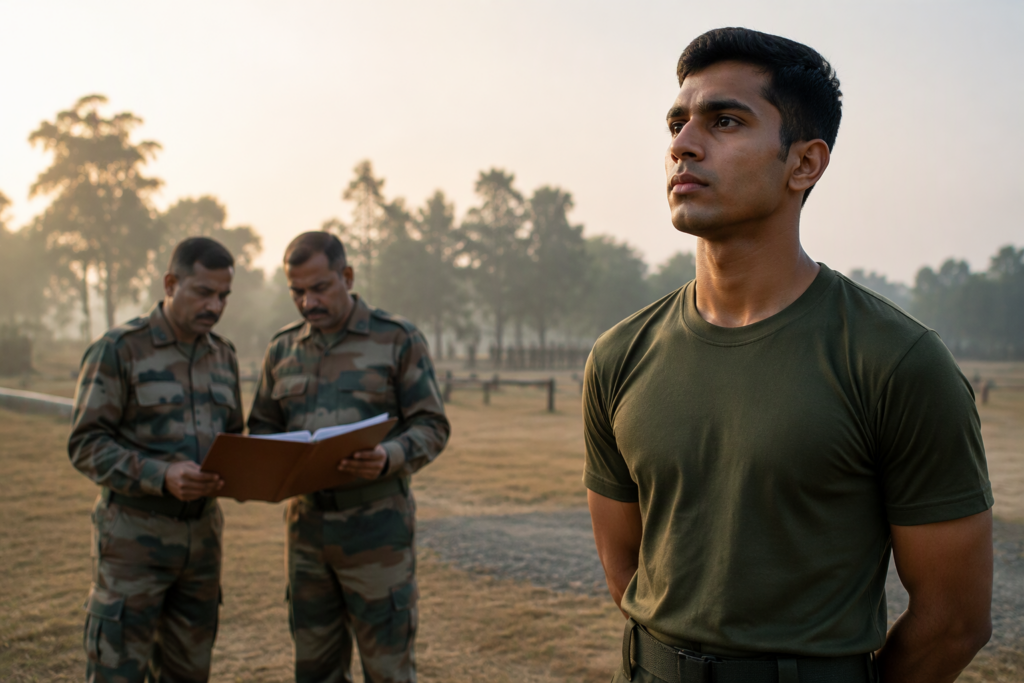
India is changing the terms for hundreds of thousands of young soldiers after facing fierce protests, unit shortages, and mounting pushback from veteran commanders over its Agnipath scheme. Under a fresh policy shift, recruits who miss out on permanent military jobs after their initial four-year contracts will get an offer to stay for another two years at higher pay.
That extra time also gives them a second opportunity to test for regular, full-career service. The move alters the core promise of the controversial 2022 overhaul, which ended lifelong careers and pensions for most new enlistees in the Indian armed forces.
Also read: Poverty in India: Why Escaping the Line Still Feels Like Hunger
For the recruits standing guard right now, the change buys precious time. More than 18,300 soldiers from the first intake reach the end of their four-year tours by late 2026, and their futures were about to hit a sudden wall.
What Chief of Defence Staff announced
Chief of Defence Staff General NS Raja Subramani announced the decision on 4 November, explaining that the military adjusted the rules after collecting direct feedback from the branches. Recruits passed over for permanent retention will receive two additional years of active duty along with increased wages.
If they meet selection standards at the end of that second run, they can try again to secure regular military roles. General Subramani maintained that the Agnipath scheme remains active policy, but the adjustment provides an immediate buffer for troops who thought their service was about to end.
Defence officials confirm the offer will extend to more than 300,000 Agniveers currently serving across the army, navy, and air force. Yet questions remain over whether future recruits will receive the same six-year runway, as the defence ministry has not clarified terms for upcoming batches.
When Prime Minister Narendra Modi’s government introduced the policy in 2022, it capped military tenures at four years. Only 25 percent of each intake could stay on for long-term service. The remaining 75 percent were set to be released into the civilian workforce with a severance payout, leaving behind the medical perks and military pensions that once anchored rural household finances.
Why military leaders doubted the four-year soldier
While the defence ministry praised the recruits as fit and technologically sharp, veteran commanders warned that modern combat cannot be learned on a sprint. Complex weapons require long training pipelines, and high-stress units depend on deep personal bonds.
“It takes eight-to-nine years to turn a raw recruit into a dependable, seasoned soldier – someone capable of handling a tank crew, an artillery gun crew or a small detachment.”
That assessment from retired Major General Yash Mor reflects a widespread worry among commanders. Mor stressed that military cohesion relies on trust built through shared years in barracks and field outposts, qualities that four-year contracts compress too tightly.
Sanjiv Krishan Sood, former additional director general of the Border Security Force, pointed out that short tenures hit technical roles hardest. Modern weapons platforms demand specialized maintenance and operation. An extra two years gives soldiers a real chance to master modern gear rather than cycling out just as they become proficient.
Retired Major General Birender Singh Dhanoa questioned the financial logic of releasing trained personnel so quickly after pouring public funds into their education. He argued that retaining recruits for eight or nine years would deliver better value for the state’s investment.
Troop shortfalls and friction inside the barracks
The policy shift also addresses urgent staffing pressures on the ground. Reports revealed the Indian army faced a shortfall of nearly 180,000 personnel late last year, following a two-year pandemic freeze on recruitment.
The sudden move to short-term recruitment dried up candidate pipelines in traditional garrison towns. In Dehradun, training institute operator Kulbeer Singh Chaudhary noticed enlistment interest plunge so fast that he halted his preparation batches. He believes the new extension might restore confidence among young job-seekers who want stable careers.
Still, running multiple tiers of soldiers inside identical platoons brings practical hazards. Units now balance three separate groups:
- Traditional soldiers entitled to lifelong pensions, family medical care, and steady promotions
- First-tour Agniveers serving out four-year contracts with no pension rights
- Retained recruits serving two-year extensions at adjusted pay scales
Commanders caution that pay gaps and uneven career futures among troops sharing the same trenches could strain unit morale. India keeps hundreds of thousands of soldiers deployed year-round along disputed, high-altitude frontiers with China and Pakistan, where teamwork decides survival.
The politics behind the Agnipath scheme revision
Money drove the original reform. India devotes nearly half of its annual defence budget to personnel salaries and pensions, which squeezes spending on warships, fighter jets, and artillery. Trimming long-term pension rolls was supposed to free up cash to modernize the ranks.
Yet the social costs hit fast. Across northern and western states where military service is a generational tradition, protests erupted within hours of the 2022 rollout. Demonstrators blocked highways and burned train cars, furious that secure public-sector employment had turned into temporary contract work.
Timing likely forced the government’s hand. Crucial regional elections are approaching in Punjab, Uttar Pradesh, and Uttarakhand, three primary recruitment belts where military families form influential voting blocs. Opposition parties, led by the Congress party, immediately labelled the extension a political retreat designed to contain voter anger.
For the thousands of recruits marching toward the close of their contracts, the extension removes an immediate cliff edge. What they face instead is an extended probation period, with the real test arriving in late 2026 when the first batch reaches its final review.
Source: BBC


