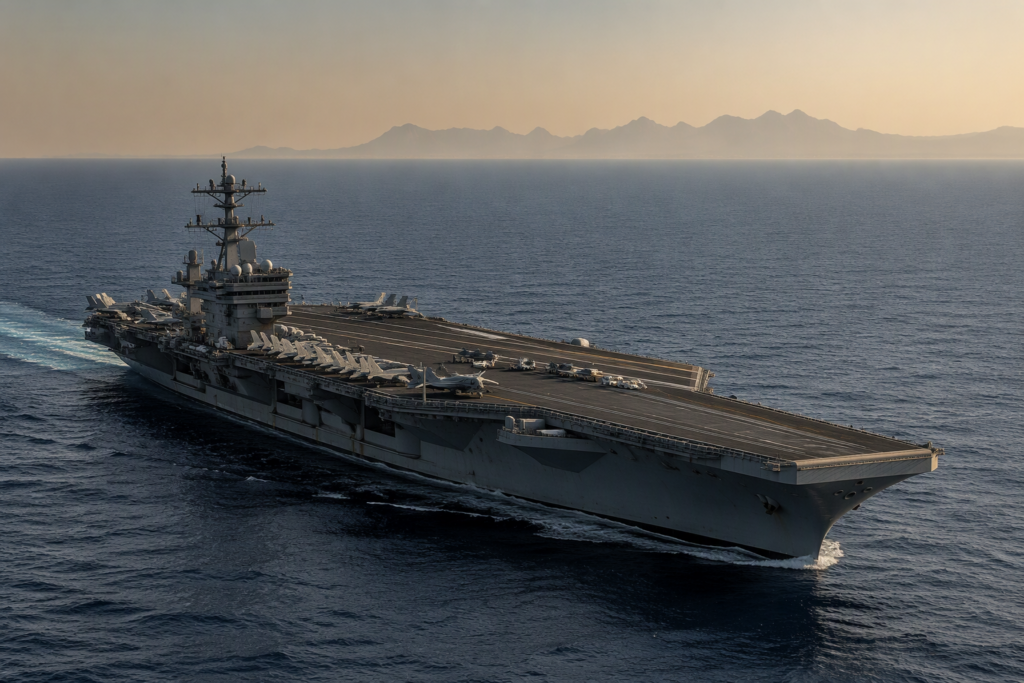
A third American carrier strike group slipped into Middle Eastern waters this week, puncturing hopes that talks would quickly end fighting with Iran. The arrival of the USS Theodore Roosevelt puts three nuclear-powered flat-tops in the same theater, giving American commanders fire support not seen in the Persian Gulf in over two decades.
The move comes at a perilous moment. A temporary truce broke down in July, and merchant traffic through the Strait of Hormuz remains locked down under an American naval embargo.
Also read: Russian Satellite Intelligence Gives Iran Warning on US Moves
If you thought the confrontation was cooling down after recent White House comments, this naval movement signals the exact opposite. While regional diplomats scramble for an exit, the Pentagon is loading the region with overwhelming combat firepower.
What the USS Theodore Roosevelt brings to CENTCOM
The USS Theodore Roosevelt departed San Diego in September and reached the region on November 15. It now operates alongside the USS George Washington and the USS George HW Bush under US Central Command.
Commissioned in 1986, the carrier houses more than 5,000 personnel. Its flight deck handles an air wing of more than 60 combat planes, including F-18 strike fighters.
The deployment does not stop with one carrier. The Makin Island Marine Expeditionary Force followed close behind, bringing another 2,000 Marines. All told, the incoming naval formations could add between 9,000 and 10,000 service members to the theater.
The warship has spent decades in regional conflicts. It flew combat runs during the 1991 Gulf War and took part in airstrikes against Iraq in 2003 before conducting allied drills across the Pacific in recent years.
The biggest air and sea buildup since 2003
Washington has steadily concentrated forces across its network of regional installations. The United States maintains permanent military bases in Bahrain, Egypt, Iraq, Jordan, Kuwait, Qatar, Saudi Arabia, and the United Arab Emirates. Those sites already held up to 50,000 troops before the latest escalations.
Flight-tracking data shows the Pentagon moved more than 120 combat and support planes to the theater starting in February. That air armada features E-3 Sentry radar craft, F-35 stealth fighters, F-22 air superiority jets, and squadrons of F-15s and F-16s.
Ground and amphibious units soon joined the air surge:
- The Tripoli Amphibious Ready Group and the 31st Marine Expeditionary Unit
- The Boxer Amphibious Ready Group carrying the 11th Marine Expeditionary Unit
- About 2,000 paratroopers from the 82nd Airborne Division’s Immediate Response Force
Together, those Marine ready groups contributed 4,500 personnel. Adding the airborne troops from Fort Bragg pushed the emergency deployment past 7,000 ground forces before the latest carrier group arrived.
Conflicting signals inside the White House
The buildup continues even as Washington delivers mixed public messages following Republican losses in the midterm elections. Secretary of State Marco Rubio argued that economic pressure alone is strangling Tehran, making renewed strikes unnecessary.
President Donald Trump took a similar line after meeting with Qatar’s prime minister, Sheikh Mohammed bin Abdulrahman bin Jassim Al Thani. Trump claimed military operations were “effectively over” and called fresh strikes unlikely, yet insisted American forces were still primed for immediate action.
Days later, Trump discarded the push for a negotiated settlement altogether. Writing on Truth Social, he revealed what he told his chief negotiator, Vice President JD Vance.
“We don’t need a deal with Iran. Those days have long since passed. We’ve got their money, Hundreds of Billions of Dollars, and we’ve got their Strait!”
That posture has frozen regional mediators from Qatar and Pakistan, who spent months trying to salvage the framework that collapsed over the summer.
Tehran draws its red lines on Hormuz
Iranian leaders insist they will not accept an indefinite standoff. Iranian parliamentary speaker Mohammad Bagher Ghalibaf sent a seven-point proposal to Washington through Qatari intermediaries. The document demands the lifting of sanctions, the release of frozen funds, and the end of the American naval blockade.
Iranian diplomats argue that the Pentagon is using backchannel talks simply to buy time for another assault. Kazem Gharibabadi, Iran’s deputy foreign minister for legal affairs, warned state television that his country will not wait quietly if attacked. He announced that the Islamic Revolutionary Guard Corps is already manufacturing missiles with extended ranges.
Iran’s Foreign Minister Abbas Araghchi echoed that defiance during a regional summit in Islamabad, urging neighboring countries to build an independent energy security framework without Western interference.
With the USS Theodore Roosevelt now stationed on station, the immediate focus turns to Washington, where the White House must formally decide whether to answer Tehran’s seven cease-fire conditions or enforce the maritime blockade by force.
Source: Al Jazeera


