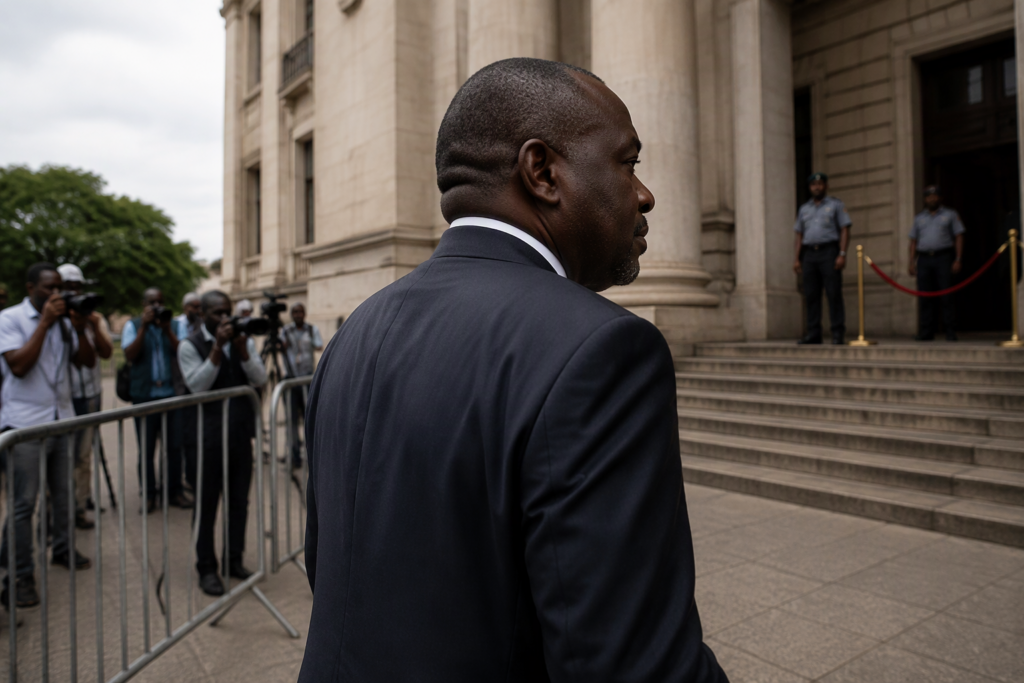
Armed police surrounded the Supreme Court in Maputo on Tuesday as Mozambique prepared to judge the man who brought hundreds of thousands of people into the streets. The Venâncio Mondlane trial puts the country’s most vocal political challenger in front of five judges, facing accusations that could put him behind bars for decades.
The Mozambique opposition leader faces up to 24 years in prison over the 2024 post-election protests that paralyzed commercial hubs, disrupted public infrastructure, and resulted in deadly clashes with police. For ordinary Mozambicans, the court case is a test of whether the state can handle political dissent peacefully, or whether the hearings will reawaken the violence that tore through the nation after the disputed vote.
Also read: William and Kate India Visit Begins with Cricket and Metro
Authorities deployed heavily armed units across major junctions in the capital ahead of the opening session. Officials fear that any sign of legal retribution against Mondlane could send angry crowds back into the avenues.
The charges and a 24-year prison threat
State prosecutors have brought a sweeping slate of accusations against the 52-year-old politician. The indictment includes public instigation to commit crimes, incitement to collective disobedience, publicly glorifying criminal acts, and offences linked to terrorism.
If convicted of the gravest charge, Mondlane faces up to 24 years in prison. The state claims his speeches and social media broadcasts deliberately provoked nationwide chaos, destroyed private property, and brought public institutions to an abrupt halt.
Mondlane rejects every accusation. His political organization, the National Alliance for a Free and Autonomous Mozambique (Anamola), insists the charges are politically motivated retaliation designed to silence an opposition figure who exposed electoral malpractice.
How the 2024 vote ignited deadly street battles
The conflict traces back to October 2024, when electoral authorities declared Daniel Chapo the winner of the presidential ballot. The result kept the ruling Frelimo party in power, extending a governance streak that has lasted since Mozambique gained independence in 1975.
Mondlane rejected the official tally, alleging widespread fraud and vote manipulation. European Union election observers echoed those concerns, reporting serious irregularities and questioning whether the published numbers reflected the real vote count.
In response, Mondlane demanded work stoppages and rallies across Mozambique. Demonstrations quickly expanded across provincial towns and Maputo, dragging on for months as citizens protested against economic hardship and political exclusion.
State forces met the rallies with live ammunition, tear gas, and mass arrests. Local civil society groups and Amnesty International documented the human cost, reporting that more than 300 people were killed in the crackdown.
What is at stake in the Venâncio Mondlane trial
The courtroom proceedings will be heard by a bench of five judges, who must decide whether Mondlane’s calls for civil resistance exceeded constitutional rights and crossed into criminal instigation. Both sides plan to present lengthy witness testimony during the hearings.
Supporters of the government view the proceedings as an essential defense of civil order and public property. Critics argue that using terrorism charges against a political leader weaponizes the legal system against legitimate dissent.
Political analyst Luis Nhachote framed the stakes for the nation’s fragile democratic institutions:
“The trial is a real test for Mozambique. It is is an important opportunity to demonstrate that the rule of law applies equally to everyone.”
The Maputo Supreme Court has firmly rejected accusations of political interference, insisting that the bench will rule solely on evidence.
Maputo locks down as journalists face restrictions
Police patrols swept key avenues across Maputo before dawn, stationing officers outside government compounds and court entrances. Police leadership issued a statement on Monday urging citizens to preserve tolerance and respect peaceful coexistence, reminding residents that protests must follow statutory limits.
Access inside the courtroom remains tightly controlled. Judicial authorities admitted only a small group of pre-selected media outlets, citing limited room inside the chamber.
The media limits sparked pushback from domestic and foreign reporters, who argue that excluding independent press obscures a matter of immense public interest. Transparency advocates say public scrutiny is essential to guarantee that the Venâncio Mondlane trial does not spark renewed unrest.
The five-judge panel will hear opening arguments and examine the prosecution’s evidence as the court reconvenes this week.
Source: BBC


