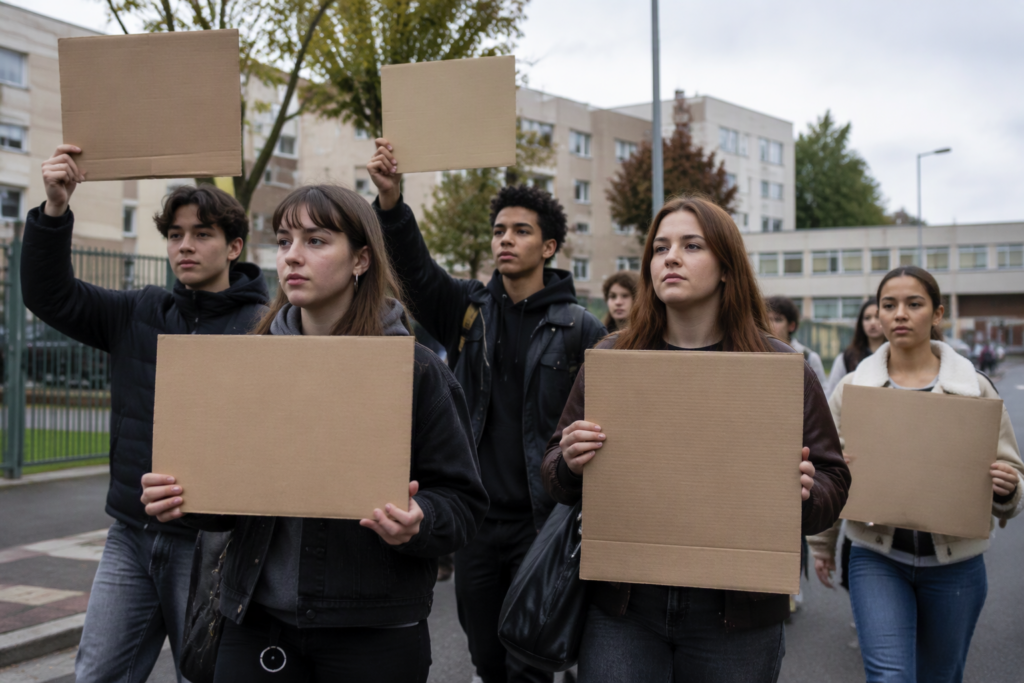
Seventeen-year-old Kamelia pulled on an inflatable dinosaur costume on a freezing, wet morning in Saint-Denis, determined to bring laughter to a school gate blockade driven by fury. Across working-class towns ringing Paris, the ongoing French student protests show no signs of fading away, even as winter approaches and government promises stall.
Students returned from their autumn break only to resume strikes and lock down school doors across the region. They argue that years of neglect have left their classrooms crumbling, unsanitary and dangerous. While government officials in central Paris speak of high-minded policy responses, teenagers outside trade schools and high schools say daily conditions inside their buildings remain intolerable.
Also read: Why the New French Malaise Is Splitting the Nation
What happens in these suburbs carries nationwide stakes for France. The unrest that started as localized anger over broken pipes and pest infestations has expanded into a test of political strength between President Emmanuel Macron and a generation of youth feeling pushed aside.
Rats, broken taps and locked gates
Outside Bartholdi, a trade school in Saint-Denis north of Paris, teenagers stood guard in front of barricaded entrances. Their complaints are not abstract theories about the future. They focus on basic dignity inside school walls.
Nohlan, a 17-year-old Bartholdi student standing at the blockade, described conditions that resemble an abandoned site rather than an educational institution. Drinking water barely trickles from taps, leaving pupils without clean water throughout the day. Filth covers hallways, and vermin regularly disrupt classes.
“Sometimes, we see rats in the courtyard and in the restrooms. The restrooms are a mess. We don’t have enough water; it flows very slowly. We don’t have enough to drink, and the restrooms are dirty. The hallways are dirty, the classrooms are dirty, and there are cockroaches.”
A short distance away at Paul Eluard high school, similar anger boiled over after students rejoined a national strike on November 5. Demonstrators insist they will keep holding the gates until local education authorities and the government commit actual money to repair their schools.
How French student protests swept the country
The wave of demonstrations did not begin in famous Parisian boulevards. It sparked on September 17 at a high school in Creteil, a suburb southeast of Paris located in the Val-de-Marne department. From Creteil, protests ignited Saint-Denis before rolling outward into cities across the country.
By late September, around 400 schools, along with several university campuses, had walked out in solidarity. The movement reached an early peak on October 17, when hundreds of thousands marched through central Paris. Police and the interior ministry estimated turnout at 550,000, while student organizers counted 800,000 demonstrators.
Suburban youths emphasize that their voices forced the capital to pay attention. For years, small blockades organized at suburban schools went unnoticed by national media and political leaders. This autumn broke that pattern of silence, drawing attention from across France and beyond.
Teachers take their stand beside pupils
High school staff have joined their students on the picket lines, reporting that conditions inside suburban schools have eroded steadily over more than a decade. Teachers argue that funding cuts have combined with rising enrollment to make basic education almost impossible.
Bruno Gbalou, who teaches English at Bartholdi, pointed out that the situation has deteriorated relentlessly since he returned from teaching in England 15 years ago. Class sizes have climbed while materials and maintenance have fallen away. Gbalou noted that staying silent would mean accepting an unfair reality for both staff and students.
At Paul Eluard, English teacher Lucie Sabze praised the clarity and political focus of her pupils, saying their mobilization stems from genuine frustration rather than teenage rebellion. Staff at the school also achieved an immediate demand after weeks of campaigning: the removal of their head teacher, Xavier Artaud.
Tensions had escalated when staff accused Artaud of allowing an armed officer from France’s motorized antiterrorism police unit onto school grounds to arrest a teenager. Education authorities confirmed that Artaud stepped down and was transferred away from Saint-Denis under protective measures following public accusations.
Political battle over austerity and classroom funding
In early October, President Emmanuel Macron addressed the unrest by stating that his administration intended to answer student grievances in a concrete manner. Macron remarked that he understood the anxieties and anger felt by young people regarding climate policy, rapid technology shifts and global conflict.
Suburban teenagers flatly rejected that framing, pointing out that Macron avoided discussing broken toilets, peeling paint and unheated rooms. For students like Nohlan, government statements represent empty words designed to stall for time while nothing improves on the ground.
National politicians have entered the dispute. Louis Boyard, a member of the French National Assembly representing Val-de-Marne for the left-wing France Unbowed party, argued that state policies deliberately starved public schools while channeling money into private alternatives. Boyard pointed to broader economic pain, emphasizing that one in three French citizens skips meals due to rising living costs.
Critics have accused France Unbowed of exploiting the student strikes to bolster political figures like Jean-Luc Melenchon, who polls around 20 percent ahead of the next presidential election. Boyard rejected that charge, arguing the uprising came entirely from teenagers demanding respect. Boyard recalled taking part in a successful school blockade against asbestos in 2018, which eventually forced authorities to rebuild the facility.
For teenagers holding signs outside suburban gates, past victories offer proof that direct action works. Blockade organizers plan to maintain school gate pickets and coordinate upcoming nationwide actions to force real funding decisions before the next academic term.
Source: Al Jazeera


