Nineteen-year-old Mohammed spends his days fighting along Yemen’s scorched Red Sea coast, yet he rarely worries about running out of supplies. He eats hot meals, receives fresh bundles of khat, and knows field medics will treat him if he catches a bullet. His steady rations exist because a vast Houthi war funding system continues to churn out billions of dollars despite a decade of blockades, airstrikes, and international sanctions.
The mechanics behind this survival tell an alarming story about modern conflict. By turning public services into extortion networks and pairing local shakedowns with illicit maritime trade, the rebel group has insulated its frontline fighters while the civilian population around them collapses into destitution.
Also read: Inside the Shenzhen AI Hub: What World Leaders Won’t See
Around 80 percent of Yemen’s population now lives below the poverty line, with 22.3 million people reliant on food aid. Yet the Houthi administration has never been richer or better equipped to dig in for the long haul.
How envelopes and text messages collect cash
In the capital city of Sanaa, the campaign to extract cash reaches into ordinary households daily. Ali Naji, a local father of three, regularly receives text messages demanding contributions to the group’s drone and missile arsenal. While Naji ignores them, thousands of his neighbours send in small sums of 100 Yemeni riyals, roughly 19 cents. When multiplied across millions of phones, these micropayments fill military coffers.
Collection officers also pursue money in public gatherings and mourning halls. When Naji attended a funeral procession for 40 civilians killed in Sanaa airstrikes, a uniformed rebel operative handed him an empty paper envelope and waited for a donation.
“I did not feel comfortable refusing or returning it empty,” Naji said. He dropped 1,000 Yemeni riyals inside just to avoid confrontation.
At public rallies, organisers spread giant cloth sheets on the pavement for attendees to throw down whatever valuables they carry. Crowds toss in cash, rifles, handguns, and traditional jambiya daggers, yielding millions of riyals before the speakers finish their sermons.
Where the billions come from in Houthi war funding
Street collections are only the visible edge of an immense financial machine. A report by the Mokha Center for Strategic Studies calculated that the rebel group extracts direct and indirect resources worth roughly $2.5 billion every year.
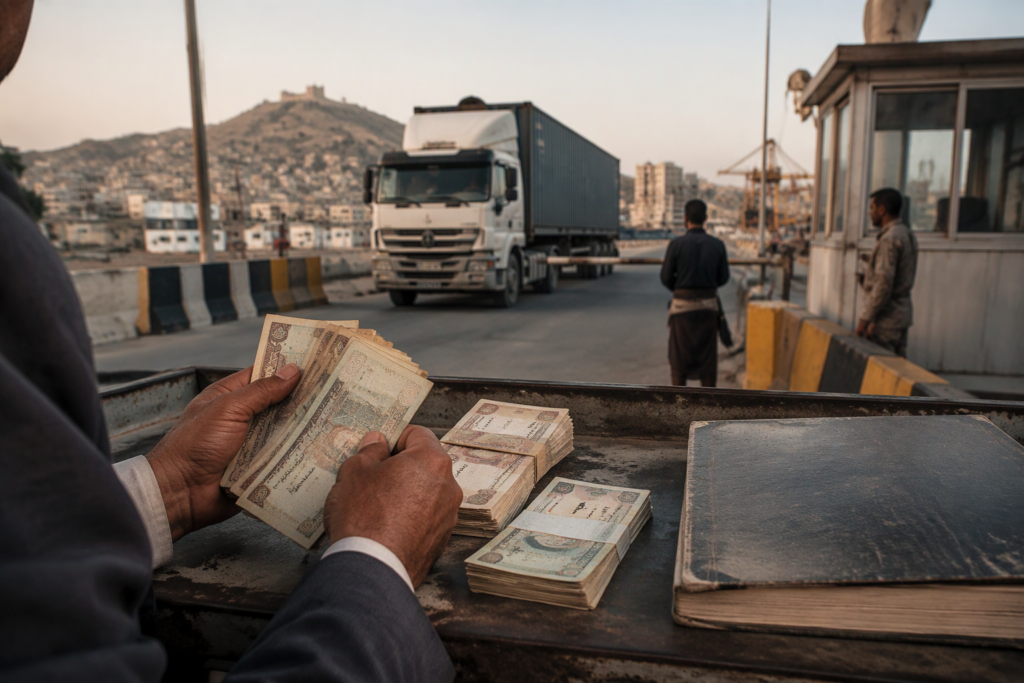
Taxes and customs duties produce about $800 million, while custom surcharges and arbitrary business levies extract another $600 million. Voluntary and coerced public contributions yield $300 million, and military mobilisation festivals draw another $100 million. The Mokha Center found that nearly 60 percent of every dollar collected goes straight to security forces and frontline commands.
Yazeed Al-Jeddawy, research manager at the Sanaa Center for Strategic Studies, explained that the group built a loop where financial dominance fuels force, and force extracts more revenue. Control over import permits, fuel distribution, telecommunications, and religious zakat taxes gives commanders unmatched authority over private merchants.
“Joining Houthi forces has become one of the few sources of income available to some young men.”
With genuine jobs disappearing, the recruitment of fighters has become an economic refuge. A 2024 United Nations panel of experts estimated the group commands about 350,000 armed men, including teenagers under 18. Money also bankrolls extensive underground infrastructure, including bomb workshops, trenches, and concrete tunnels designed to withstand aerial bombardment.
Illicit Iranian oil shipments keep the engines running
Domestic taxes supply internal muscle, but foreign fuel provides the liquid wealth that keeps the Houthi war funding apparatus expanding. The United States Department of the Treasury found that the Iranian government delivers monthly shipments of crude oil to the group free of charge. Front companies based in Dubai manage the transfers to evade maritime enforcement.
By receiving free fuel and selling it across northern Yemen, rebel authorities generate more than $2 billion annually in illicit oil profits. This shadow trade covers foreign procurement and gives regional commanders immense supplies of foreign currency.
Starving civil servants to feed the frontline
This mountain of cash never reaches ordinary Yemenis who clean streets, teach classrooms, or run clinics. Civilian agencies face crippling budget cuts while fighters enjoy guaranteed wages and field rations.
Wafiq Saleh, executive director at the Taiz Centre for Yemeni-Gulf Studies, pointed out that roughly one million public workers have gone without regular salaries since 2016. Hospital wards run out of medicine and schools collapse while underground weapons factories expand every month.
For frontline fighters like Mohammed, the sacrifice of the civilian economy is completely justified. He views every seized tax dollar as an investment in a protracted siege against foreign enemies. The immediate test for Yemen’s battered population is whether any international diplomatic push can interrupt these shadow cash flows before the country’s public institutions collapse entirely.
Source: Al Jazeera


