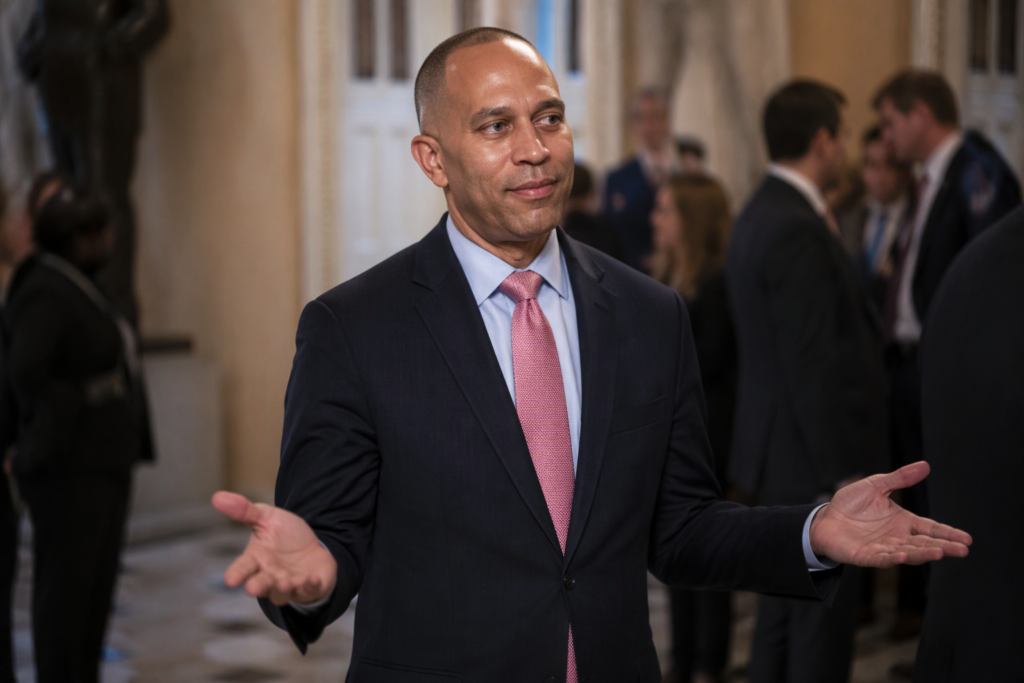
House Minority Leader Hakeem Jeffries secured the Hakeem Jeffries speaker nomination on Wednesday, brushing aside a small pocket of left-wing resistance as Democrats prepare to take power.
Eleven Democrats voted against Jeffries or announced plans to oppose him during the closed-door caucus meeting. The dissent came from incoming lawmakers pushing the leadership to adopt hardline progressive stances on healthcare, immigration, campaign finance, and foreign policy. The margin did not slow down Jeffries, who enters the new Congress backed by the vast majority of his colleagues.
Also read: House Democrats Nominate Hakeem Jeffries for Speaker
The internal contest shows the immediate balancing act waiting for leadership in Washington. Jeffries must hold together a large conference while activist lawmakers test their leverage before the term even starts.
Inside the 11 dissenting votes
The opposition emerged primarily from a bloc of newly elected representatives. Lawmakers who opposed Jeffries or planned to register no votes included Representatives-elect Darializa Avila Chevalier, Adam Hamawy, Frederick D. Haynes III, Melat Kiros, Donavan McKinney, Chris Rabb, and Claire Valdez.
The group released a joint statement confirming that discussions with Jeffries regarding their legislative agenda remain ongoing. They argued that their campaign victories gave them a clear directive from voters to press leadership on core progressive demands.
“Whether on Medicare-for-all, stopping ICE terror, getting money out of politics or ending the genocide in Gaza, our constituents sent us to Congress with a mandate on these issues,” the incoming lawmakers said in their statement.
The group added that they have worked to secure commitments directly from Jeffries through good-faith conversations. Even with those talks in motion, they chose to withhold their backing on Wednesday’s ballot.
The policy list behind the pushback
The dissenting members are pressing for major shifts that go far beyond standard party platforms. Their demands include creating a single-payer healthcare system through Medicare-for-all, abolishing U.S. Immigration and Customs Enforcement, overhauling campaign finance, and ending American military aid to Israel regarding the war in Gaza.
When reporters questioned him about the pushback, Jeffries declined to say whether he would adopt any of those policy items. He pointed straight to the ballot count instead, arguing the caucus election results spoke for themselves.
Instead of addressing the specific policy list, Jeffries framed the internal friction as an ordinary part of managing a broad coalition. He argued that differing opinions inside the ranks would not stop the party from governing effectively.
Why Haynes missed the morning ballot
One of the listed dissenters was not in the room when ballots were cast. Representative-elect Frederick D. Haynes III, who is set to succeed Representative Jasmine Crockett of Texas, missed the vote after waking up unexpectedly ill on Wednesday morning.
Haynes attempted to travel to the caucus meeting in time to vote in person, according to a statement released by his office. He ultimately arrived too late to participate in the tally.
His office clarified that his intended vote was no, aligning directly with the joint statement issued by his incoming colleagues. The office said Haynes intends to work with Jeffries once recovered to push for Medicare-for-all, changes to federal immigration enforcement, campaign finance limits, and an end to the Gaza conflict.
How Jeffries plans to handle a 260-seat majority
With the Hakeem Jeffries speaker nomination wrapped up, Jeffries turned his attention toward running the floor. He noted that he will lead an incoming majority of 260 members from across the country, each arriving with distinct regional and political priorities.
“It’s an honor to be serving with a majority of 260 members from all across the country, people who have different perspectives, and we embrace that,” Jeffries said after the caucus meeting. “But we’re going to work together to find the highest common denominator in order to make life better for the American people. That’s our commitment.”
Jeffries argued that intraparty friction should take a back seat to opposing Republicans. He told lawmakers that their central mission must be unified opposition rather than factional conflict inside the party.
“To fight MAGA extremism and to get big things done for the American people,” Jeffries said. “And that is what we are going to accomplish together, beginning on Jan. 3.”
The true test of caucus unity comes on Jan. 3, when the full House convenes to cast the official public vote for speaker.
Source: Fox News