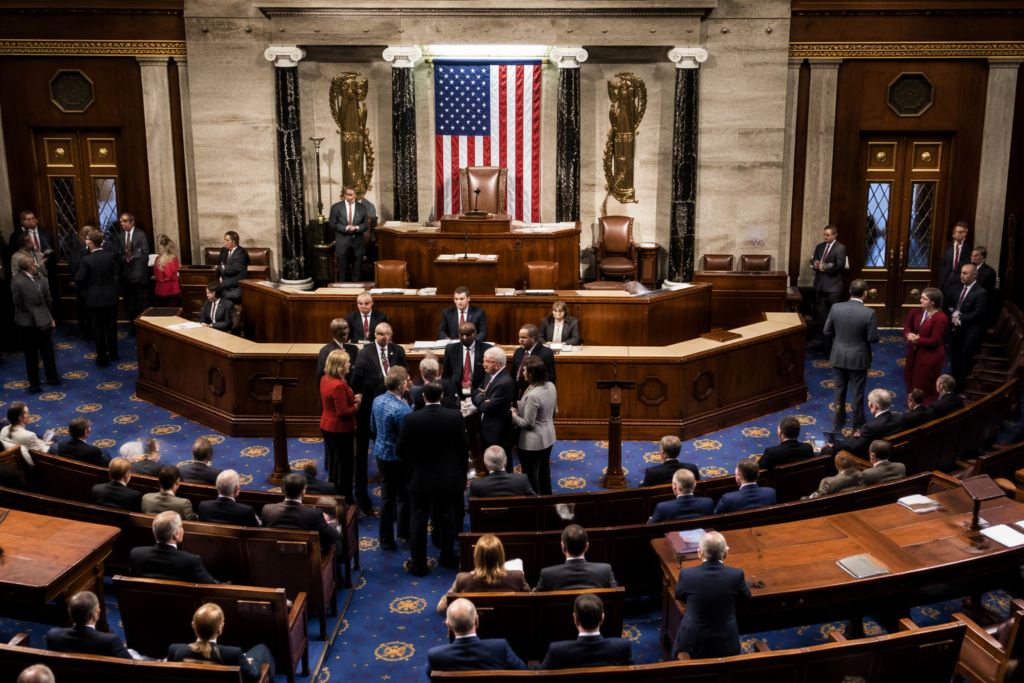
House Democrats are stepping into closed-door rooms to select their leadership team, putting Representative Hakeem Jeffries on a direct path toward the historic House speaker vote set for early next year. With Democrats claiming a decisive majority in the November midterms, Jeffries stands poised to make history as the first Black speaker of the House when the new Congress convenes.
That transition will immediately reshape Washington. After two years of unified Republican rule under President Donald Trump, Democrats now hold 257 seats against 171 for Republicans, with seven races still undecided. Taking back the gavel shifts control over federal spending and gives Democrats the power to halt White House legislation in its tracks.
Also read: Trump Rebukes Reporter Over White House Construction
Jeffries faces no declared opposition inside his caucus. Representative Ayanna Pressley of Massachusetts briefly sparked chatter about a progressive challenge after pushing a petition on party priorities, but she declared she would not run. Instead, Jeffries wants a recorded ballot rather than a voice vote, forcing every member to put their stance on paper.
How the House speaker vote works on the floor
The formal path to the speaker’s chair follows a strict two-step process that mixes party tradition with constitutional rules. Before anything happens in public view, each party gathers privately to nominate its preferred candidate through a secret ballot. Winning that internal contest secures the party’s nomination, but it gives the candidate no official authority in the Capitol.
Everything changes on January 3 at noon. The House convenes in its south wing chamber, and the clerk calls the roll for the official House speaker vote. Lawmakers do not press buttons or file paper slips; each representative stands and calls out the surname of their chosen candidate from the floor.
To claim the gavel, a candidate must win an outright majority of all votes cast for a specific person. If all 435 members show up and vote for an individual, the threshold sits at 218 votes. But lawmakers who choose to vote “present” or do not attend reduce the total pool of ballots, which lowers the mathematical target needed to win.
If nobody crosses that line on the first roll call, the chamber deadlocks. Under House rules, representatives cannot be sworn in, cannot assign committee seats, and cannot introduce or vote on any bills until a speaker is chosen. Lawmakers must keep voting over and over until someone secures the majority.
Why first-ballot drama remains fresh in memory
Most speaker contests finish in a single round, but recent memory proves how fast things can fracture. In January 2023, former Republican speaker Kevin McCarthy endured a grueling 15 ballots across four days before finally securing the gavel. It was the first time in an entire century that a speaker race dragged past the opening ballot.
McCarthy’s troubles did not end with that marathon floor fight. By October 2023, his own conference turned on him, voting to strip him of the gavel and leaving the entire chamber frozen for three weeks without an elected leader. That spectacle revealed just how damaging a razor-thin majority can be when small factions decide to withhold their votes.
Jeffries enters this round in a far stronger position, backed by a cushion of dozens of seats. A few progressive members have hesitated to commit their backing, pressing for firm pledges on campaign finance reform and a halt to military aid for Israel. Yet without a competing candidate on the ballot, Jeffries carries enough mathematical breathing room to absorb stray defections and clear the floor vote cleanly.
The new faces filling top congressional posts
The party leadership rosters on both sides of the aisle are getting an overhaul. Alongside Jeffries, House Democrats are promoting Katherine Clark of Massachusetts for majority leader, a victory that will make her the first woman to occupy that specific post. Representative Pete Aguilar of California is running to secure the majority whip position, responsible for counting heads and maintaining party discipline on tough floor votes.
Republicans have already settled their minority leadership following the midterm losses. In their November 10 elections, GOP lawmakers chose Jim Jordan of Ohio to serve as minority leader. Tom Emmer of Minnesota will work alongside him as minority whip, while outgoing speaker Mike Johnson opted against running for a leadership role.
A separate battle is unfolding on the Senate side of the Capitol. Chuck Schumer, who has led Senate Democrats since 2017, faces a formal leadership challenge from Senator Chris Van Hollen of Maryland, with that contest scheduled for early December.
Divided government returns to the Capitol
When the clock strikes noon on January 3, the existing Congress dissolves and the incoming lawmakers take their places. Once the House speaker vote concludes, the newly elected speaker takes the oath and immediately swears in all other 434 members en masse. The chamber then passes its internal operating rules, setting the terms of debate for the next two years.
Across the building in the Senate chamber, Vice President JD Vance will swear in newly elected senators, and members will select a president pro tempore to run proceedings when Vance is absent. From that moment forward, Washington enters an era of split government.
Democrats will wield their committee gavels to launch investigations into executive branch actions and bury conservative proposals. President Donald Trump retains the veto pen, which requires a two-thirds vote in both the House and Senate to overturn. The next clear checkpoint arrives in early December, when Senate Democrats cast their ballots to decide whether Schumer keeps his post.
Source: Al Jazeera