New York City Mayor Zohran Mamdani has moved to shut down the police department’s specialized protest-handling division, fulfilling a contentious campaign promise and setting off immediate celebrations among far-left activist networks across the city. His announcement on Monday morning that the city will dissolve the NYPD Strategic Response Group marks a direct overhaul of how the nation’s largest municipal police force handles street demonstrations.
The decision shifts crowd management away from heavily equipped tactical officers and splits future oversight between a civilian-led division and newly designated police units. For millions of New Yorkers who live, commute and demonstrate on city streets, the policy redefines how public order will be maintained during large demonstrations.
Also read: Strategic Response Group Axed: NYC Police Unions Slam Mamdani
“New Yorkers exercising their constitutional right to protest should not be met with the same police response as a terrorism threat,” Mamdani said during a press conference explaining the overhaul. “We are establishing a new, civilian-led approach that prioritizes dialogue, engagement and de-escalation.”
Activist networks celebrate a major campaign pledge
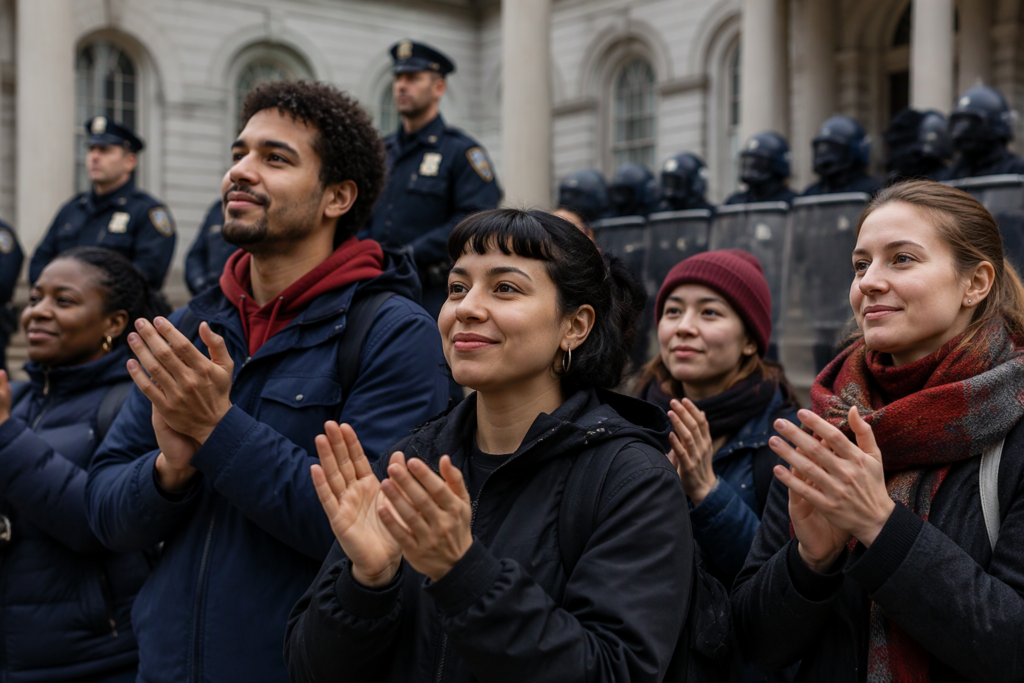
Applause from political organizers and activist networks came within hours of the morning announcement. The Party for Socialism and Liberation, which frequently helps organize demonstrations against immigration enforcement, corporate power and American foreign policy, quickly claimed credit for the policy shift online.
“The mass movement has won the disbanding of NYPD’s Strategic Response Group — but the fight continues,” the organization posted to X. In the statement, the group argued that protesters had faced harsh tactics from the unit over recent years, asserting that grass-roots pressure kept the pledge alive until Mamdani acted.
The Party for Socialism and Liberation shares deep organizational ties with the People’s Forum, an organizing hub on West 37th Street in Manhattan. Records show tech entrepreneur Neville Roy Singham, who is based in Shanghai and married to CodePink co-founder Jodie Evans, directed $278 million into six non-profit entities, including $22.4 million directly to the People’s Forum. Activists and marshals tied to the party routinely stage marches out of the Midtown Manhattan building, carrying equipment, placards and loudspeakers into city streets.
Leadership across those groups overlaps considerably. Claudia De la Cruz, who ran as the party’s 2024 presidential candidate, served on the founding board of the People’s Forum alongside Evans. Longtime organizer Brian Becker helped turn the space into an operations center for the party and the ANSWER Coalition, while his son, Ben Becker, serves as editor-in-chief of BreakThrough News, an outlet that shares office space at the same West 37th Street address.
Influencers and organizers press for further police limits
Prominent figures across online left-wing media and local street demonstrations joined in to support Mamdani’s decision to disband the NYPD Strategic Response Group. Hasan Piker, a high-profile political streamer on Twitch, endorsed the move by midday, describing protest policing as one of the hardest challenges facing any New York City administration.
Piker pointed out that the unit, originally created with counterterrorism tasks in mind, had evolved into the primary police squad deployed against street demonstrators. He praised the mayor for moving ahead with the phaseout instead of walking the promise back.
Later in the day, Nerdeen Kiswani, founder of the activist group Within Our Lifetime, called the move overdue while arguing that city hall must enforce penalties against individual officers who previously restrained demonstrators. Mamdani had previously appeared alongside Kiswani at past rallies where crowd members chanted slogans to globalize the intifada. Within Our Lifetime does not operate as a registered non-profit, meaning its financial records and donors remain private, though it regularly marches alongside Singham-linked groups.
Kiswani stressed that past legal settlements had failed to curb aggressive protest policing on the pavement, warning that activists would test the administration’s new boundaries immediately:
“The limits Mamdani announced today give us more specific rules to point to when we challenge police conduct. We’ll see whether the NYPD actually follows them when we’re back in the streets, especially when we’re protesting something the people in power would rather we stay quiet about.”
Law enforcement veterans issue sharp warnings
The dismantling of the NYPD Strategic Response Group drew fierce criticism from former police officers and federal agents who warn that the change strips the city of vital crowd-control capabilities. Opponents argue that removing the tactical unit removes an essential deterrent against spontaneous riots and organized property damage.
James Gagliano, a retired FBI supervisory special agent who collaborated with city police during his career, criticized the mayor’s new policy as an invitation to disorder. “I think it’s one more step towards emboldening the criminals, emboldening the anarchists and emboldening the terrorists,” Gagliano said.
Critics also questioned whether a civilian-led corps can protect bystanders and small businesses if demonstrations turn violent. Retired officers noted that the tactical unit possessed specific training and protective gear designed to break up coordinated disruptions that standard patrol officers are rarely equipped to handle.
What replaces the NYPD Strategic Response Group
Under the city’s new structure, responsibility for monitoring protests will be divided between civilian mediators and standard police commands. The transition relies on a few core changes to city operations:
- Civilian liaisons will handle primary front-line communication to de-escalate crowds before confrontations start.
- New internal police units will take over crowd management duties rather than deploying specialized counterterrorism officers.
- City hall will establish new rules of engagement limiting physical containment tactics and crowd-dispersal equipment.
Mamdani maintains that the structural shift strikes the right balance between public safety and the protection of civil liberties. Whether the new framework can maintain street security without tactical backup will face an immediate test as activist coalitions prepare their next wave of planned marches through Manhattan.
Source: Fox News