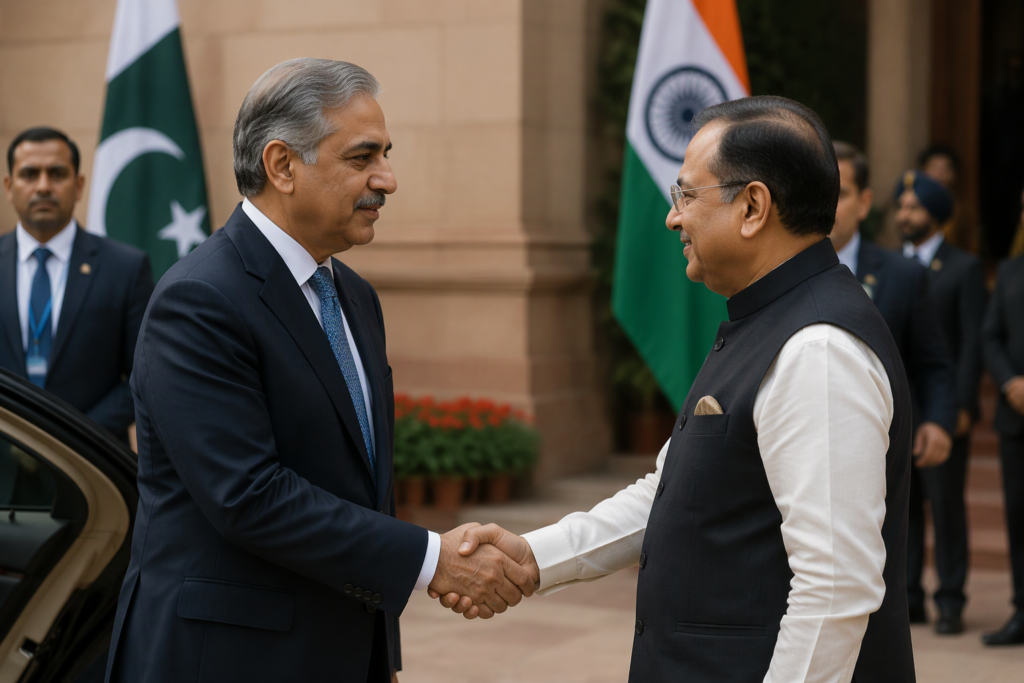
Eighteen months after artillery duels and air combat shook the border, a high-ranking Pakistani official crossed into Indian territory on Friday morning without fanfare or a red carpet. Climate Change Minister Musadik Malik arrived in New Delhi, the first moment a Pakistan minister visits India since both nuclear-armed nations fought a deadly four-day war in May 2025.
Malik landed to attend the three-day Shanghai Cooperation Organisation Civilisational Dialogue Forum, inaugurated Friday evening by Indian Prime Minister Narendra Modi. No bilateral room has been booked, no one-on-one handshake is planned between ministers, and both foreign ministries insisted the trip is strictly routine multilateral protocol.
Also read: Houthi War Funding: Inside the $2.5B Shadow Machine
Yet the arrival matters because diplomatic channels between Islamabad and New Delhi have sat almost completely frozen since the conflict. With Pakistan holding the rotating chairmanship of the Shanghai Cooperation Organisation and scheduled to host regional leaders in August 2027, this quiet border crossing represents the first tentative probe into whether the two rivals can sit in the same room again without open hostility.
Why a Pakistan minister visits India under strict limits
The invitation list from New Delhi came with quiet diplomatic maneuvering. Indian officials originally sent an invite intended for Pakistan’s national heritage and culture minister, Aurangzeb Khan Khichi. Islamabad sat on the letter for weeks before choosing to dispatch Musadik Malik instead.
Islamabad never explained publicly why it swapped portfolios. But former Pakistani foreign secretary Jauhar Saleem pointed out that representation at such gatherings remains the host’s invitation and the guest’s choice. Civilisation, Saleem noted, touches how societies relate to their rivers, land, and neighbors, not merely ancient monuments.
Political figures in Pakistan saw a deliberate tactical signal in sending Malik. Former defence and foreign affairs minister Khurram Dastgir Khan explained that choosing Malik allowed Islamabad to honor its treaty obligations without playing entirely by New Delhi’s script. The choice, Dastgir said, lets Pakistan demonstrate that it is a constructive participant ahead of its own summit duties.
Malik is scheduled to address the forum on Saturday. Outside formal plenary sessions, he plans to hold informal talks with delegates from other member states, carefully avoiding unilateral overtures toward his hosts.
Shadows of the 2025 war and frozen diplomacy
The bitter backdrop to Malik’s flight into Delhi began in April 2025, when gunmen launched the Pahalgam attack in Indian-administered Kashmir, leaving 26 civilians dead. India pointed the blame directly across the Line of Control, an accusation Islamabad denied. Within weeks, the tension erupted into the four-day May war.
Since that conflict, normal ties have vanished entirely. Neither country has posted a high commissioner to the other’s capital since 2019. In the months following the fighting, India placed the 1960 Indus Waters Treaty in abeyance, defying an August 31 ruling from the Permanent Court of Arbitration in The Hague that barred unilateral suspensions.
Incidents on the water have kept tempers short. Indian and Pakistani naval vessels collided in the Arabian Sea in September, provoking official diplomatic protests in Delhi. Beyond low-profile Track 2 and Track 1.5 backchannel talks, official government business has stopped dead.
This is a meeting in the SCO framework, where India, as the organiser, has to invite all member countries. Therefore, at this juncture, there is no reason to look for any deeper meaning in this visit.
Former Indian high commissioner Sharat Sabharwal warned against reading political thaw into forum protocol. India’s external affairs ministry spokesperson Randhir Jaiswal echoed that view, repeating that India’s strict stance on border security and terrorism after the Pahalgam attack has not shifted an inch.
The Shanghai Cooperation Organisation as a thin safety wire
Since both nations entered the Shanghai Cooperation Organisation in 2017, the bloc has functioned as one of the very few tables where their officials cannot easily refuse to sit. Even so, multilateral attendance rarely guarantees peaceful outcomes.
When Bilawal Bhutto-Zardari traveled to an SCO foreign ministers gathering in Goa in May 2023, the trip degenerated into bitter public recriminations. Indian External Affairs Minister S. Jaishankar openly labeled Bhutto-Zardari a spokesperson for militant networks, and bilateral talks never took place.
Jaishankar’s return visit to Islamabad in October 2024 for an SCO heads of government summit went quietly, but produced zero diplomatic breakthroughs. As Dastgir observed, that trip did not prevent the two nations from waging open warfare just seven months later.
Former Pakistani diplomat Salman Bashir described the bloc as a tool to preserve basic decorum rather than a road toward genuine peace. For now, both capitals use the organization’s rulebook to avoid direct confrontation while maintaining face in front of Central Asian and Chinese observers.
Will Narendra Modi travel to Islamabad?
The timing of Pakistan’s SCO leadership sets up an inescapable calendar collision. Islamabad assumed the rotating chair in September and will host the leaders’ summit in August 2027—the exact month both nations mark 80 years since independence.
That milestone forces New Delhi to decide whether Indian Prime Minister Narendra Modi will fly to Islamabad. Indian officials have indicated they will wait until the deadline approaches before announcing who represents the country.
Diplomatic observers in New Delhi note that Indian voters hold little appetite for concessions without measurable progress on cross-border security. Still, international summits offer unique diplomatic cover: sideline handshakes require no preconditions, no formal agendas, and no public promises.
The diplomatic calendar between Delhi and Islamabad will face its next immediate checkpoint when SCO cultural delegates gather in Lahore, the designated regional culture capital for 2026-2027.
Source: Al Jazeera


